Salesforce Is Writing Your Exit Clause
A platform confident in its future does not decompose itself into endpoints, give away the data layer, and hand you React. Salesforce is unbundling itself because the human-seat era its footprint was built for is ending. Agents don't log in. The real question is which two layers survive the transition, and whether you own them.

Contents
Agents don’t log in.
Hold onto that, because it is the whole story, and it explains a run of Salesforce moves that otherwise look like generosity. Over the past two years Salesforce has decomposed its platform into endpoints, handed you the data layer, and let you bring your own front-end framework. A company does not give away the layers it believes are its future. It gives away the layers it has already decided are its past. So if you have been reading this series as a set of instructions for writing your own exit clause, here is the turn: for Salesforce, the vendor is drafting yours for you. The only question left is whether you read what it says before you sign the renewal.
The confession in the roadmap
Read the last two years of Salesforce announcements as a single document and they stop looking like features and start looking like a confession.
Headless 360 decomposed the CRM into REST and MCP endpoints and let agents run against it from ChatGPT, Gemini, and Claude instead of only from inside Salesforce. Zero Copy let your records stay in a lakehouse and be read in place, which means the system no longer insists on holding the only copy. Multi-Framework let you build the front end in React and run it on the platform, conceding the last layer most shops still owned off it. Agentforce turned the product itself toward agents doing the work humans used to do in the UI.
Each of those is Salesforce handing back a layer it used to require you to rent: the integration boundary, the data copy, the user interface, the human in the seat. Line them up and the message is hard to miss. The platform is telling you, in the only language a roadmap speaks, which parts of itself it no longer believes are load-bearing.
Why a confident platform unbundles itself
A vendor only dismantles its own moat when it can see the moat draining.
The entire Salesforce footprint, and the pricing stapled to it, assumes a human sitting in a user interface consuming a seat. That assumption is what a decade of per-seat licensing was built on. Agents break it at the root. An agent reasons over data and acts through an API; it does not sit in Lightning, it does not consume a seat the way a person does, and it does not care which vendor’s screens exist. When the work moves to agents, the seat stops being the unit of value, and the per-seat model is already repricing in front of us.
So the exit you keep treating as a future project is not in the future. The ground is already moving, and Salesforce is repositioning ahead of it rather than waiting to be caught flat. That is why the roadmap reads like a confession instead of a retreat. It is a company deciding, early, which two layers it wants to be standing on when the seats stop mattering, and quietly letting go of the rest.
The two layers that survive
Strip the seat era out of the platform and ask what an agent still genuinely needs. The answer is short, and it is the whole game.
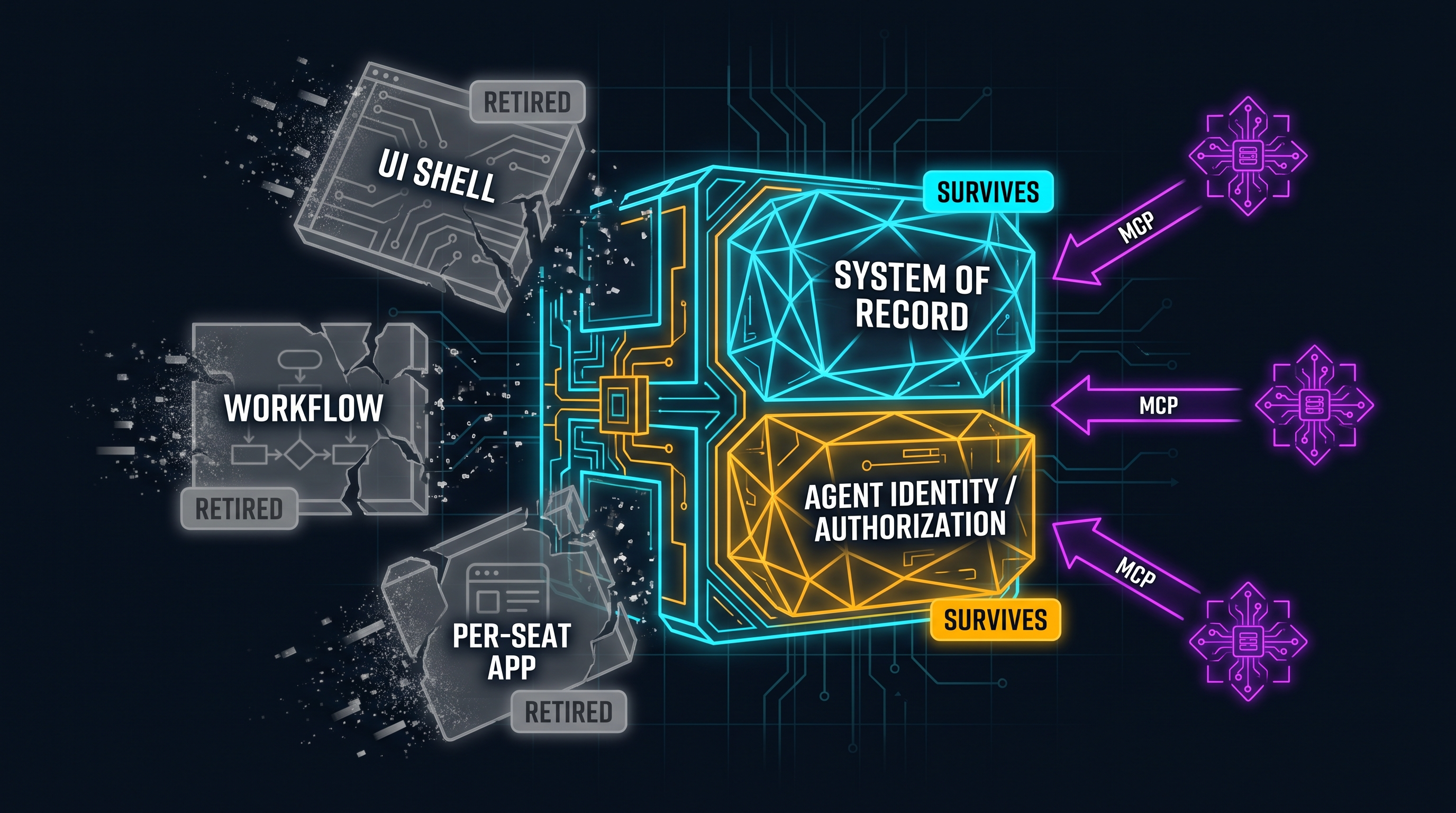
The system of record. An agent is only as good as the grounded truth it reasons over. The data and, more importantly, the governed meaning of the data survive every shift in how the work gets done, because a wrong answer delivered confidently is the one failure a bank cannot ship. This layer is worth owning where it is portable: a lakehouse and a context layer you control, with Salesforce reading it in place through Zero Copy as a consumer, not holding it as the master.
The agent identity and authorization plane. The moment agents act on your behalf, something has to say who a given agent is, what it is allowed to do, and on whose authority, and has to prove it afterward to someone whose job is to doubt you. That layer survives too, and it is the genuinely contested frontier of 2026, the place the next control-plane fight is already underway and the identity seam is still unsettled. It is worth owning off-platform, on an identity and agent runtime you control (Microsoft Entra and Azure AI Foundry, where the Atlas reasoning engine is not something you can call without buying Agentforce seats). That is the opt-out architecture that keeps Salesforce a governed tool your agents call through MCP rather than the place your agents have to live.
Everything else, the Lightning shell, the workflow engine as the center of gravity, the per-seat app, is not something you migrate off. It is something the agent era retires whether you act or not.
The decoy and the prize
Here is the part worth slowing down on, because it inverts the obvious move.
The layer Salesforce most visibly helps you leave is the decoy. Zero Copy makes moving your system of record off-platform feel like a win the vendor is cheering you toward, and it is cheering, because data mastery was never where the lock-in lived. The same is true of the UI: bring React, and the runtime, the identity, and the governance quietly stay Salesforce’s. The open doors are the ones that lead somewhere the vendor is happy for you to go.
The prize is the layer nobody is handing you: the identity and authorization plane for agents. That is where the lock-in has been relocating this whole time, one open announcement at a time, which is the same pattern I keep tracing where openness at one layer moves the lock-in up a layer rather than removing it. So “reduce the footprint,” done the obvious way, by moving the data and bringing your own front end, is precisely the shrinkage Salesforce is engineering for you. It feels like progress and it deepens the one dependency that will decide your optionality for the next decade. The reduction that matters does not chase square footage. It targets the control plane.
It is worth being concrete about what that plane decides, because it stays abstract right up until it is not. When an agent moves money, pulls a credit file, or books a loan, someone has to answer three questions afterward: which agent did it, who authorized that agent to act, and under what policy. If the plane that answers them is yours, you can tell one account of the event across every system the agent touched, the core, the lakehouse, a vendor’s API, in a single authority. If the plane belongs to Salesforce, you can attest cleanly to everything that happened inside Salesforce and you are stitching logs together everywhere else, which is the exact position an examiner has the least patience for. Owning the identity plane is not a portability nicety. It is whether you can give one defensible answer for what your agents did, or several partial ones.
What it costs to get this right
I am not going to pretend owning those two layers yourself is the obvious call, because for many institutions it is not.
Keeping the system of record and the identity plane on Salesforce is a legitimate choice, and often the better one. One trust plane, one audit trail, one place an examiner looks, and governance that already works is a real answer to a real problem, not a cage. The control the platform gives you is, a lot of the time, exactly the control you wanted. Pulling those layers out buys you optionality and portability, and it charges you for them in a currency that does not show up on the renewal: a split-brain operation, two governance surfaces, two on-call rotations, and an integration seam you now own forever. That cost is real, and architecture cleverness does not make it disappear.
So the reconciliation is not “shrink Salesforce.” Footprint was always a vanity metric. The move is to decide, on purpose, who owns the two layers that survive, rather than inheriting the answer from gravity because on-platform was the path of least resistance the day each decision came up. A large Salesforce whose two surviving layers you could move if you had to is safer than a small one you cannot. Size was never the thing. Optionality on the two layers that outlast the seat era is.
The companion piece showed that leaving nCino can quietly fatten the platform underneath it. This one is the same lesson one floor down: the platform itself is collapsing to two layers as the seats stop mattering, and the vendor has already told you which two. The hard part of an exit was never the leaving. It is knowing which layer holds the value after the dust settles, and getting there first. Salesforce already knows. Read the clause it is writing, and decide whether you want to own the survivors or rent them back.
The companion read is Open at the Bottom, Locked at the Top, on how open formats move lock-in up a layer rather than removing it. This is the same pattern read forward: the open doors lead where the vendor is happy for you to go, and the locked one is the prize. The other half of the pair is Leaving nCino Won’t Set You Free.
I write about AI-assisted development, enterprise architecture, and building in regulated environments. If you are deciding who should own your agent identity plane, or you think I am wrong that the seats are what is ending, I would like to compare notes. Find me on X @orestesgarcia or LinkedIn /in/setsero.
Get the next field note.
Regulated AI, architecture and platform economics — in your inbox as they publish.