The Exit Clause Your Architecture Is Missing
Vendor lock-in is a weaker trap in the AI era than the renewal quote assumes. The leverage was never the platform, it was the cost of understanding your own estate, and that cost just collapsed. A practical path off MuleSoft, and why every renewal needs an exit already written.

Contents
A renewal quote lands in your inbox, and the number assumes something about you: that you can’t leave. Every serious contract you have ever signed had an exit clause. Your integration platform is the one place you forgot to write one.
That omission is not an oversight. It is the business model. The quote is priced against your inertia, and your inertia has always had two components: you don’t fully know what you built on the platform, and re-expressing it somewhere else used to cost more than the renewal. Hold both of those in your head, because the second one just changed, and the first one is a choice you can reverse this quarter.
The renewal conversation is a negotiation you already lost
Picture a bank that bought into MuleSoft Anypoint eight years ago, around the time Salesforce acquired it for about 6.5 billion dollars. The decision was sound. API-led connectivity was the right pattern, the runtime was solid, and the platform genuinely unlocked data trapped in cores, mainframes, and a decade of acquisitions. Hundreds of flows got built. The integration worked, the business shipped, and nobody regrets the original purchase.
Then the estate grew quiet. The architects who designed the first wave moved on. The flows kept running, the DataWeave transforms kept mapping, and the institutional memory of why each one existed thinned out with every reorg. By year five, the platform was less a decision and more a fact of nature.
That is the exact moment the renewal arrives, and the vendor knows it. The pitch is never “our product is worth this price.” It is “you have too much invested here to walk away.” Sunk cost, dressed up as strategy. And for most of the history of enterprise software, it worked, because the thing the vendor was really charging you for was not the runtime. It was the cost of ever understanding your own system well enough to leave it.
The leverage was always documentation cost
Ask why MuleSoft migrations stall, and the honest answer is rarely technical. The runtime is replaceable. The gateway is replaceable. What stops teams cold is that nobody can say, with confidence, what the system actually does.
Six hundred flows. Which ones are load-bearing and which are dead? What does this DataWeave script transform, and what breaks downstream if the mapping shifts by one field? Which integrations touch the system of record, and which are cosmetic? The knowledge that would answer those questions left the building years ago, scattered across people who are gone and comments that were never written.
DataWeave sharpens the problem to a point. It is MuleSoft’s proprietary transformation language, and it is specific to the platform. It has no drop-in equivalent anywhere else. Every transform with real business logic in it is logic that only MuleSoft-skilled developers can read, and that does not travel to any other platform without a rewrite. In practice, DataWeave is consistently the single largest workstream in any migration off Anypoint, because each transform has to be understood and rebuilt by hand, typically in code for anything with rules and in a declarative format for the pure mappings.
So the sunk cost was never really the license fees you already paid. It was the latent cost of reverse-engineering your own estate: the year of consultants, the archaeology, the careful tracing of what connects to what before you dare touch anything. That cost was the moat. The vendor did not build it. Your own undocumented history did, and the vendor simply priced against it.
What AI reverse-engineers cheaply now
Here is the part the renewal quote has not caught up to. The documentation cost collapsed.
The work that used to take a room of consultants a year is, in large part, comprehension work: read the Mule XML, read the DataWeave, read the API specs, and reconstruct what the system does, what depends on what, and what each transform means. That is precisely the half of modernization where current models are strong. The consistent finding across legacy-modernization practice is that AI is most useful at comprehension: summarizing modules, drafting documentation, tracing dependencies, and generating characterization tests that pin down existing behavior. It is least useful when you ask it to emit final production code with nobody checking the result. Which is to say: it is strong at exactly the thing that used to be the expensive part, and weak at the thing that was always going to need an engineer.
Point a capable model at a Mule flow and it will tell you what the flow does, what it calls, and what shape of data moves through it. Point it at a DataWeave transform and it will produce a plain-language description of the mapping and a candidate rewrite in the target language of your choice. Point it at the whole repository and it will build you the dependency graph that nobody has had since the original architects left.
None of that is magic, and it is not a one-click migration. It is something more useful: it turns an unknowable estate into a documented one in weeks instead of quarters. The archaeology that justified the renewal price is now cheap. The moat was made of your own ignorance, and that is the one raw material whose cost is falling fastest.
I have made a version of this argument before about the model layer in You’re Renting the Model. Own the Harness. The model is a commodity you rent. The durable asset is the understanding and the scaffolding you build around it. Reverse-engineering your own integration estate is the clearest case of that principle paying rent: you are using a rented model to produce a permanent asset, the documented knowledge of what you actually run.
An exit clause is just a target architecture
A lawyer would never let you sign a material contract with no exit terms. You negotiate the offboarding, the data return, the transition assistance, the wind-down, all of it, at the start, when you have leverage, not at the end when you are desperate. Nobody finds this controversial in a contract.
Technology architecture is held to a lower standard, and it is the same document. An exit clause for a platform is not a lawyer’s paragraph. It is a target architecture: a clear, written description of where each capability would live if you left. You cannot negotiate an exit you cannot describe, and you cannot describe one you have not drawn.
The reason this used to feel impossible is the comprehension cost above. You could not credibly draw the target because you could not fully map the source. That excuse is gone. Which means the exit clause is now something you can actually write, and writing it is the single highest-leverage thing you can do before the next renewal.
Write the exit clause: name where each layer goes
What makes a MuleSoft exit describable is that Anypoint is not one irreducible thing. It is a bundle of capabilities that live at different altitudes, and each has mature substitutes. The trick is to stop thinking “replace MuleSoft” and start thinking “re-home four layers.” Here is the map I would put on the wall.
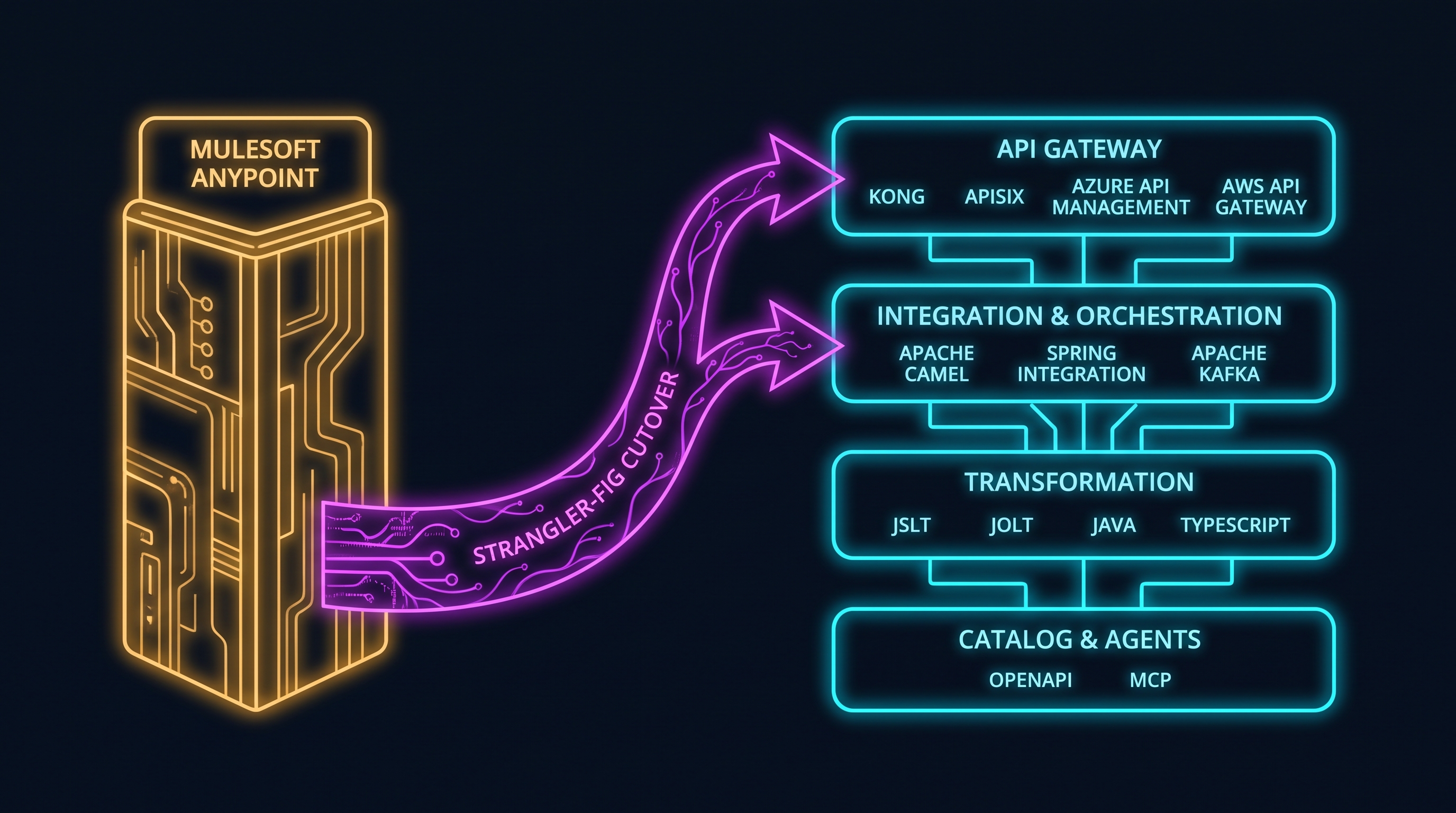
The API gateway and management layer. This is Anypoint’s API Manager and its gateway runtime: the place you publish, secure, rate-limit, and observe APIs. It is also the most commoditized layer in the whole stack, which is good news for an exit. Kong and Apache APISIX are mature open gateways. If your estate is already on a hyperscaler, Azure API Management and AWS API Gateway fold the capability into infrastructure you already pay for. Nothing here is exotic.
The integration and orchestration layer. This is the Mule runtime itself, the flows that connect systems and move data. The quietly decisive fact about this layer is that Mule and Apache Camel are siblings. Both are implementations of the same Enterprise Integration Patterns, the connectors and routers and transformers from the Hohpe and Woolf book. The patterns you built your flows on were never proprietary. Only the runtime that executed them was. Camel runs those same patterns on an open, broadly supported engine; Spring Integration does the same inside a Spring estate; and for anything that should have been event-driven in the first place, Apache Kafka moves the work from request-reply plumbing to a streaming backbone. This is also a natural return to the Java and Spring stack I argued for in Python Won’t Run Your Bank: the enterprise integration world already lives here.
The transformation layer. This is where DataWeave lived, and it is the hardest honest part of the move, because this is the proprietary core. The pure mappings, field-to-field with light reshaping, port to a declarative format like JSLT or JOLT. The transforms with real business logic in them become code, in Java or TypeScript, where they are testable and readable by any engineer you will ever hire. This is exactly where AI-assisted rewrite earns its keep: the model drafts the rewrite and the characterization tests, and an engineer verifies the behavior matches. Labor-intensive, yes. Impossible, no. And unlike DataWeave, the result is not a skill you have to keep hiring for.
The catalog, governance, and agent layer. This is the layer MuleSoft itself is climbing toward with Agent Fabric, and it is the one worth designing with intent. Your API catalog is just OpenAPI specifications, an open contract that every gateway above understands. And the emerging way agents reach governed APIs is the Model Context Protocol, now a cross-vendor standard rather than anyone’s proprietary port. If you build this layer on OpenAPI and MCP, you own the one layer that is becoming the real control plane, instead of renting it back from whichever vendor got there first.
Four layers, four named homes. That is the exit clause. It fits on a slide.
The strangler fig, not the big bang
Writing the target architecture does not mean you rip and replace. The way you execute an exit like this has a name and a track record: the strangler fig pattern, which Martin Fowler named in 2004 after the vine that grows around a tree and gradually takes over its structure. You put a façade in front of the old platform, and you route work to the new homes one capability at a time, while the incumbent keeps running everything you have not moved yet.
Concretely: new integrations go to the target stack from today, so the problem stops growing. Then you migrate the highest-value, lowest-risk flows first, the ones you now understand because you documented them, and you let the long tail of rarely-touched flows sit on MuleSoft until they are either migrated or retired. You measure as you go. Every flow you move is reversible until you cut the façade over, and the business never experiences a flag day.
This is the same desired-state, incremental-reconciliation discipline I wrote about in The Reconciliation Loop. You are not performing a migration event. You are continuously reconciling the running estate toward a declared target, one bounded capability at a time, and stopping whenever you like.
Negotiate from the exit
Here is the move that makes all of this pay off even if you never migrate a single flow.
A credible exit changes the renewal conversation completely. The vendor’s entire pricing leverage rested on the assumption that you cannot leave. The moment you can describe where every capability would go, show a working façade, and point to the first few flows already running on the target, you have a real alternative, and a real alternative is the only thing that has ever moved a renewal price. You do not have to threaten. You just have to be visibly capable of it. The exit clause is leverage whether you exercise it or not.
That is the whole argument about lock-in in the AI era, compressed: the vendor was never charging you for the runtime. It was charging you for your inability to describe your own system. That inability was real, and expensive, and now it is cheap to fix. The fight is no longer unfair. The vendor cannot keep using the investment you made into their platform as the reason you are not allowed to reconsider it.
The part I won’t pretend away
I would be doing exactly what I accuse the vendor of if I made this sound frictionless. It is not.
First, give the incumbent its due. MuleSoft is a genuinely good platform. The runtime is mature, the operational tooling is real, and years of production hardening live in those flows: the retry logic, the error handling, the edge cases that only surface at 2 a.m. when an upstream system returns something malformed. AI lowers the cost of understanding that logic. It does not lower the cost of the understanding being wrong. Every migrated flow still needs the same assurance the original had, and in a bank, every one of them is a thing you may have to defend to someone whose job is to doubt you. That testing, validation, and cutover work is the real cost of the move, and no model removes it.
Second, the exit is real engineering, not a prompt. The comprehension got cheap. The migration did not become free. You are trading a predictable annual fee for a project with its own risk, its own timeline, and its own need for people who know what they are doing. For plenty of shops, the right answer after writing the exit clause is to keep the platform and simply renew at a better price. That is a legitimate outcome, and it is a win, because you chose it instead of inheriting it.
And this is where the two legitimate pressures reconcile. The business wants the integrations delivered, the data flowing, the new systems connected without friction. The institution needs cost control, optionality, and the ability to prove it is not hostage to a single vendor. Those are both real goods, and they pull against each other only when you have no map. The target architecture is what lets you serve both: you keep saying yes to the integration the business depends on, while keeping the institution’s hand on cost and exit. The exit clause is not how you abandon the platform. It is how you stay in control of the decision to keep it.
The point was never “leave MuleSoft.” The point is that you can, which means the next renewal is a negotiation between equals instead of a toll you pay for your own forgetfulness.
Write the exit clause before the renewal, not during it. By the time the quote lands, it is too late to start drawing the map, and the price already knows it.
The companion read is Open at the Bottom, Locked at the Top, on how open formats move lock-in up a layer rather than removing it. The exit-clause discipline here is the same instinct pointed at the integration tier: know exactly where the proprietary part lives, and decide on purpose.
I write about AI-assisted development, enterprise architecture, and building in regulated environments. If you are drawing an exit for a platform you have lived with for years, or you think I am underselling how hard the move really is, I would like to compare notes. Find me on X @orestesgarcia or LinkedIn /in/setsero.
Get the next field note.
Regulated AI, architecture and platform economics — in your inbox as they publish.