Leaving nCino Won't Set You Free
nCino runs on Salesforce, so the exit does not lead outside. For most banks it leads one floor down, into deeper dependence on the platform you were already renting. There are three doors out of nCino. Only one of them actually sets you free, and it is the one almost nobody takes.
Contents
The nCino renewal reads like a decision about nCino. It is a decision about Salesforce, and that is the part the quote stays quiet about.
If you read the earlier piece in this series about getting off MuleSoft, you came away with a clean idea: once understanding your own system gets cheap, the exit sets you free. That holds when the thing you are leaving is a platform you can actually walk away from. nCino is not that. nCino runs on Salesforce, and the door marked exit does not lead outside. For most banks it leads one floor down, into a building you end up renting harder than before. So this is the follow-up the first piece earned. The exit you can finally afford to take is also the one most likely to deepen the trap, and that is worth seeing before you take it.
You are paying two landlords
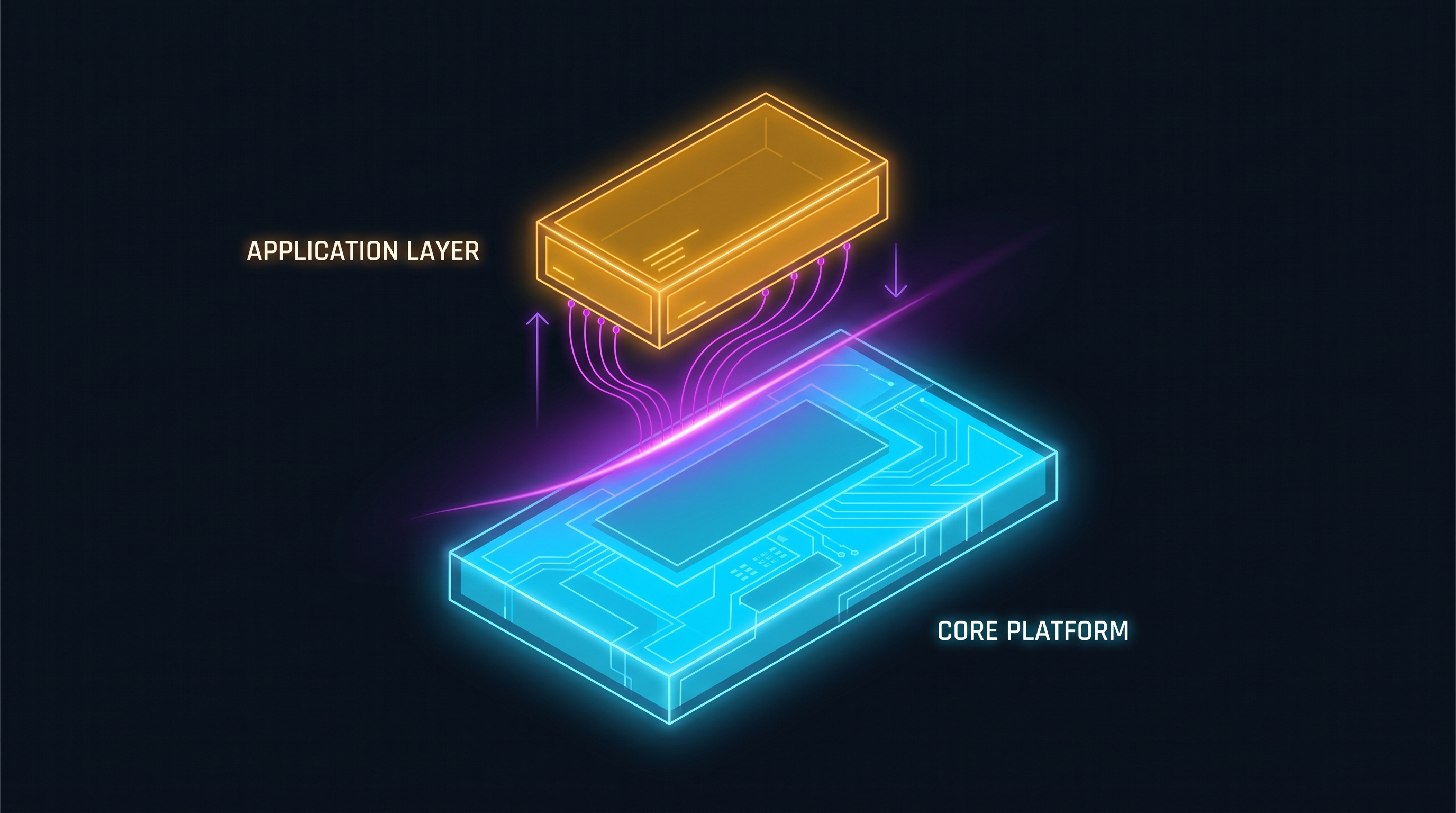
Start with what nCino actually is, because the whole decision turns on it. nCino is not a system you installed next to Salesforce. It is a managed package that runs inside Salesforce, and its loan and deposit objects are Salesforce custom objects sitting in your own org. The records your lenders create every day already live on infrastructure you already pay Salesforce for. What nCino sells on top of that is the wrapper: the opinionated objects, the configured stages, the credit screens, the spreading templates. You hold the building lease. You are renting an apartment built inside it.
That is a strange thing to pay a second vendor for, and it is also why the renewal feels heavier than the value in front of you. You are paying the subletter, and the subletter’s rent is priced against years of configuration nobody on your team can still fully explain. The record types that encode how a commercial loan differs from a line of credit, the validation rules that are really credit policy in disguise, the stage model that took a year of change requests to settle, the spreading templates that quietly embed how your bank reads a balance sheet. That is the apartment. For most of the history of this arrangement, the configuration was the end of the conversation, because re-expressing all of it somewhere else cost more than renewing. That is the part that changed, and it is where the doors open.
The exit got cheap. That is the problem.
AI did to nCino configuration what it did to MuleSoft flows. It made the estate legible. Point a capable model at the managed package, the custom objects, the flows, the validation rules, the spreading templates, and in weeks you have the map of what the thing actually does that nobody has held since go-live. I made the general version of that argument in the opening piece of this series, and I will not relitigate it. Assume it is true. Assume you can now describe your nCino estate well enough to move it.
Here is what the first piece never had to confront, because MuleSoft was a platform you left. When you move nCino, you are not leaving anything. You are choosing where each capability goes, and the most natural choice, the one the whole market nudges you toward, quietly turns a two-vendor problem into a one-vendor one. You remove nCino and hand the entire floor to Salesforce. That can be the right call. It is not a free one, and it is not an exit. It is consolidation, and this is the same move I keep watching platforms make: open or leave one layer and the lock-in does not disappear, it relocates to the layer above or below it. With nCino the lock-in relocates straight down, onto the platform you were already standing on.
Three doors out of nCino
Strip the branding off the decision and there are three ways out, not one. They are not equally easy, and they are emphatically not equally free.
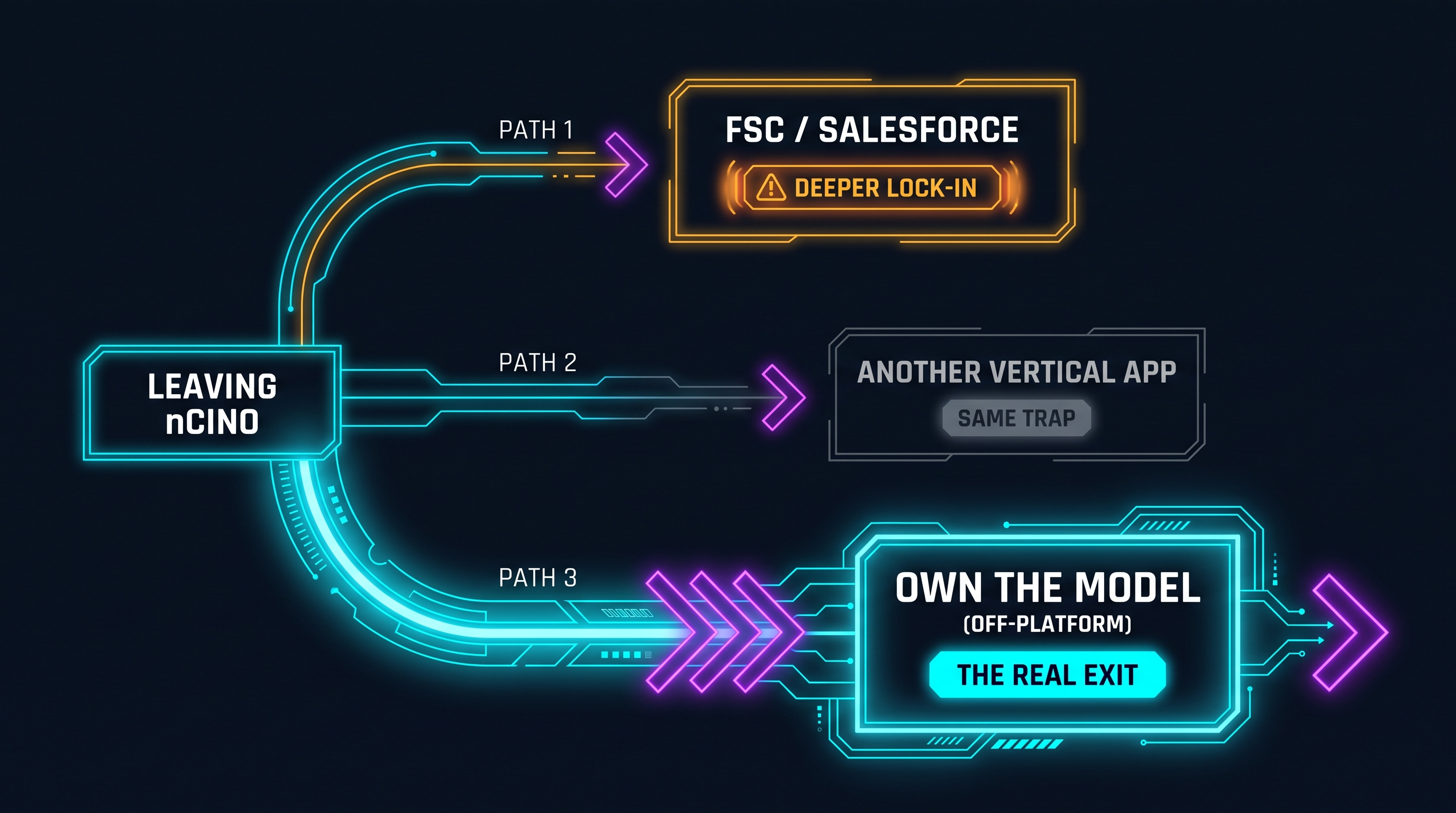
Door one leads up, into Salesforce. This is re-homing nCino onto Financial Services Cloud plus native platform build, and it is the door every incentive points at. The banking data model moves onto FSC’s own objects where they overlap, Financial Account and its party relationships, household and relationship modeling, with native custom objects for the commercial-lending structures FSC does not cover, because FSC is strong in retail, wealth, and relationship banking and does not match nCino’s commercial origination depth. The configured workflow moves onto Flow Orchestration and OmniStudio. Documents move to native files and a direct e-sign integration. The credit spreading is the genuinely hard piece: the calc and the templates are Salesforce configuration you can port, but the automated extraction that lifts numbers off financial statements leans on machine learning you rebuild or rebuy. All of it is doable. And Salesforce will help you through this door, because it has been building toward it for a while now with FSC lending features, a Digital Origination for Lending add-on, and its agent tooling for financial services. When the landlord holds a door open, ask why. Door one ends with you more dependent on Salesforce than you were the morning before, not less.
Door two leads sideways. Swap nCino for another vertical origination vendor, on Salesforce or off it. Sometimes that is the right answer on product fit alone. Just see it for what it is: a new sublease on the same kind of floor. You have changed who you pay, not whether you are renting someone else’s opinion of how a loan gets made.
Door three leads out, and almost nobody takes it. The one asset in this entire estate worth owning outright is not the screens and not the workflow. It is the loan and deposit data model and the origination logic, the structured record of how your bank actually underwrites and books. Door three puts that where neither nCino nor Salesforce owns it: your own system of record and a context layer you control, with the core at the floor doing what a core still has to do and the meaning living in a layer you own rather than inside a vendor’s objects. Salesforce can stay as an engagement surface that reads and writes through an API. nCino can go. But the thing that defines your lending is now yours, portable, and not up for renewal.
Concretely, door three is less exotic than it sounds, because you already hold the raw material. The loan and deposit records are custom objects in your org today. The credit policy is sitting in validation rules and spreading templates you can finally read. The origination steps are flows you can trace end to end. Door three is the discipline of lifting that into a schema and a set of services you own, running the stage logic as code or as agents you control, and treating any vertical app, nCino’s or Salesforce’s, as a view onto the process rather than the home of it. The core keeps the ledger. Your context layer keeps the meaning. The app becomes something you can swap without re-underwriting your own bank. The cost is honest and large: you now own an integration seam and a build instead of a license, and you carry the failure modes a vendor used to carry at two in the morning. For a small shop with three products, that is overkill. For a bank whose lending is the business, it is the difference between renting your own strategy and owning it. Door three is the most work by a wide margin, and it is the only one that ends the two-landlord problem instead of renaming it.
The door the vendor holds open
I am not going to pretend door one is a mistake. For a lot of banks it is the right answer, and the reasons are real. Your lenders already spend their day in Salesforce, the governance is one plane, the audit is one trail, and re-homing onto FSC keeps the experience your staff is trained on while retiring a second vendor’s license. That is a genuine good, and waving it off as capitulation would be its own kind of dishonesty. Velocity is a real asset, and one party to hold accountable is a real comfort to the people who have to answer for an outage.
The other side is just as real, and the quote never raises it. Door one concentrates everything that matters, the data model, the workflow, the record of who approved which loan, inside a single vendor whose own incentives are to climb one layer further up your stack every year. It also walks you into the pricing exposure coming for every per-seat vertical app, because the seat is the unit of value that an agent era quietly erases. A loan officer is a seat. An agent that originates a loan is not. The more of your lending you consolidate onto a per-seat platform right as the seat stops being the unit of work, the more of next year’s renewal you are pre-committing to without noticing.
So the reconciliation here is not a door. It is reading the three of them honestly and picking one on purpose. Door one, chosen deliberately because the velocity is worth the concentration, is a sound decision a good architect can defend. Door one, taken because it was the path of least resistance and the landlord was holding it open, is how a bank ends up more locked in than nCino ever had it, calling the move an exit the entire way down.
Leaving nCino will not set you free. It will make you choose a landlord. The only version that ends with you holding your own keys is the door almost nobody walks through, and the reason to name all three is so that if you take the easy one, you take it awake.
The companion read is Salesforce Is Writing Your Exit Clause. Once you notice that re-homing nCino into Salesforce fattens the platform underneath it, the next question is unavoidable: how much should live on that platform at all, and who decides. The answer there is stranger than it looks.
I write about AI-assisted development, enterprise architecture, and building in regulated environments. If you are weighing these doors for a vertical app you have run for years, or you think door three is a fantasy for a real bank, I would like to compare notes. Find me on X @orestesgarcia or LinkedIn /in/setsero.
Get the next field note.
Regulated AI, architecture and platform economics — in your inbox as they publish.