A Second Brain Needs a Body
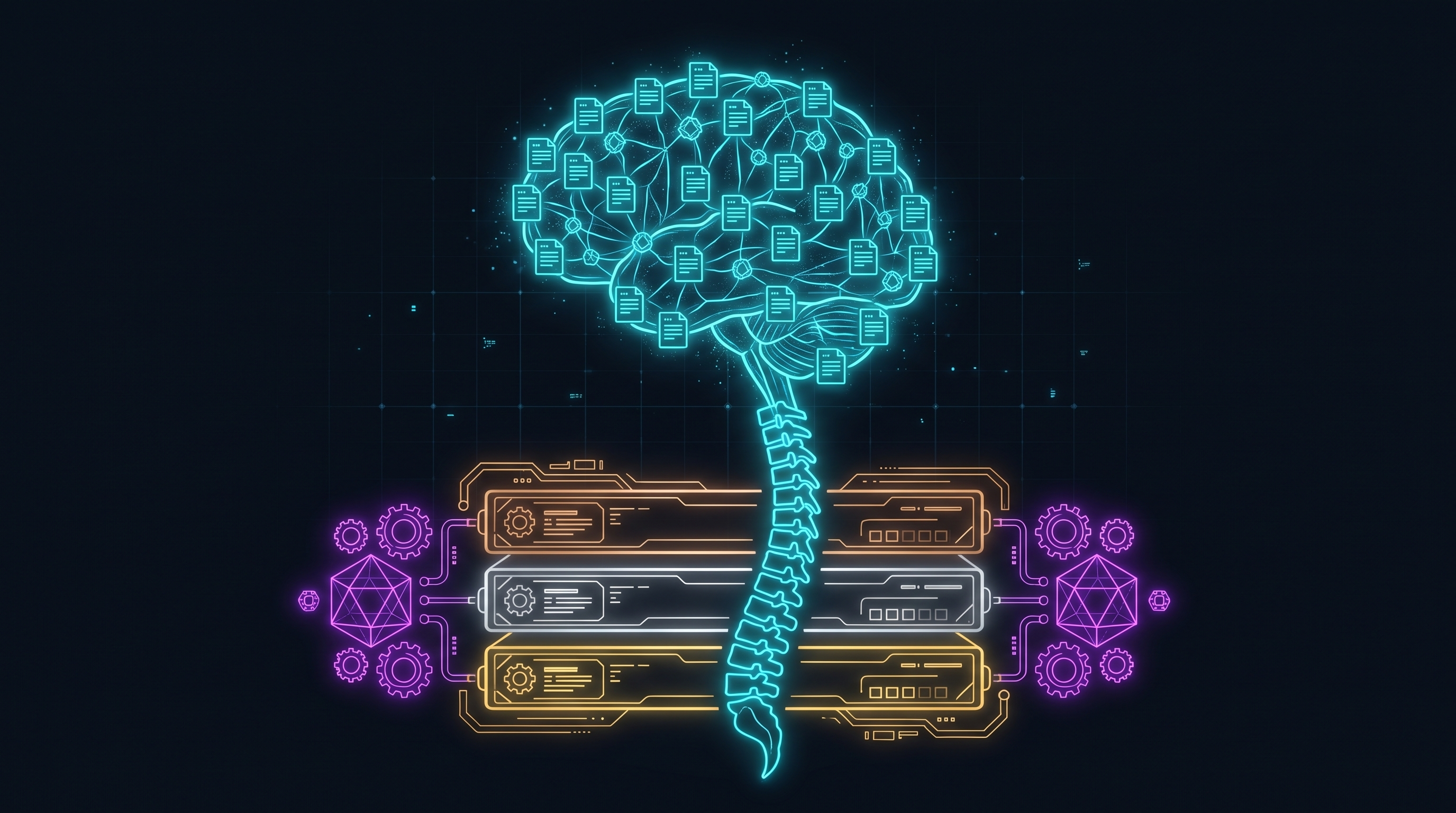
Your second brain is brilliant and it cannot come to work. Not because it doesn't know enough, but because it has no body: no permissions, no immune system, no way to serve anyone but you. This is the personal second brain scaled from the individual to the enterprise, and the argument that the lakehouse is the body the cortex has been missing. Markdown is the authored meaning; Databricks is the governed substrate that keeps it alive at scale.
Contents
Your second brain is brilliant, and it cannot come to work.
Not because it does not know enough. You have fed it for years: every article worth keeping, every decision and the reasoning behind it, every hard-won note, cross-linked and distilled until it answers you better than your own memory does. The knowledge is real. The problem is that it has no body. No permissions, no immune system, no circulation, no way to serve anyone but you. The moment it has to work for a team, a division, or an institution, the smartest second brain in the building just sits there. Thinking was never the part that was missing.
This is the gap between a personal knowledge system that feels like magic and an enterprise one that almost always flatlines. And the fix is not a smarter brain. It is a body.
The brain that only works for one person
Start with why the personal version is so good, because the reasons it wins are the exact reasons it cannot scale.
The modern second brain is a well-worn discipline. Tiago Forte’s CODE method moves information through four steps, Capture, Organize, Distill, Express, so that what you consume turns into something you can actually use. Forte files it with PARA, organizing by actionability rather than topic. Further back sits the Zettelkasten, whose whole ethos is “connection, not a collection”, a web of linked thoughts instead of a pile of notes. The common thread is that a second brain is not storage. It is structure: meaning you authored, linked to other meaning you authored.
Mechanically, mine and most good ones are plain markdown that a model maintains, the case I made in Markdown Is the Knowledge Layer. You talk to it, it writes what it learns back to disk, and the whole graph stays as fast and local as your filesystem.
Here is the load-bearing detail. For yourself, you do not care about governance. No access control, because there is one user. No audit trail, because there is one hand on the keyboard. No tenant isolation, because there is one tenant. Every hard problem a database exists to solve, you get to skip, because you are a population of one. The personal second brain is a cortex in a jar: pure authored meaning, no body to feed or defend, and it is glorious precisely because it never had to grow one.
The same brain, four times
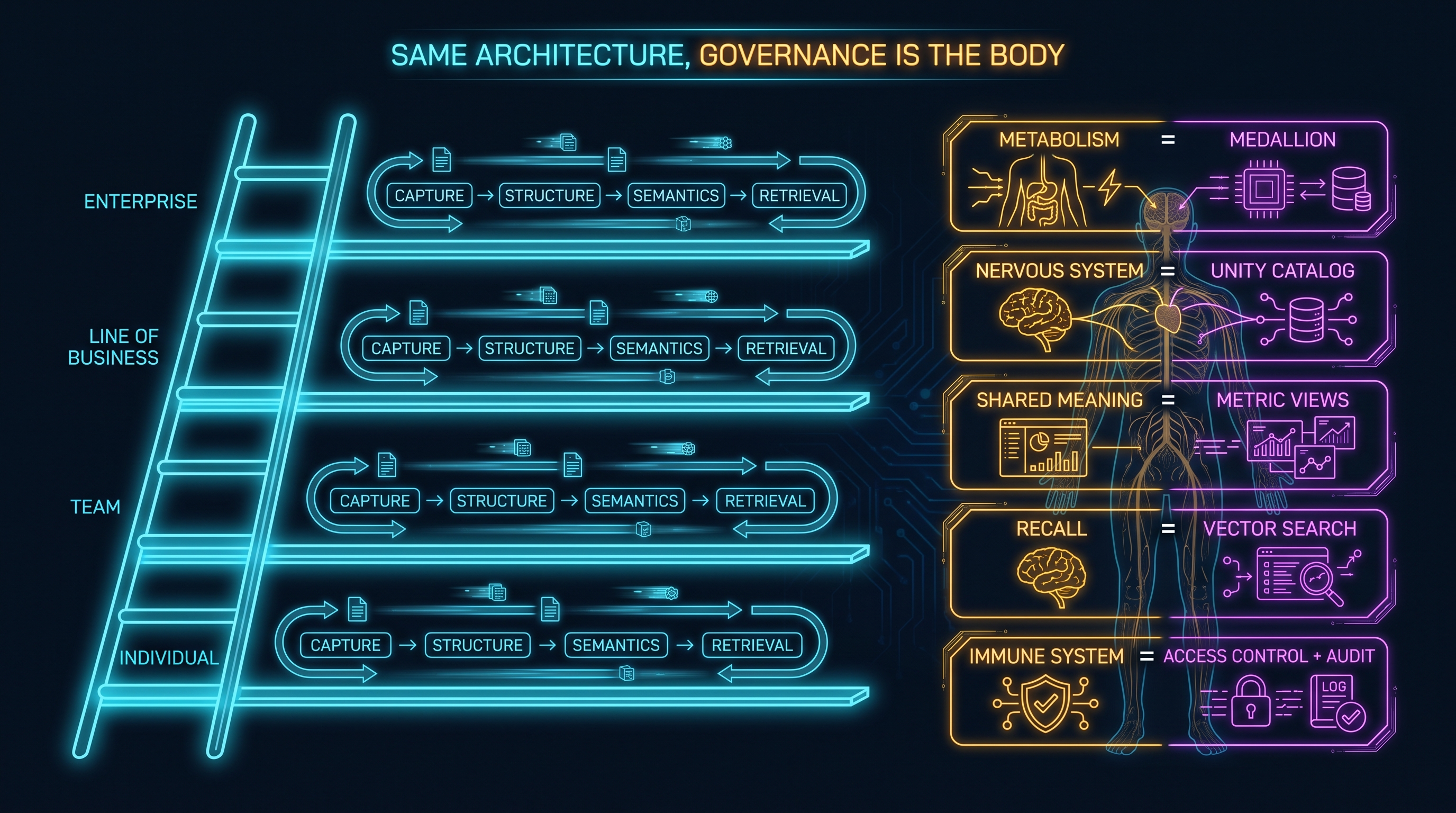
Now scale it. The enterprise is not one thing, so the brain has to exist at four scales: the individual, the team, the line of business, and the whole institution. I drew that ladder as the spine of the AI-first operating system in IT Is the Blueprint, where each pillar gets solved four times, from a person’s desk up to infrastructure with audit and access control.
The surprising part is what does not change as you climb. The architecture is identical at every rung. Capture, structure, give it semantics, retrieve against it. One analysis of this calls the personal brain, the company brain, and the multi-agent brain “the same primitive applied at three different scopes”, sharing identical underlying architecture and differing only in scope and consumer. You do not design a new brain for the team or the division. It is the same loop, wider.
What changes is everything the single user got to ignore. A company brain, the same source puts it, has to be shared, enforceable, evolving, and agent-readable, where an individual’s needs none of that. Those four words are the whole climb. Shared means one source of truth instead of a thousand private copies. Enforceable means alternatives get deprecated, not left to rot in parallel. Evolving means it updates without one person hand-editing it. Agent-readable means a machine can reach it under enforced permissions.
Miss them and you get the failure everyone has lived through. Fragments of truth multiply, permissions drift, nobody deletes the stale copy because nobody owns it, and the moment people cannot tell which source to trust, they stop consulting the system and fall back to a Slack search and the one colleague who remembers. The knowledge is in there somewhere. The brain just has no way to serve it reliably to a second person. That is not a bigger cortex problem. It is a missing body.
Why the enterprise brain keeps flatlining
Enterprises have been trying to build a shared brain for thirty years, and the graveyard is enormous. Knowledge management, the wiki, the intranet, the SharePoint nobody opens. They failed for one reason, and it is not the tool.
They failed because governance was manual human labor. Every one of those systems asked people to extract knowledge from where work actually happened, rewrite it into an article, file it somewhere findable, and then maintain it as reality changed, forever, as unpaid librarian duty on top of their real jobs. No incentive structure sustains that. The content goes stale within a quarter, the first person burned by a wrong answer stops trusting it, and usage collapses. The brain did not die because it was dumb. It died because nothing kept it alive.
The modern numbers say the same thing in a new accent. Gartner expects 80 percent of data and analytics governance initiatives to fail through 2027. RAND found more than 80 percent of AI projects fail, roughly double the rate of ordinary IT, and its root causes are organizational, not technical. MIT’s 2025 study reported that 95 percent of enterprise generative-AI pilots deliver no measurable return, and attributes it to a learning and integration gap rather than model quality. Three different studies, three different framings, one finding underneath: the brain is fine, the body is missing.
There is an older version of the same disease, and the Zettelkasten people named it decades ago: the collector’s fallacy, the comfortable illusion that having information is the same as knowing it. Every enterprise is a collector on a heroic scale. The data lake full of raw tables nobody distilled, the drives of documents nobody connected, is the collector’s fallacy at petabytes. McKinsey Global Institute once put the knowledge worker’s information-hunting at nearly a fifth of the workweek. You do not fix that by hoarding more. You fix it the way a second brain does, by distilling and connecting, which is exactly the work no enterprise has been able to sustain by hand.
The lakehouse is the body
Here is the turn. Everything the personal brain got to skip, access control, freshness, isolation, audit, is a solved problem in a different discipline. It is what a data platform does. So the enterprise second brain is not a bigger wiki. It is the same cortex given a body, and a lakehouse like Databricks is the most complete body on offer. Walk the anatomy.
Metabolism is the medallion. A body turns raw intake into usable energy in stages, and so does the medallion architecture: Bronze is raw capture, Silver is cleansed and conformed, Gold is business-ready. Line that up against Forte and it is the same method wearing an enterprise suit. Capture is Bronze. Distill is the climb to Gold. CODE and the medallion are the same four moves, one authored by a person, one run by a pipeline, and the pipeline is the part that does not get tired.
Shared meaning is the semantic layer. A cortex is useless to a second person if your “net revenue” is not my “net revenue.” Databricks puts certified definitions in the platform itself through metric views, compiled to deterministic SQL so every consumer, human or agent, resolves the same term the same way. That is the governed glossary a personal brain never needed, and it is the concrete form of the argument I made in Banks Don’t Need Another Agent. They Need a Context Layer..
Recall is governed retrieval. The personal trick of promoting the golden nuggets out of a conversation and recalling them later, the one I detailed in The Second Brain Doesn’t Ship, becomes Vector Search over governed indexes plus per-user memory. The difference is the leash: every index carries access controls, so an HR agent cannot read finance and one customer’s memory never surfaces for another. Retrieval without that isolation is the same grounding problem I wrote about in Grounding Is a Memory Problem, now with a tenant boundary welded on.
The immune system is governance. This is the organ the cortex-in-a-jar never grew, and the one that keeps the whole body from poisoning itself. Databricks runs it through Unity Catalog: access control, lineage, and audit across the agent’s models, tools, and data, enforced identically whether the query comes from a dashboard, a notebook, or a conversational agent. Permissions, provenance, and the ability to reconstruct what the system saw and why. In a regulated shop that immune system is not a nicety, it is the price of being allowed to operate at all.
The claim that ties it together is the one worth keeping. You do not rebuild the brain at each tier. The capture, structure, semantics, retrieval loop is the same from your laptop to the institution. Governance is a layer you add on top of that identical loop, and the lakehouse is where the layer physically lives. That is why this scales where the wiki never did: the hard part is not re-authored every time, it is enforced by a substrate that does the librarian work no human was ever going to sustain.
The honest limit: a body is heavy
A body is also expensive, and pretending otherwise would be the tidy-but-wrong kind of claim I try to avoid.
The lakehouse bill is real and hard to forecast, metered in consumption units stacked on cloud infrastructure, and the efficiency numbers vendors quote are their own benchmarks. The operational weight, pipelines, cluster tuning, semantic models kept in sync, lands on your team. The maintenance did not vanish, it moved from humans writing wiki pages to engineers running pipelines, which is a far better trade but not a free one. And the lock-in is real: the open table formats are portable, but the compiled meaning, the definitions and lineage and accumulated corrections, lives in the platform, which is exactly the portability question I raised in The AI Context Portability Problem. The sticky asset is the body, not the bytes.
The inverse warning matters just as much, and it cuts against my own enthusiasm. Do not give your personal brain a body. For a population of one, plain markdown in a git repo is genuinely ideal, and reaching for a lakehouse there is building an immune system for a cell culture. The whole point of the cortex-in-a-jar is that it skips what it does not need. A body is metabolically costly, and you only grow one when something depends on the brain surviving contact with other people.
So the reconciliation is not pick a side, it is match the anatomy to the tier. The architecture scales for free, the same loop all the way up. The body is what costs, and you add exactly as much of it as the scale demands: none for yourself, a shared corpus and agreed definitions for a team, governed domain assets for a division, the full governed substrate for the institution. Over-build it on your desk and you have solved problems you do not have. Under-build it at the enterprise and you have a brilliant brain that cannot come to work.
The brain was always there
The thing I keep landing on is that the brain was never the bottleneck.
Every enterprise already has the cortex. It is just disembodied, scattered across a thousand heads, a hundred tools, and a data lake nobody distilled, full of meaning that no one person holds and no system reliably serves. The work of the next few years is not inventing a smarter brain. It is building the body: the metabolism that refines raw data into meaning, the shared definitions, the governed recall, and the immune system that lets the thing operate where real people and real money are on the line.
Markdown taught us what the cortex is. The lakehouse is finally a place to give it a body. Build the body. The brain was always there.
The companion read is The Second Brain Doesn’t Ship, which marks the exact axis where plain files stop scaling, and From Medallion to Meaning, on the lakehouse half of the body in detail. For the four-scale ladder this post climbs, see IT Is the Blueprint.
I write about AI-assisted development, enterprise architecture, and building in regulated environments. If you’re drawing the line between a personal brain and the one your organization has to govern, I’d like to compare notes. Find me on X @orestesgarcia or LinkedIn /in/setsero.
Get the next field note.
Regulated AI, architecture and platform economics — in your inbox as they publish.