The Economics of Renaming AI
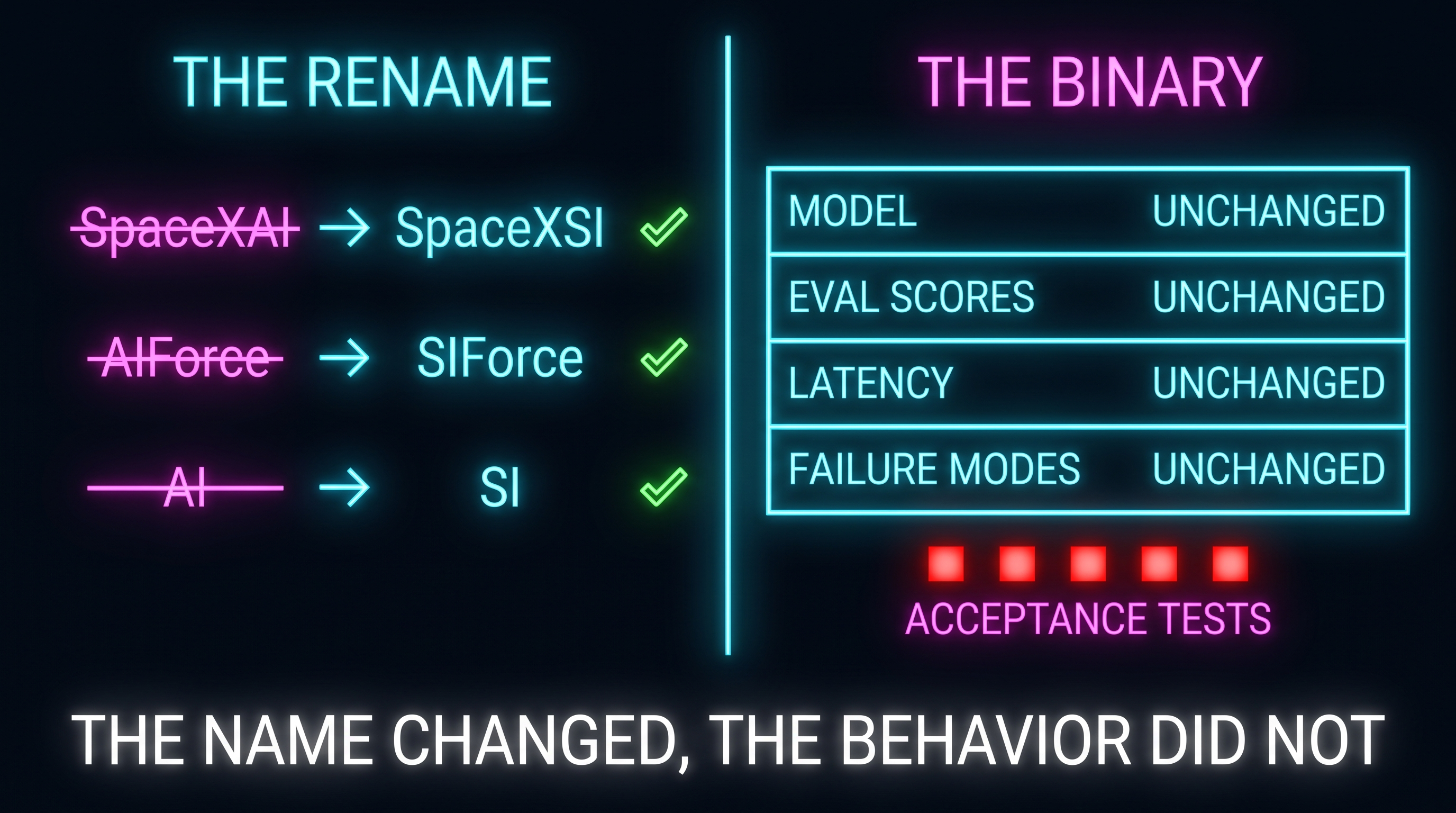
Musk renamed SpaceXAI to SpaceXSI. Benioff flipped AIForce to SIForce. A September 29 executive order told federal agencies to stop writing 'artificial intelligence' and start writing 'super intelligence.' As an engineer I know what that is: a find-and-replace. Here is what the rename actually ships, what it doesn't, and why the gap between those two is where the money gets made or lost.

Contents
Elon Musk renamed SpaceX’s AI unit from SpaceXAI to SpaceXSI. A few days later Marc Benioff flipped Salesforce’s AIForce to SIForce and posted that “the era of Super Intelligence is here.” Both were reacting to a September 29 executive order that told federal agencies to stop writing “artificial intelligence” and start writing “super intelligence,” or SI.
As an engineer, I know exactly what that is. It’s a find-and-replace. s/AI/SI/g across every doc, every slide, every product page. And I know the thing every engineer learns the hard way: renaming a variable does not change what the function does.
So set the politics aside, because they are the least interesting part. I want to look at what the rename actually ships and what it doesn’t, since the gap between those two is where the money gets made or lost.
A rename is a string change
Run it in your head as a refactor. Benioff did not rebuild AIForce overnight. He changed its name. The models behind it, the eval scores, the latency, the failure modes, all of it was byte-for-byte identical on Friday night as it was on Friday morning. The class got renamed. The methods still do what they did.
That is the part the word “super” papers over. Superintelligence already has a definition. Nick Bostrom pinned it in 1998: an intellect much smarter than the best human brains in practically every field. That system does not exist yet. What we have is the jagged kind: great at one task, useless at the next, confidently wrong in between. You can rename ChatGPT to a superintelligence, but your tests do not read the label. They still fail exactly where they failed yesterday.
I have shipped enough renames to know the shape of this. You rename a service, every reference updates, the pipeline goes green, and nothing about the system is better or worse than it was an hour ago. A rename is overhead that buys you clarity, or overhead that buys you confusion. It never buys you capability. The old joke is that the two hard problems in computer science are cache invalidation and naming things. This is the naming-things problem at national scale.
But the name still does real work
Here I have to argue against my own instinct, because “it’s just a string” is too easy.
Names move money. Call a pile of scripts a “platform” and it gets a team, a roadmap, and a budget line. Call the same code a “hack” and it gets deprecated. Nothing in the repo changed; the funding did. I have watched a project live or die on whether leadership filed it under “infrastructure” or “somebody’s side thing.” A label is a routing decision for attention and capital, and those are the two scarcest things in any organization.
“Super intelligence” is that move run at the scale of a whole country. “Artificial” quietly says fake, derivative, a cheap copy of the real thing. “Super” says ahead, winning, the thing to race toward. Trump put it bluntly when he first floated the term at the UN: whoever wins super intelligence wins. Frame the category that way from the top and you pull private capital toward it, you tell ambitious people where to point their careers, and you lower the felt risk of betting big. That is a real effect, and it is genuinely good for a country that wants the next thing built here. Optimism is cheap to print and it moves the same budgets a subsidy would.
So the rename is not nothing. It is a bet that belief is a resource. On that narrow point, the bet is right.
Where the bet goes wrong
The trouble is that the name wrote a check the systems have to cash, and some of them can’t.
Every dollar that chases “super” instead of a working feature gets clawed back when the demo meets production. We already have the receipts. Gartner expects 40 percent of agentic AI projects to get cancelled. Pilots stall before they ship. The keynote stack turns out half-built the second you wire it to real data. A louder name does not close that gap. It widens the distance between what the word promises and what you can actually deploy, and you pay that distance back with interest.
Here is the tell that it is branding and not capability: not everyone is playing along. OpenAI said it has no plans to rename anything. The people closest to the actual systems are the least eager to call them super, because they are the ones who have to answer for what the systems still can’t do. When the teams who build the thing won’t use the label, the label is marketing.
So which is it, a useful signal or an empty rebrand? Both, and that is not a dodge. The confident name is what gets the hard work funded. The honest spec is what keeps that funding from lighting itself on fire. You need the optimism to raise the money and the precision to spend it on something that actually runs. Drop the optimism and nothing gets built. Drop the precision and you ship the wrong thing at scale, then spend the next year writing it off. The rename hands you the first with none of the second. That is not a reason to mock it. It is a reason to supply the missing half yourself.
What I would actually do with this
If you build or buy this stuff, the rename changes your inputs, not your job. Treat it like any loud signal coming from upstream.
Do not refactor your roadmap because a label changed. The money, the talent, and the attention are pointing harder at this category, and that part is real, so plan for it. But the gap between “super intelligence” and what you can ship this quarter is also real, and it is a different number. Act on the first. Discount the second. Do not let one word do both jobs.
Write your tests against behavior, not the name on the box. I have never had a system pass or fail because of what we called it. Point your evals, your budgets, and your controls at what it can demonstrably do, and let the branding slide off the top without moving a single number.
And name your own systems honestly, because naming is design, not decoration. Call something an “assistant” and people forgive the misses. Call it “autonomous” and they will hold it to a bar it can’t clear yet, and you will own the gap. I would rather under-promise in the name and let the behavior surprise people than ship a superlative my logs can’t back up.
A rename is cheap. Living up to it is not. SpaceXAI became SpaceXSI over a weekend; making SpaceXSI actually superintelligent is the work of a decade, if it is possible at all. The country just picked the more ambitious name and said it out loud. Whether that turns into a real lead or an expensive write-off comes down to the unglamorous part the word skips: the evals, the data, and the systems that have to do the thing. The rename set the ambition. The rest of us still have to go build the substance. That has always been the job, whatever we are calling it this week.
If the gap between the pitch and what ships is the part that interests you, the companion read is Agent as a Service Is Real. The Vendor Pitch Isn’t., on what the stack looks like once you strip the keynote, and The Model Was Never the Problem, on why the label almost never decides whether the system works. For how standards turn into durable advantage, see Steal the Contract, Not the Catalog.
I write about AI-assisted development, enterprise architecture, and building in regulated environments. If you’re reading a rebrand for the engineering signal underneath it, I’d like to compare notes. Find me on X @orestesgarcia or LinkedIn /in/setsero.
Get the next field note.
Regulated AI, architecture and platform economics — in your inbox as they publish.