IT Is the Blueprint
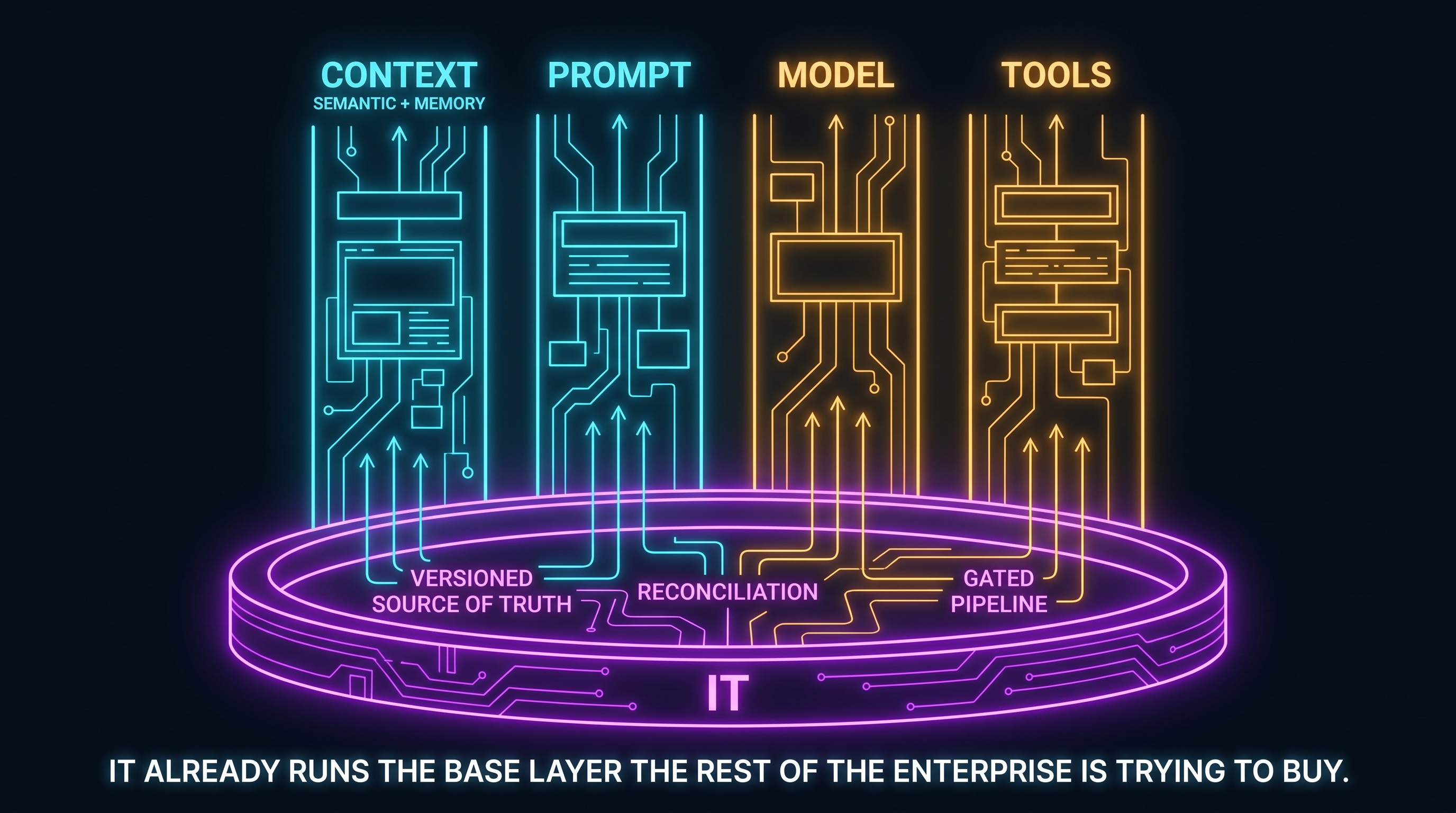
Every post in this series built one pillar of a larger machine. The AI-first enterprise is an operating system with four of them: Context, Prompt, Model, and Tools, each solved from the individual up to the enterprise. The reason IT gets to go first is that IT already runs the blueprint. The governed lifecycle isn't an aspiration in software, it's Tuesday. This is the case that IT is the reference implementation the rest of the business copies, and the honest account of what it still can't do for you.

Contents
A business unit decides to “do AI.” They buy a tool, pipe some data into it, and demo something impressive in six weeks. Then it stalls, because there is no versioned source of truth for the unit to ground on, no governed way to change what the agent knows, no lifecycle to move a change from idea to production safely. They are trying to stand up an operating system by installing one app, and they are reinventing, badly, a discipline that already exists one floor away. This series has been about that discipline. This last post is about where it leads.
Everything-as-code was never the whole thing. It is one pillar of a larger machine, and it is time to name the machine. The AI-first enterprise is an operating system, and like any operating system it has a small number of load-bearing primitives that everything else runs on.
Four pillars
There are four. Context, the searchable state of the business, which the pillar post split into a semantic layer and a memory layer and which the rest of this series built out. Prompt, the new programming language, the way intent gets expressed to the system. Model, the intelligence level a given task requires, chosen per job rather than standardized once. And Tools, the actions the system is allowed to take.
I will not restate the full definition; the pillar did that. What matters here is that they are pillars, not features. An enterprise missing any one of them does not have a slower operating system, it has no operating system. Most “AI initiatives” that stall are missing three of the four and calling the one they bought a strategy.
Solved at four scales
Each pillar has to be solved four times, because the enterprise is not one thing. At the individual scale, Context is your notes, Prompt is your personal skill, Model is what you reach for, Tools are what you have wired up. At the team scale, those become shared: a common corpus, agreed prompting patterns, a sanctioned model, a shared tool surface. At the line-of-business scale they become governed domain assets. At the enterprise scale they become infrastructure with audit and access control.
The same four pillars, instantiated four ways, from a person’s desk to the whole institution. The reason most transformation efforts feel incoherent is that they solve one pillar at one scale and declare victory, then wonder why it does not compound. It does not compound because an operating system is the whole grid, not one cell of it.
IT is the reference implementation
Here is the claim the whole series has been building toward. You do not have to invent this operating system, because one part of the enterprise already runs it. IT has a versioned source of truth, a reconciliation loop, a gated pipeline, and a governed lifecycle. Not as an aspiration. As Tuesday.
I have written the components elsewhere: the six primitives of a code factory, the prompting disciplines encoded as infrastructure, the reference architecture for AI tooling, the maturity ladder most shops are partway up. Put them together and the shape is unmistakable: IT is the reference implementation of the four-pillar operating system, and every other domain, risk, finance, operations, marketing, is now trying to build the same thing. The fastest path is not to invent it from scratch in each silo. It is to copy the blueprint from the floor that already has it running.
Can the pattern extend?
That was the question the series opened with, and the answer is yes. We walked it deliberately. Infrastructure already fell. Architecture, policy, and the governance layer take the same lifecycle. The data substrate scales the source of truth from git to the lakehouse. The memory layer, the hardest, has a clear shape even where the engineering is young. Domain by domain, the governed lifecycle IT earned generalizes, which is the entire thesis: we already solved this, for one artifact, and the solution travels.
The one place it strains is the one the previous post spent itself on: reviewing meaning at machine speed. That is a limit on the review gate, not on the pattern. The pattern extends. The judgment inside it does not automate.
What stays human, and where this leaves us
Which is the close, and it is the same note every post in this series has landed on, now said once for all of it. The operating system is a conveyor. It moves artifacts through a governed lifecycle with a discipline no human team can match. It does not decide where they should go. Authoring the intent, owning the accountability, deciding what “correct” means for a control that protects real people and real money, that is the human’s, and as execution gets cheap it becomes the whole job. That is the durable moat: not running the loop, but knowing what should go through it.
I will be honest about the state of the thing. The operating system is mostly unbuilt. The blueprint is proven, IT is running it, and almost nobody has hired the general contractor to build it out across the enterprise. That is the work of the next few years, and it is less invention than remembering. Every governance problem the enterprise hands me still triggers the same déjà vu the pillar opened with, and I have made my peace with it. We already solved this. The whole job now is to remember where we put the answer, and to point the discipline software spent decades earning at everything we left out the first time.
This closes the Everything as Code series. Start at the beginning with I Already Solved This, the déjà-vu pillar, or revisit Judgment Is the New Moat, on the human half that never automates.
Find me on X @orestesgarcia or LinkedIn /in/setsero.
Get the next field note.
Regulated AI, architecture and platform economics — in your inbox as they publish.