Grounding Is a Memory Problem
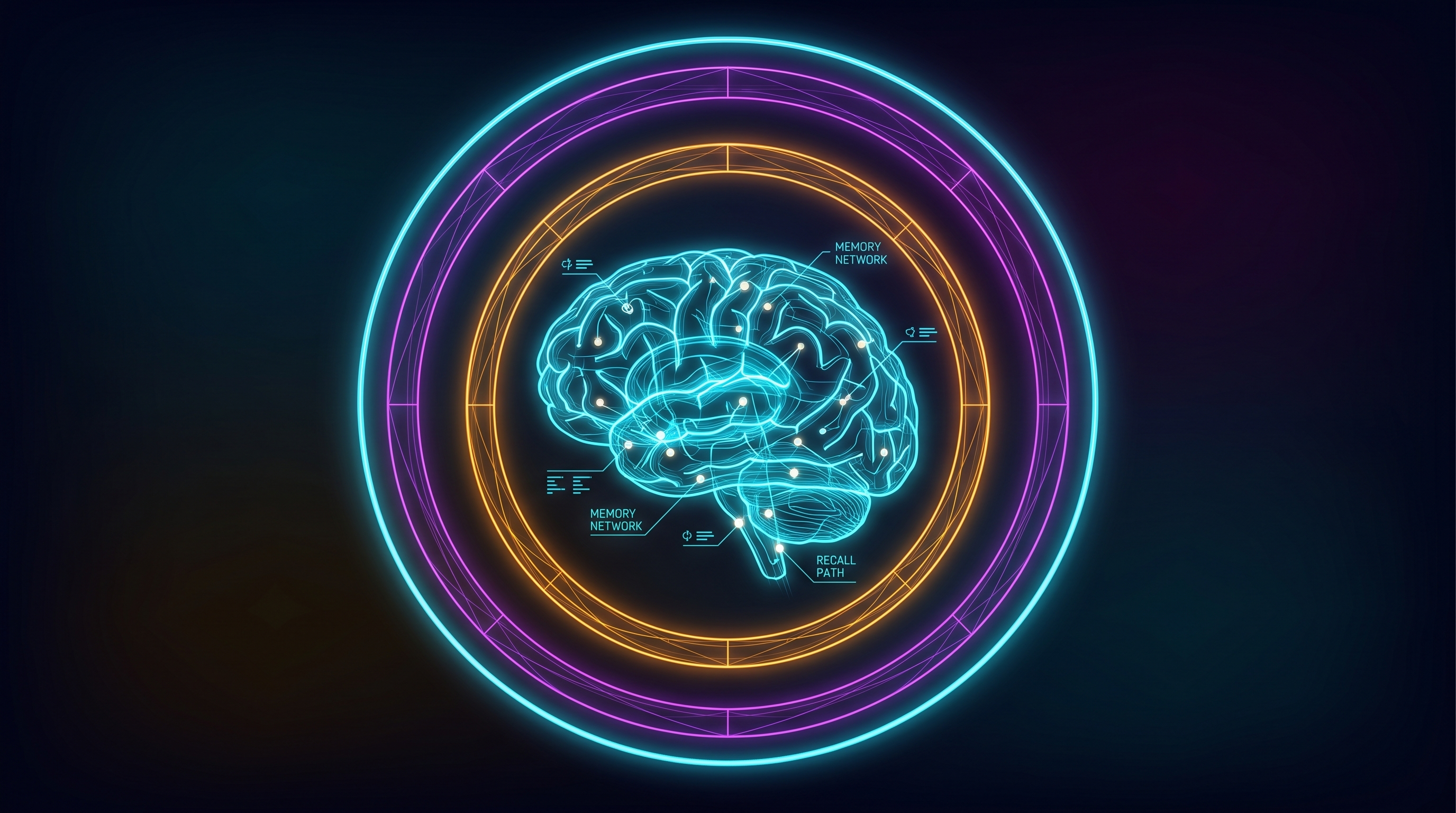
Everything-as-code builds the semantic layer of context, the governed meaning of the business. It does not build the other half. Grounding an AI turns out to be a memory problem, and the answer has always been the second brain, at every scale from a person's notes to an enterprise knowledge base. Here is the practical shape of memory at the individual, team, line-of-business, and enterprise level, and why every framework keeps rediscovering what neuroscience still can't fully explain.
Contents
An engineer spends a year getting dramatically better with AI. She learns to prompt, to delegate, to review machine output well. And at the end of that year the institution around her is exactly as smart as it was, because everything she learned lives in her chat history and her head. I wrote about that gap in The Bank Got Dumber While Its People Got Smarter, and it is the clue this post follows. The individual got smarter. The memory did not accumulate anywhere shared.
Everything in this series so far has built one half of the Context pillar: the semantic layer, the governed and versioned meaning of the business. This post is about the other half, and it is a different kind of problem. Grounding an AI is, underneath, a memory problem, and the enterprise has been trying to solve memory for as long as it has kept records.
Semantic is meaning, memory is recall
The two halves are easy to conflate and worth separating cleanly. The semantic layer is what things mean: the model, the policies, the contracts, the definitions, all versioned in the substrates the last post described. Memory is what happened and what we know: the accumulated, retrievable record an agent draws on to answer in context.
An agent needs both. Semantics without memory is a system that understands the shape of the business but remembers nothing specific. Memory without semantics is a pile of recall with no structure to make sense of it. Everything-as-code gives you the first. It does not give you the second, and pretending it does is how “we put our docs in git” quietly fails to ground anything.
Memory is infrastructure, not a skill
The reason memory is hard is that it has two failure points and most efforts only fund one. You have to capture, and you have to retrieve, and a system that nails capture but fumbles retrieval is a write-only archive nobody can use. I argued in Context Engineering Is Infrastructure that fifty years of knowledge-management projects keep dying at exactly this seam, and that treating context as a skill someone should just have, rather than infrastructure the organization builds, is the recurring mistake.
The second brain has become the popular name for getting this right at the personal scale. The trap, which I named in The Second Brain Doesn’t Ship, is assuming that a person’s capture habit becomes institutional memory on its own. It does not. Individual memory and organizational memory are different systems with different owners, and the jump between them is the whole problem.
Practical memory at four scales
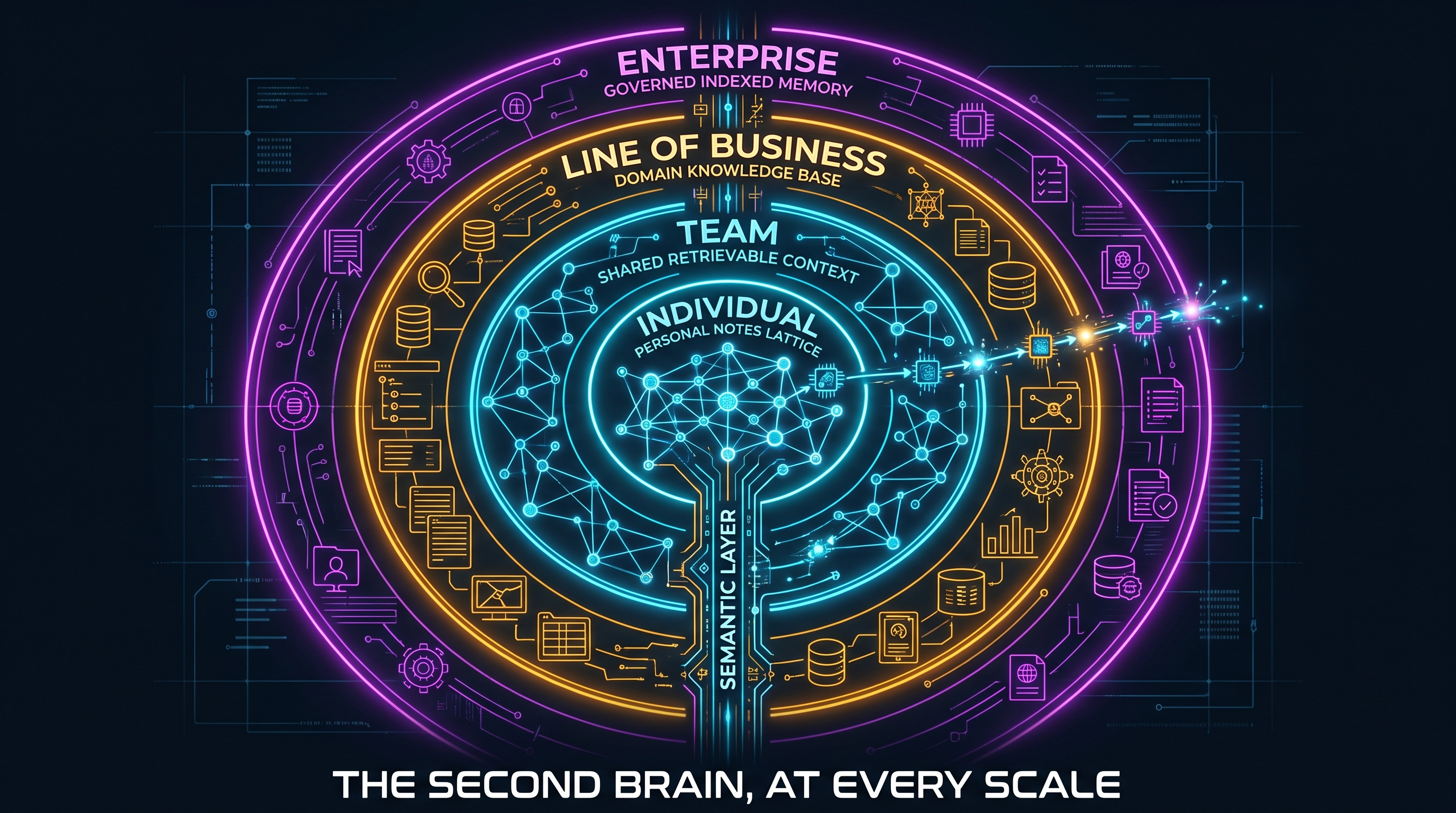
So here is the practical shape, because the abstraction is useless without it. Memory has to be solved at four levels, and the primitive changes as you climb.
At the individual level it is a personal notes lattice, plain text in git, the same markdown knowledge layer that holds the semantic text. Small, portable, yours. At the team level it becomes shared retrievable context: the same corpus, but with access and search across a group, so a teammate’s captured decision is recallable by the whole team and by their agents. At the line-of-business level it grows into a domain knowledge base with real retrieval, where the volume forces you past plain files into indexed and vectorized stores, the point where markdown ends and retrieval infrastructure begins. And at the enterprise level it is governed, indexed memory across the whole org, with the lineage and access controls the semantic-layer substrates already taught us to demand. The portability of that context across tools is its own unsolved fight, and it gets harder at every level up.
What neuroscience keeps reminding us
There is a humbling pattern worth naming. Every generation of AI memory frameworks arrives announcing a taxonomy, working memory, episodic memory, semantic memory, and every time it turns out to be a rediscovery of distinctions cognitive science has studied for decades. That is not a criticism. It is a signal that the problem is genuinely deep.
The reminder the neuroscience offers is that human memory is reconstructive and lossy. It does not store and replay; it rebuilds, imperfectly, and forgets on purpose. An enterprise memory that only ever accumulates and never forgets, never decays, never prioritizes, is not more capable than a human one. It is a different and often worse thing, drowning in undifferentiated recall. Anyone who claims memory is a solved feature has not sat with how strange the target actually is.
The least-solved pillar
The honest admission is bigger than usual, because this is the frontier. The semantic layer, this series has argued, is largely a matter of applying software’s governed lifecycle to new artifacts, and the path is clear even where the work is hard. The memory layer is not clear. Retrieval quality is uneven, provenance of a retrieved fact is often lost, and deliberate forgetting is barely attempted. Of the four pillars of the operating system the next post describes, this is the one furthest from done.
But the shape of the answer is not mysterious, even if the engineering is. Grounding is memory, memory is the second brain, and the second brain has to be built deliberately at every scale from the person to the enterprise, as infrastructure and not as a habit you hope catches on. Everything-as-code builds the meaning. The memory that makes that meaning recallable is the other half of the Context pillar, and it is the half still mostly waiting to be built.
If this resonated, read Context Engineering Is Infrastructure, on why capture-and-retrieval keeps failing, and The Second Brain Doesn’t Ship, on the jump from personal to institutional memory. Both sit in the Everything as Code series, under the pillar.
Find me on X @orestesgarcia or LinkedIn /in/setsero.
Get the next field note.
Regulated AI, architecture and platform economics — in your inbox as they publish.