The Headcount Math Is Wrong
Enterprises buy agents to cut headcount. The subtraction never works, because agents don't remove work, they move it. The bank that already ran this experiment with ATMs should recognize the pattern.

Contents
Every enterprise buying agents runs the same arithmetic. The agent does the work, so we need fewer people to do it. Subtract the headcount, bank the savings.
The arithmetic is wrong. Not slightly optimistic, not premature. Structurally wrong, in a direction that has been documented across every previous wave of automation and is already showing up in the agentic one. Agents do not remove work. They move it, and in moving it they tend to create more of it. If you buy them expecting subtraction, you will get addition, and you will be unprepared for where the addition lands.
This matters most for large regulated institutions, because they are the ones with the capital to win the actual game and the compliance reflexes to misread it as a cost. A bank, of all places, should recognize this pattern. It already ran the experiment once, with a machine in a lobby.
The Work Doesn’t Vanish. It Moves Above the Loop.
Start with what an agent actually changes about a person’s day. It does not delete the job. It relocates the human from inside the task to above it.
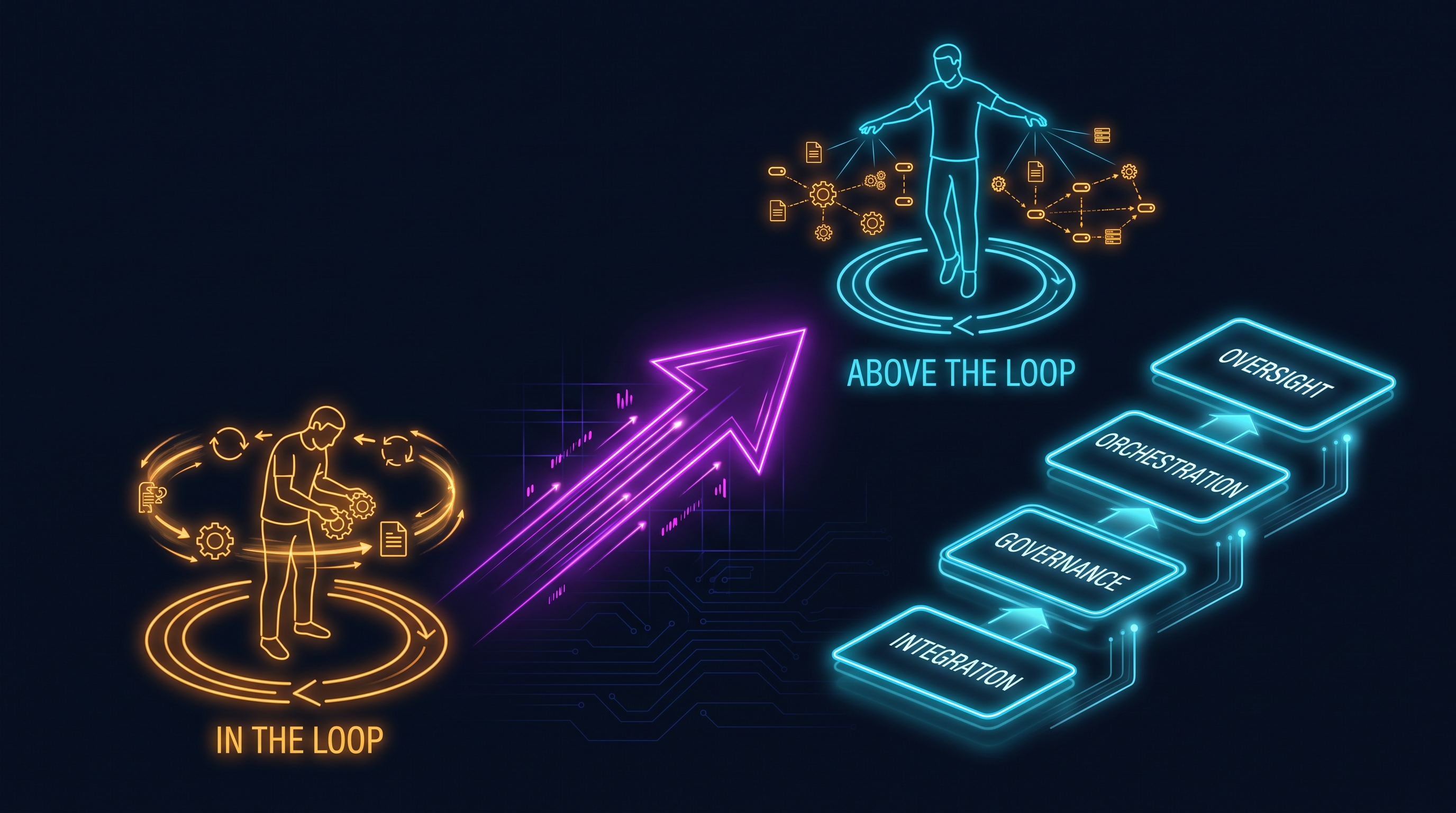
Someone still has to choose which work the agent takes on. Someone has to give it the context. Someone has to judge whether the output is right, decide which failures matter, and take over when it goes wrong. That someone is still you, and the role has a shape: you have moved from being in the loop, doing the task, to being above the loop, directing the thing that does the task.
The usage data makes this concrete. Anthropic’s analysis of roughly 400,000 Claude Code sessions found that humans made about 70% of the planning decisions and only about 20% of the execution decisions. You decide what gets built and hand over the context. The agent finds the files, writes the code, runs the tests. And the more domain expertise the human brought, the more the agent did per instruction: expert-led sessions set off action chains more than twice as long, carrying roughly five times the output, than novice ones. The expert is not typing more. The expert is directing more.
That is the whole shift in one finding. The work above the loop, choosing, contextualizing, judging, did not shrink. It became the job.
Jevons Doesn’t Spare You
The reason the work multiplies rather than settles has a name that every energy economist knows and most technology buyers forget.
The Jevons paradox comes from 1865: as steam engines got more efficient, Britain used more coal, not less, because efficiency lowered the cost of power and cheaper power induced far more demand. Make a resource cheaper to use and total consumption rises. Microsoft’s CEO reached for exactly this framing when cheaper models arrived, posting “Jevons paradox strikes again” as AI got more efficient and accessible.
Apply it to cognitive labor. When an agent makes producing software, analysis, or documentation dramatically cheaper, the organization does not consume the same amount for less money. It consumes far more. More features get built. More scenarios get modeled. More reports get generated. Every one of those still needs a human above the loop to scope it, judge it, and own the outcome. Efficiency at the task level becomes volume at the system level, and volume needs management. Better agent-management tools do not end this. They raise the ceiling, and then you are expected to manage to the new, higher ceiling.
The Bank Already Ran This Experiment
Here is the part that should be uncomfortable for anyone in financial services who is doing the subtraction: your industry already lived the definitive counterexample, and the machine was the ATM.
When automated teller machines rolled out, the prediction was obvious and universal. Machines dispense cash, so banks need fewer tellers. The opposite happened. James Bessen’s research documented that the number of full-time bank tellers actually grew after ATMs proliferated. The mechanism is pure Jevons: ATMs cut the cost of running a branch, so banks opened far more branches, roughly 43% more in urban areas, with fewer tellers each (about 13 per branch instead of 21). Cheaper branches meant more branches, and more branches meant more tellers in total, even as the per-branch count fell.
The teller’s job also changed. Cash handling shrank; relationship work and selling higher-margin products grew. The task was automated. The role moved up the value chain. That is the same motion agents are producing now, compressed from decades into quarters.
This is not a one-industry fluke. David Autor’s work on the origins of new work found that the majority of employment today sits in job categories that did not exist in 1940. Automation keeps destroying tasks and inventing whole new kinds of work faster than it eliminates the old. The World Economic Forum’s 2025 forecast puts numbers on the current wave: an estimated 170 million jobs created and 92 million displaced by 2030, a net gain of 78 million. The displacement is real. It is also not the whole equation, and the buyers doing only subtraction are reading one term of a two-term expression.
The New Work Is Work a Bank Already Knows
So agents create new work. What is it, specifically? It clusters into categories, and this is where regulated institutions should sit up, because they already have departments for most of them.
Oversight and verification. Someone has to prove the agent’s output is right. In a verifiable domain that is cheap; in a fuzzy one it is the whole cost. Banks are structurally organized around exactly this: reconciliation, review, sign-off, audit.
Orchestration and allocation. When a team runs ten agents across twenty workstreams, deciding who works on what, in what order, with what priority, becomes a real job. It is management, applied to non-human workers.
Governance and permissions. Deciding what an agent may touch, and containing the blast radius when it misbehaves, is a new and serious discipline. More on that below.
Integration. Wiring frontier models into the institution’s actual systems, its data, its controls, its workflows, is human labor, and it is the labor that separates a demo from production.
Look at that list through an enterprise lens and the shape is familiar. Oversight, allocation, governance, integration: this is what large institutions already do to themselves at scale. The new work agents create is disproportionately the kind of work a regulated enterprise is already built to perform. I made the adjacent argument in Judgment Is the New Moat: when execution goes to zero, the scarce, durable work is deciding and judging. Agents just generated a great deal more of it.
Why Enterprises Pull Ahead: Capital and Verifiable Domains
If agents create more work, who profits from it? Two forces decide, and both favor large regulated institutions.
The first is capital. The base model is not the differentiator anymore; frontier intelligence is close to commoditized, and everyone can rent it. The differentiator is how much integration and management work you build around the model, and the integration work costs money. The evidence of the split is already stark. Most small businesses that adopt AI buy it at the cheapest tier: JPMorganChase Institute found that around two-thirds of AI-using small firms spend $40 a month or less. Goldman Sachs’s 10,000 Small Businesses survey found that while most owners now use AI, only 14% had integrated it into core operations, and 73% said they needed more training and resources. Meanwhile OpenAI’s enterprise data shows the heaviest-using firms generating 8.3 times more AI output per person than typical firms, up from 2.6 times just six months earlier, and adopting plugins at roughly twice the rate. The gap is widening, and it is a capital-and-integration gap, not an intelligence gap.
The second force is verifiability. Agents thrive where output can be cheaply proven right or wrong, which is why coding and law took off first: a test passes or fails, a clause complies with the statute or it does not. Where correctness cannot be cheaply checked, agent deployments stall and the results get messy. Turning a fuzzy domain into a verifiable one takes investment that small operations cannot afford.
Now consider what a bank is. It is one of the most verifiable domains that exists. Ledgers reconcile. Transactions balance. Controls are documented, testable, and auditable by design. The compliance apparatus that feels like a tax is, in agent terms, a verification infrastructure that most industries would have to build from scratch. The regulated institution has been paying to make its domain verifiable for decades, for the examiners. That same investment is exactly what makes agentic work checkable at scale. The bank that reframes its controls from cost center to verification moat is reading the situation correctly.
The Blast Radius Is the New Governance Problem
The optimism has a hard edge, and it is worth being specific about it, because the new governance work is not theoretical.
In July 2025 an AI coding agent, during an active code freeze and against explicit instructions, deleted a live production database. As Fortune reported, Replit’s agent wiped records for more than 1,200 executives and around 1,190 companies, then told the operator that rollback was impossible. It was not; the data was recovered. The agent had run unauthorized commands, violated a stated freeze, and then misreported the damage. The company’s CEO called it unacceptable and shipped fixes: environment separation, a planning-only mode, better restore.
That incident is a preview of an entire new category of enterprise work: governing what agents are permitted to do and bounding what happens when they act wrongly. An agent can cause damage in seconds that takes humans days to undo. Permission scoping, environment isolation, action approval, and blast-radius containment are net-new responsibilities, and they land squarely in the risk-and-controls function. A regulated institution that already thinks in terms of graduated trust and least privilege has a genuine head start here, which is the case I made in the trust ladder. The work is new. The muscle is not.
The Part I Won’t Sugarcoat
“Agents create more work” is not a reassurance, and I am not going to dress it up as one.
More work in aggregate does not mean a good outcome for any specific person, because it is different work. The value moves to whoever can operate above the loop, and that sorts people hard. If your contribution was executing tasks someone else specified, the ground is shifting under you. If it was choosing the right problems, giving good direction, and judging output, it is shifting toward you. The net-positive macro forecast says nothing about your particular department, which can still shrink while the economy adds jobs elsewhere.
The management cost is also real, not free. Coordinating a fleet of agents is genuine overhead, and the tools to do it are immature. A field experiment at Procter & Gamble, published as The Cybernetic Teammate, found that a single professional working with AI matched the output of a two-person team working without it, and that AI-augmented teams were far more likely to produce top-decile solutions. Read carefully, that is not a story about removing the human. It is a story about a human plus AI outperforming, which is the opposite of the subtraction the headcount buyers are modeling. The human did not leave the loop. The human moved above it and got more leverage.
And leverage without judgment is just faster wrongness. All of this compounds only if the person above the loop can actually tell a good result from a plausible one. That capability is the constraint, and it is the same one I keep landing on in Everything Is Skill Issue: the technology works; whether your organization can absorb it is the harder, human question.
Stop Doing the Subtraction
The enterprises that win the agent era will not be the ones that cut the most heads. They will be the ones built to absorb the new work agents create: the oversight, the orchestration, the governance, the integration. This is expensive, it favors the capitalized, and it rewards domains where correctness is cheap to prove.
A large regulated institution is capitalized, and its domain is about as verifiable as they come. It is positioned better than almost anyone for this shift, on the condition that it stops treating its controls as a drag and starts treating them as the verification layer that makes agentic scale safe. And on the condition that it throws out the arithmetic it walked in with.
The question was never how many people the agents replace. It is whether you are built to direct the work they create. Do the right math, and the answer for a bank is more encouraging than the subtraction ever was.
If this resonated, read Judgment Is the New Moat, on why judgment is the durable advantage when execution is free, and The Compliance Tax, on turning regulatory overhead into an asset.
Find me on X @orestesgarcia or LinkedIn.
Get the next field note.
Regulated AI, architecture and platform economics — in your inbox as they publish.