
Judgment Is the New Moat
Execution used to be the hard part.
Building a product meant hiring engineers, managing sprints, burning runway. Validating a business idea meant months of prototyping and thousands of dollars. The barrier to entry was the ability to build. If you could ship, you had an advantage.
That advantage is evaporating. A CNBC reporter built a project management tool in under an hour using AI agents. Over half of Y Combinator’s latest batch is building agentic AI systems, and solo founders now account for more than a third of all new startups. The cost of execution is collapsing toward zero, and with it, the moat that execution once provided.
So what’s left?
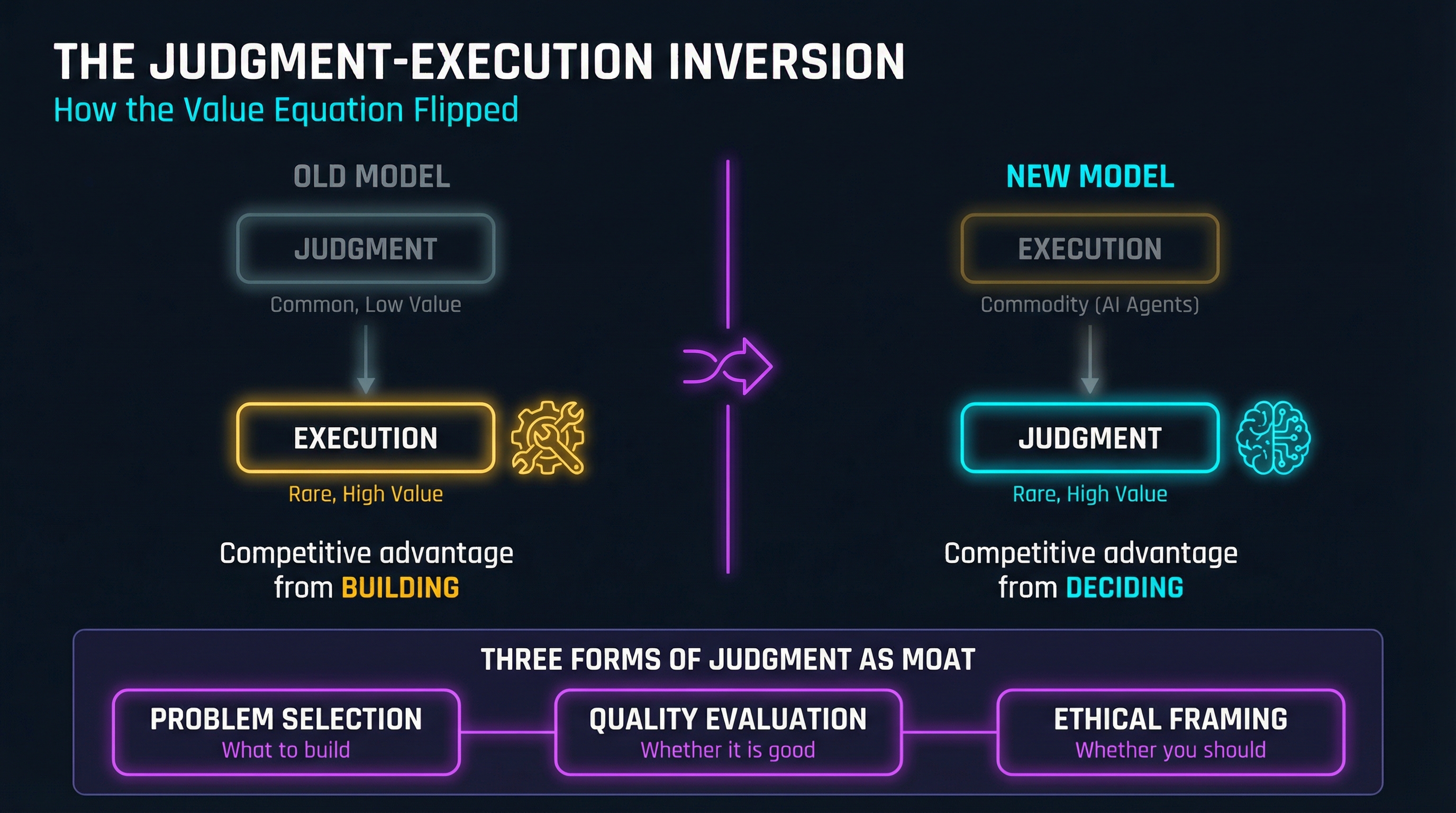
The Judgment-Execution Inversion
For decades, the formula was simple: good judgment was common, good execution was rare. Everyone knows what problems need solving. The hard part was building solutions. Companies competed on engineering talent, operational efficiency, speed to market.
AI agents invert this. When an agent can write code, draft legal briefs, process loan applications, and generate marketing copy, all at machine speed and near-zero marginal cost, execution stops being the bottleneck. The scarce resource shifts from “can you build it?” to “should you build it?” and “did you build the right thing?”
This isn’t hypothetical. Sam Altman predicted the first solo billion-dollar company. The economics are already visible: top AI-native startups average $3.5 million in revenue per employee, roughly 5.7 times the traditional SaaS benchmark. The execution gap between a 50-person team and a solo operator with an agent fleet is narrowing fast.
But here’s what most people miss: the judgment gap is widening.
Why “Wisdom > Intelligence” Is Suddenly Literal
There’s a principle in entrepreneurship circles that wisdom matters more than intelligence. Intelligence solves puzzles. Wisdom chooses which puzzles to solve.
In the pre-agent era, this was nice philosophy. In practice, intelligence (raw problem-solving ability) still dominated because execution was the bottleneck. A brilliant engineer who picked mediocre problems still outperformed a wise strategist who couldn’t ship.
Not anymore. When agents handle the execution, the wise strategist wins. They don’t need to ship; they need to direct. The architect who identifies that the real problem is context fragmentation across agent fleets beats the engineer who builds a faster standalone agent, even if that agent is technically superior.
This is the judgment-execution inversion playing out. And it has specific, uncomfortable implications for how we think about competitive advantage.
Three Moats That Used to Work
Entrepreneurship frameworks identify three classic competitive walls:
-
Technical complexity: “We built something hard to replicate.” AI agents compress technical complexity. What took a team of specialists six months now takes a directed agent fleet six days. The wall gets shorter every quarter.
-
Operational scale: “We have infrastructure competitors can’t match.” This still matters for physical operations, but for digital businesses, agent fleets scale without the overhead. A solo operator can run customer support, content production, and data analysis simultaneously through orchestrated agents.
-
Speed to market: “We shipped first.” When everyone can ship in hours, first-mover advantage compresses from years to weeks, sometimes days. The legal plugin that triggered a $285 billion repricing wasn’t first to market. It was just first to demonstrate the right capability at the right moment.
None of these walls are worthless. But they’re all degrading. The question is: what wall holds?
Judgment as Competitive Wall
The wall that holds is judgment, specifically, three forms of it:
Problem selection. Knowing which problems are worth solving, for which customers, at what price point. This requires domain expertise, customer empathy, and market reading that no agent possesses. An agent can build anything you describe. It cannot tell you what’s worth describing.
Quality evaluation. Knowing whether the solution actually works, not just technically functions, but solves the real problem. This is the trust ladder applied to business: the higher the stakes, the more human judgment matters in evaluating agent output. An agent can generate a microservices architecture. An experienced architect judges whether that architecture will survive production traffic, team scaling, and a platform migration two years out.
Ethical framing. Knowing which problems you should solve, not just which ones you can. As agents make execution trivially cheap, the decisions that matter increasingly involve values, tradeoffs, and second-order consequences. An agent doesn’t know that your “engagement optimization” feature is actually addictive by design. A thoughtful founder does.
These three capabilities (selection, evaluation, framing) are the new moat. They compound with experience, they’re domain-specific, and they can’t be automated because they require understanding context that agents don’t have access to.
The Architecture Advantage
Here’s where this gets personal for anyone who designs systems for a living.
If you’ve spent your career evaluating tradeoffs, drawing system boundaries, deciding build-versus-buy, and choosing integration patterns, you’re accidentally positioned for the agent era better than almost anyone.
Think about what an enterprise architect does daily. They evaluate whether a proposed design fits the organization’s actual constraints: team capability, existing tech debt, migration paths, vendor relationships. They assess which abstractions will hold under load and which will collapse. They make judgment calls in ambiguous situations where the technology doesn’t give a clear answer. They understand the difference between what’s architecturally elegant and what’s actually operational.
That’s pure judgment work. And it’s exactly the kind of work that agents can’t do.
An agent fleet can generate a reference architecture in minutes. It can propose microservices boundaries, draft API contracts, and scaffold infrastructure-as-code. What it can’t do is evaluate whether that architecture fits an organization: whether the team can actually operate six independent services, whether the abstraction boundaries align with how the business evolves, whether the integration pattern creates a coupling that will cost you eighteen months to unwind.
Every hour spent learning why certain architectural approaches fail in production (why “just add a microservice” creates operational overhead, why distributed systems have coordination costs that diagrams don’t show, why the right abstraction boundary depends on organizational context) is an hour building judgment that agents can’t replicate. That judgment is what separates architects who’ve internalized the lessons of agentic engineering maturity from those still drawing boxes on whiteboards.
The startup founder with an agent fleet still has to learn that enterprise systems have gravity. That migrating off a platform isn’t a weekend project. That the “right” architecture depends on who’s maintaining it at 2 AM. That learning takes years. If you already have it, your judgment is the moat.
The Uncomfortable Part
I need to be honest about the limits of this argument.
Judgment as a moat works if you actually exercise it. Plenty of architects have experience without judgment; they apply patterns without understanding why the pattern exists. Cargo-cult architecture: TOGAF by rote, microservices because Netflix does it, event sourcing because it sounds sophisticated. That kind of pattern-matching without understanding is exactly what agents will automate. The architect who draws diagrams but doesn’t understand the runtime behavior gets replaced. The architect who understands why the framework exists becomes more valuable.
There’s also a timing question. Right now, the judgment gap is widening because agents are new and most people don’t know how to direct them effectively. That gap will narrow as agent interfaces improve and best practices emerge. The moat isn’t permanent; it’s a window. The advantage goes to people who use the window to build judgment-intensive positions that compound.
And judgment alone isn’t enough. You still need to pair it with agent fluency: the ability to translate your judgment into directives that agents can execute. The architect who can’t work with AI tools loses to the slightly-less-experienced person who can. The moat is judgment plus the ability to operationalize it through agents.
What This Means Now
If execution is commodity and judgment is moat, the implications are concrete:
For entrepreneurs: Stop optimizing your ability to build. Start optimizing your ability to evaluate. The founder who can look at ten agent-generated prototypes and correctly identify which one solves a real problem has a bigger advantage than the founder who can build one prototype really well.
For enterprise professionals: Your domain expertise is more valuable than you think, but only if you pair it with agent fluency. The architect who can direct an agent fleet to evaluate integration patterns, stress-test system boundaries, and generate migration plans is worth more than the architect who manually draws diagrams or the AI engineer who doesn’t understand enterprise constraints.
For career planners: Invest in domains where architectural judgment compounds: enterprise systems, platform engineering, AI infrastructure, high-stakes system design. Avoid domains where execution was the only advantage, because that advantage is dissolving.
The agent era doesn’t make humans obsolete. It makes a specific kind of human contribution, careful, domain-informed judgment, the scarcest and most valuable resource in the economy. The irony is that the people who’ve spent years understanding why systems fail might be the best positioned for an era obsessed with building new ones.
The moat isn’t what you can build. It’s what you know is worth building.
If this resonated, you might also enjoy The 48-Hour Repricing, a look at how a single AI plugin erased $285 billion in software market cap and what it means for banking technology.