The Craftsman's Goodbye
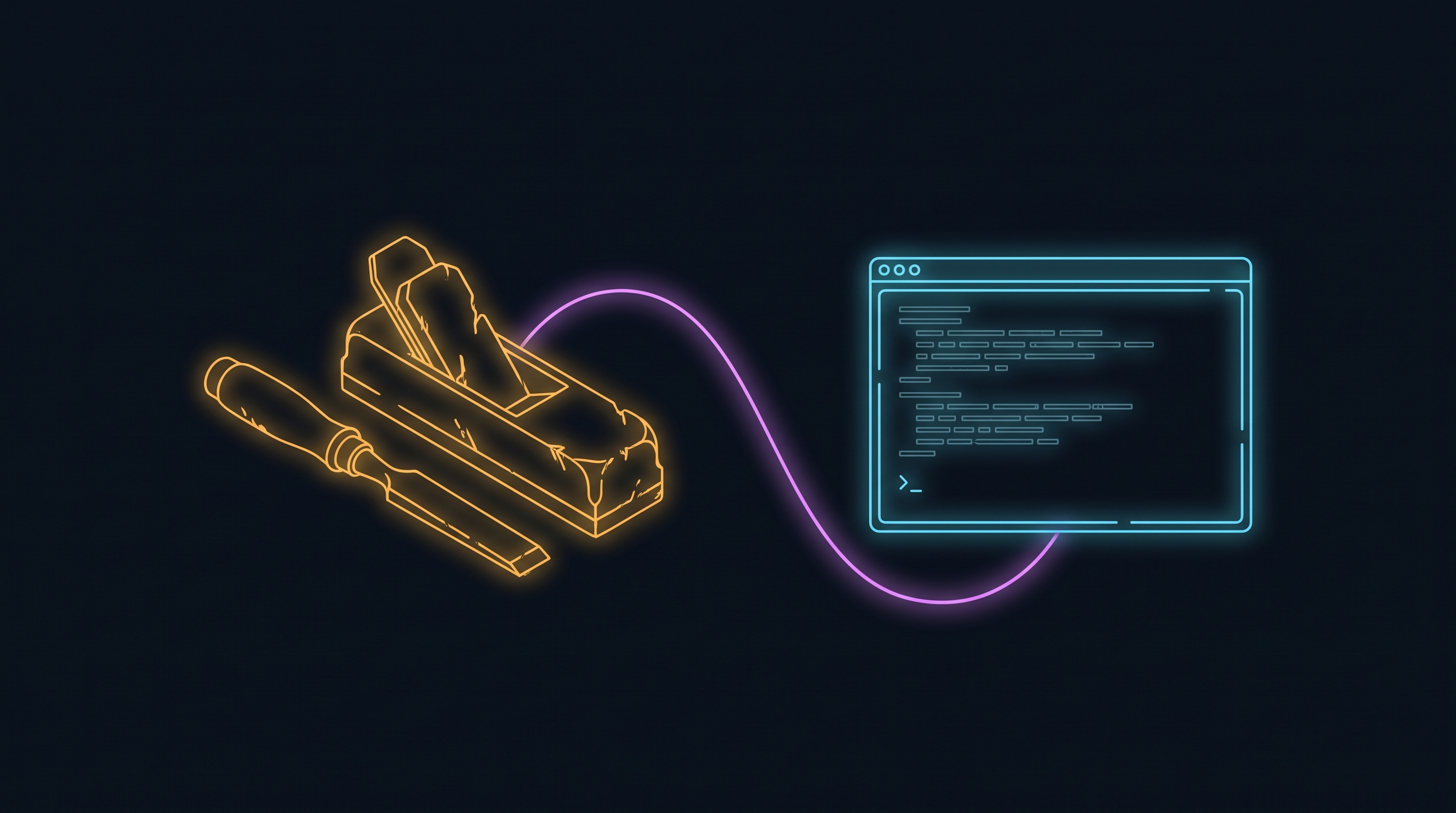
I spent more than thirty-five years getting good at something a machine now does in seconds. The grief is real, and skipping past it is dishonest. But the years weren't spent on the craft. They were spent building the eye.
Contents
I want to start with the part most people writing about AI skip, because it makes for a worse LinkedIn post: the grief is real.
If you spent fifteen or twenty years getting genuinely good at building software, and you are honest with yourself, some part of the last two years has felt like a quiet bereavement. A thing you were proud of, that took a decade of struggle to earn, is now something a machine does in seconds and does not even find hard. That is a loss. Pretending it is pure liberation is a lie we tell because the alternative feels like weakness.
It is not weakness. It is the appropriate response to watching a craft you loved become a commodity. Let me sit in it for a minute before I tell you why it turns out fine.
What the Craft Actually Was
The craft was never the typing. Anyone can learn syntax. The craft was the accumulated intuition: the sense of when an abstraction is going to hold and when it is going to buckle, the smell of a design that will rot in eighteen months, the instinct that this innocent-looking change is going to cause a 2am page three weeks from now. You earned all of that the hard way, by being wrong repeatedly and paying for it.
And there was a specific kind of pride in code that read well. Not because the machine cared, it never cared, but because another human would have to open that file someday and understand it. Writing software beautifully was an act of respect for the next person, often your future self. The whole aesthetic of good code, its clarity, its economy, its legibility, rested on one premise: that humans would read and modify it.
That premise is the thing coming undone. When the primary reader and modifier of code becomes a model, the reasons the craft existed start to wobble. It is disorienting to have spent your best years perfecting something whose foundational assumption is quietly being removed from under it. If you feel that, you are not being dramatic. You are paying attention.
The Turn
There is an old idea from philosophy called amor fati, love of fate. The Internet Encyclopedia of Philosophy describes it as Nietzsche’s formula for human greatness: to want nothing to be different, not forward, not backward, not in all eternity. Not merely to bear what happens, but to love it. To meet your actual life, including the parts you did not choose and would not have chosen, and affirm it anyway.
I keep coming back to that, because it is the difference between two responses to this moment that look similar from the outside and are opposite on the inside. One is resignation: the craft is dead, I guess I’ll adapt, said with a sigh. The other is affirmation: I loved that craft, it made me who I am, and I actually want to see what comes next, said with something closer to hunger. Same acceptance of the facts. Completely different orientation toward the future.
I know which one I want, and it happens to be the one my whole life has trained me for. I left one country with nothing and rebuilt in another, and the lesson that experience burns into you is that reinvention is not the same as loss. You do not get to keep the old world. You do get to bring yourself into the new one. Growth was always the point. Stagnation, staying a great craftsman of a craft the world has moved past, is the actual death, dressed up as loyalty.
What Survives, and Why the Years Weren’t Wasted
There is a line, usually attributed to Picasso though the attribution is almost certainly apocryphal, that you should learn the rules like a professional so you can break them like an artist. The words may not be his. The idea is exactly right, and it is the whole answer to the grief.
Those thirty-five years were not spent on the craft. They were spent, without your realizing it, building the eye. The judgment. The taste. The ability to look at a solution and know, fast and for reasons you could articulate if pressed, whether it is right or whether it is plausible garbage. You could only develop that by being the person who built things and lived with the consequences. There was no shortcut. The struggle was the tuition, and the eye is what you bought.
That eye is exactly what does not commoditize. A model can generate ten architectures in the time it takes you to read one. It cannot tell you which of the ten will survive contact with your organization, your regulators, your team at 2am, your migration two years out. That judgment is the residue of everything you built by hand, and it is worth more now, not less, because there is suddenly so much generated output that needs judging. I made the fuller argument for this in Judgment Is the New Moat. The short version: execution went to zero, and the thing your craft was secretly teaching you the whole time, discernment, is the thing left standing.
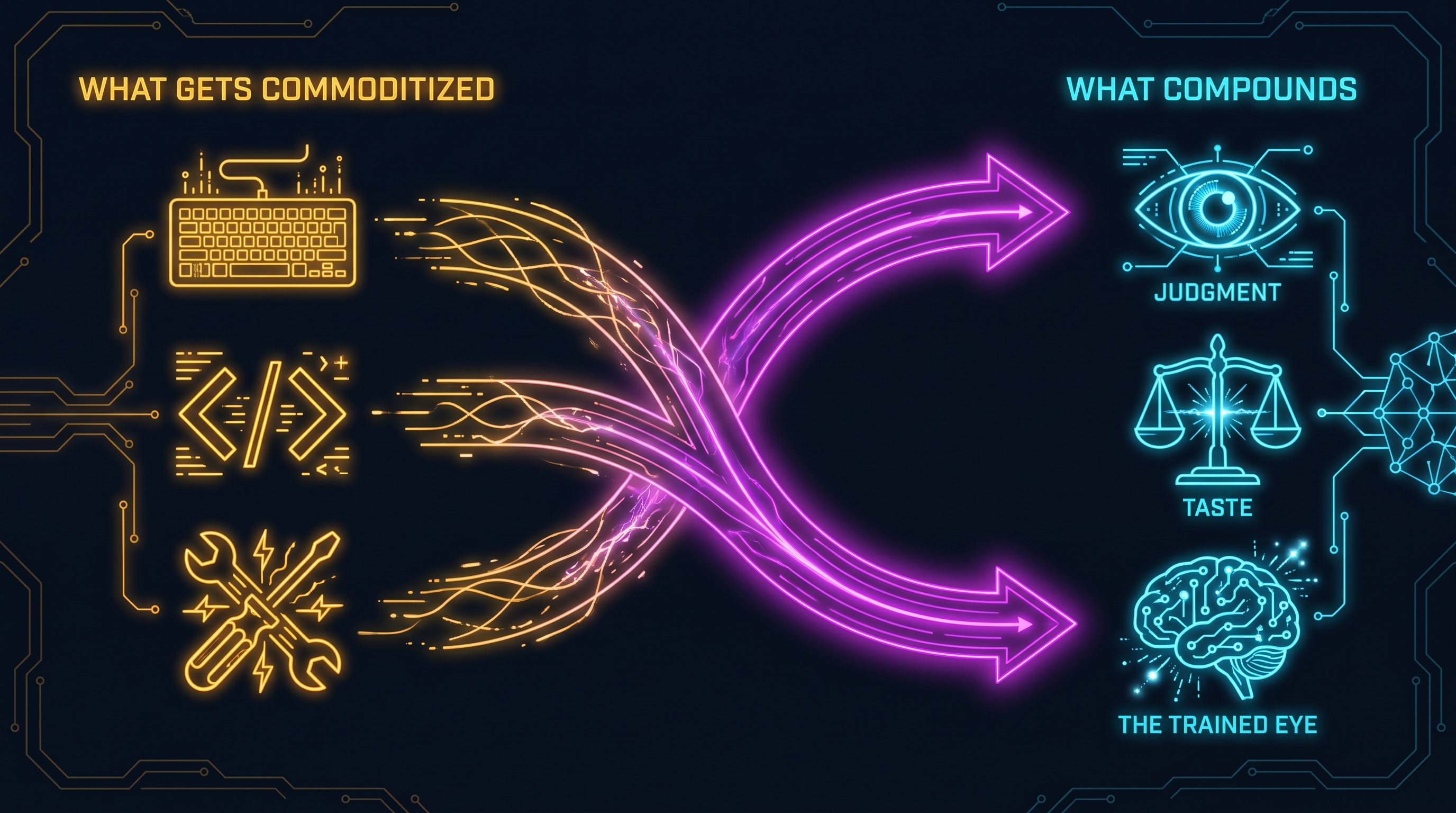
You did not master realism so you could paint photorealistic apples forever. You mastered it so that when the moment came, you had earned the right to draw the apple as a square and have it mean something. The craft was the training. The judgment is the art.
The Part I Have to Be Honest About
The comforting version of this essay ends there, and it would be dishonest to stop, because the reframe has a catch that matters.
The judgment only counts if it is real. Nostalgia is not judgment. “I used to be able to write that by hand” does not pay rent, and neither does the seniority that comes from having been around. There are people with twenty years of experience who never actually built the eye, who applied patterns by rote without understanding why the pattern existed, who mistook familiarity for taste. For them this is not a graceful transition. The machine does the rote pattern-application faster and cheaper, and there is no accumulated judgment underneath to fall back on.
So the goodbye is not automatically a promotion. It sorts people. It rewards the ones who used their craft years to genuinely learn how systems succeed and fail, and it exposes the ones who were coasting on the fact that building things used to be hard enough to hide the difference. That is uncomfortable, and it should be. The claim is not “if you are senior, you are safe.” The claim is “if you turned your craft into judgment, you are more valuable than ever, and if you didn’t, this is the moment you find out.”
Which means the work now is to keep earning it. Not to hand-code out of nostalgia, but to stay close enough to the building to keep your judgment sharp and honest, to keep being wrong occasionally and paying attention to why. The eye needs maintenance. It dims if you stop looking. That, I wrote about from a different angle in Everything Is Skill Issue.
Saying It Properly
So here is the goodbye, said the way I actually mean it.
Thank you to the craft. It was hard and it was beautiful and it taught me to see. I am not going to pretend I don’t miss the version of the work where the value was in my hands, because I do. And I am not going to stay there, guarding a skill the world has automated, calling that loyalty when it is really just fear of the next thing.
I loved my fate. I also want to see what happens next. Those turn out to be the same sentence, and learning to say both at once is, I think, the actual skill this whole era is asking us to develop. The apple is a square now. Draw it like you earned it.
If this resonated, read Judgment Is the New Moat, on why discernment is the durable advantage when execution is free, and Everything Is Skill Issue, on keeping your calibration sharp.
Find me on X @orestesgarcia or LinkedIn.
Get the next field note.
Regulated AI, architecture and platform economics — in your inbox as they publish.