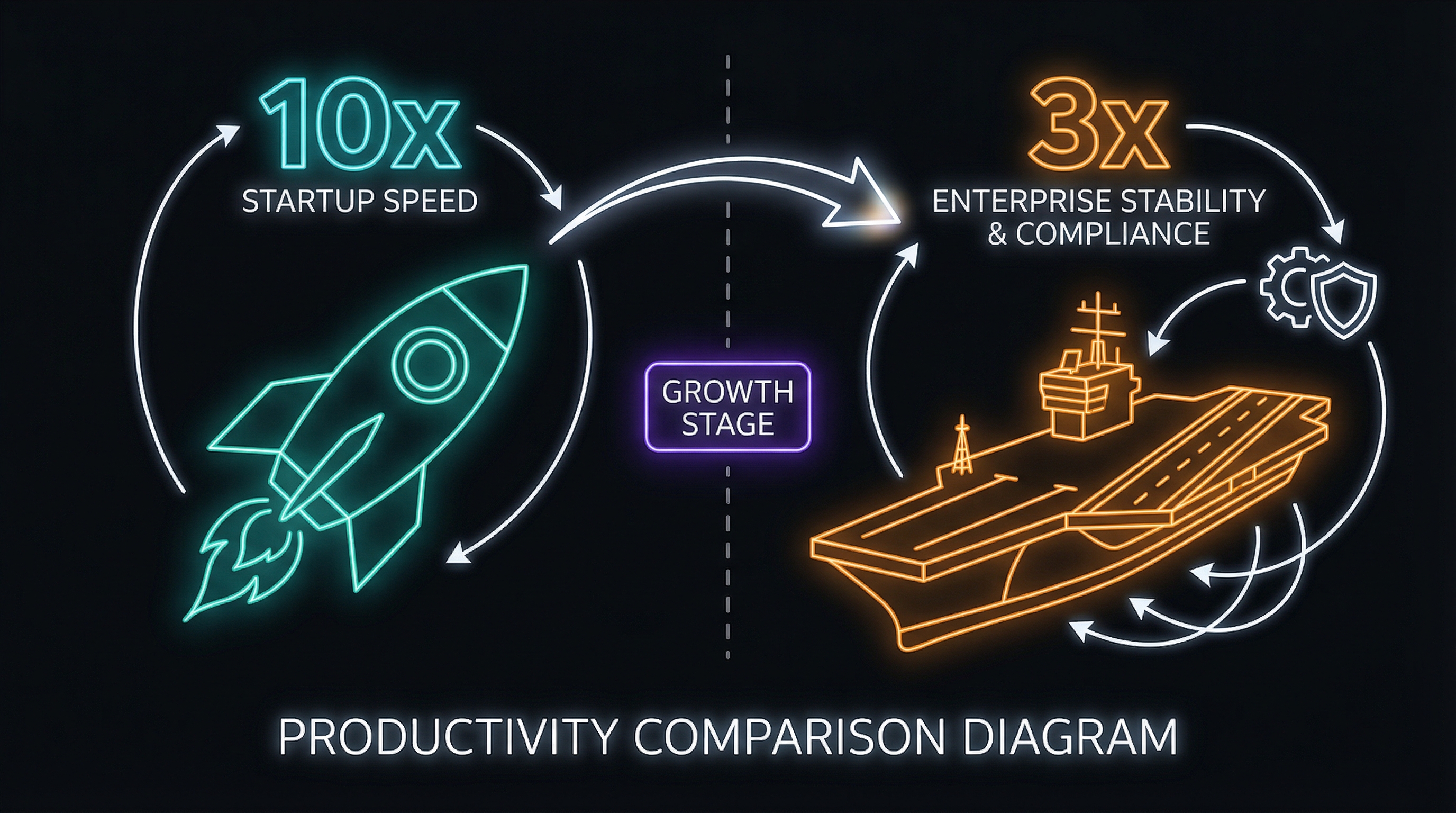
The Compliance Tax: Why Your AI Productivity Isn't 10x (And Why That's Okay)
Every AI tool promises 10x productivity. The demos are compelling: watch this developer build an entire application in 20 minutes. See this analyst process a month’s worth of data before lunch. Marvel at the future of work.
Then you try it at your actual job.
If you work in banking, healthcare, government, or any regulated industry, you’ve probably noticed a gap. The 10x promise feels more like… 3x? Maybe 2x on a good day? And you start wondering: am I doing something wrong?
You’re not. You’re paying the compliance tax.
The 10x Illusion
Let’s be honest about where those “10x” claims come from.
They come from startups where a developer can spin up a new service, push to production, and iterate based on user feedback, all in an afternoon. They come from contexts where “good enough” ships and “move fast and break things” is a feature, not a fireable offense.
They come from environments where:
- Data can live anywhere (no residency requirements)
- Retention policies are “keep everything” (no regulatory minimums or maximums)
- Audit trails are nice-to-have (not legally mandated)
- Approvals flow through Slack (not compliance committees)
In other words, they come from contexts that look nothing like enterprise regulated work.
What the Compliance Tax Actually Looks Like
The compliance tax isn’t one thing. It’s the accumulated friction of operating in an environment where mistakes have consequences beyond “we’ll fix it in the next sprint.”
Data Classification Overhead
Before an AI tool touches any data, someone needs to answer: What classification is this? Can it leave our network? Which models are approved for this sensitivity level? In a startup, you paste data into Claude and get an answer. In a bank, you first verify you’re allowed to paste that data anywhere.
Approval Chains
“Let the AI refactor this codebase” sounds great until you realize the refactored code needs security review, architecture review, and change advisory board approval. The AI might generate code in seconds, but the humans still need to validate it moves at human speed.
Audit Trail Requirements
Every AI interaction in a regulated environment should be logged, searchable, and defensible. “The AI told me to do it” is not an acceptable audit response. This means wrapper tooling, logging infrastructure, and review processes that add friction to every interaction.
Context Switching Costs
Regulated workers often can’t use the same tools across different contexts. Client A’s data requires different handling than Client B’s. Internal projects have different rules than customer-facing work. The mental overhead of context-switching between compliance requirements fragments the productivity gains.
Introducing Compliant Velocity
I’ve started using a different mental model: Compliant Velocity.
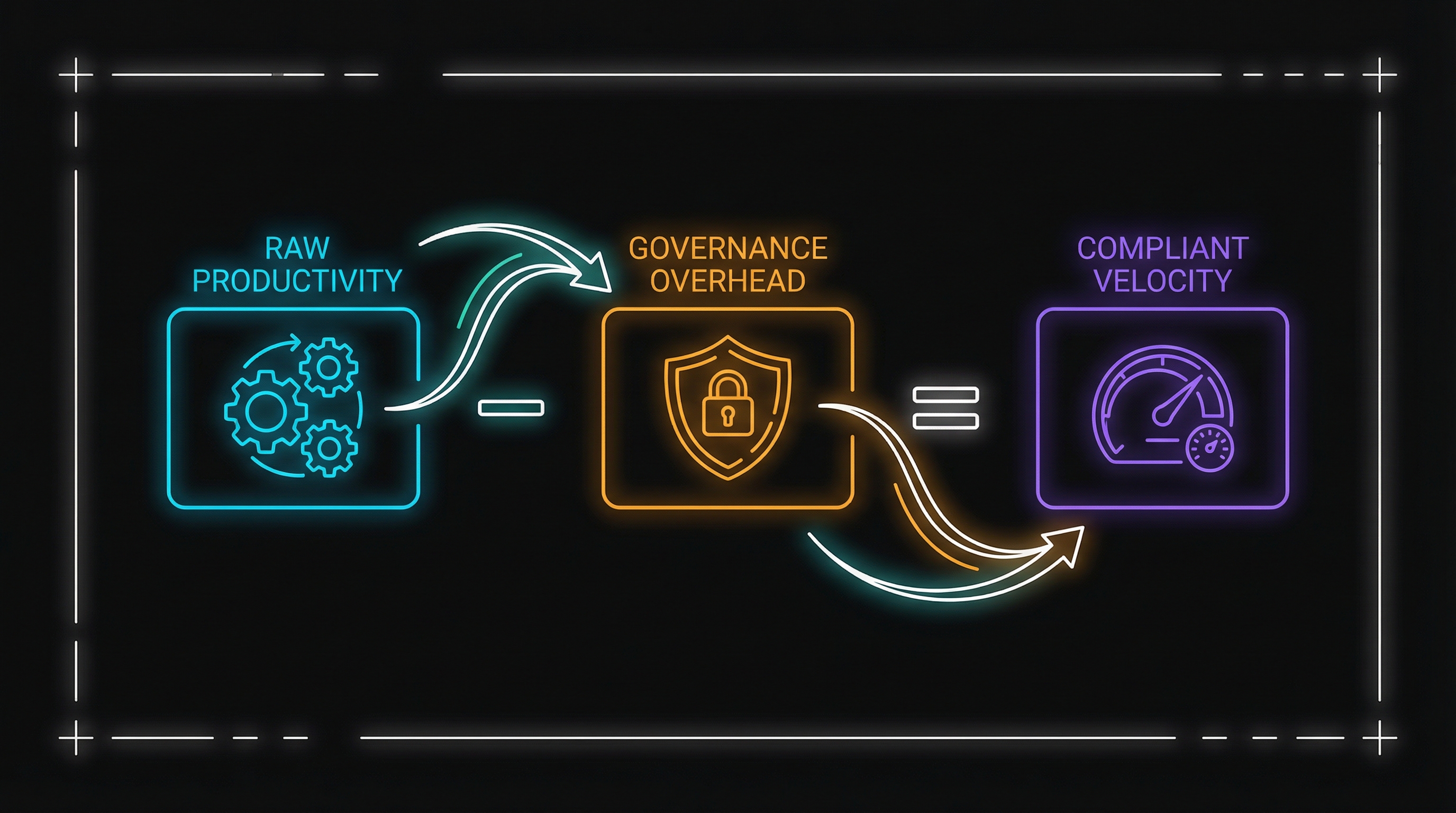
The formula is simple:
Raw Productivity - Governance Overhead = Compliant Velocity
Raw productivity is what you’d achieve in an unconstrained environment: the theoretical maximum. Governance overhead is the compliance tax: the friction imposed by operating responsibly in a regulated context. Compliant velocity is what actually ships.
The insight isn’t that governance overhead is bad (it exists for good reasons). The insight is that measuring regulated workers against raw productivity benchmarks is misleading. We’re not running the same race.
What 3x Actually Means
Here’s the thing: 3x productivity improvement is still extraordinary.
If you’re an analyst who could process 10 reports a day and now you process 30, that’s a career-changing improvement. If you’re a developer who shipped one feature per sprint and now you ship three, that’s transformational. If you’re a manager who spent 4 hours on documentation and now spends 1, that’s time back for strategic work.
The comparison to 10x makes 3x feel like failure. But 3x sustained over a year compounds into something massive. And unlike the 10x claims, 3x in a regulated environment is real, measurable, and defensible.
The Right Benchmarks
Instead of chasing unrealistic multipliers, I’ve started tracking what actually matters:
Time to Compliant Delivery: How long from idea to approved, deployed, documented feature? AI helps here, but the approval chain is the bottleneck, not the coding.
Review Cycle Compression: How many review iterations before approval? Better AI-assisted code means fewer revision cycles, even if each cycle still takes time.
Documentation Completeness: How much of the required documentation gets generated versus manually written? This is where AI excels in regulated environments: thoroughness is mandated anyway.
Context Retention: How much knowledge transfer happens between AI sessions versus starting from scratch? Tools that maintain compliance-aware context provide compounding benefits.
Reframing the Conversation
The next time someone asks why you’re not 10x more productive with AI, try this framing:
“Our environment has different constraints. We’re operating at maximum compliant velocity, which is approximately 3x improvement while maintaining full auditability, regulatory compliance, and risk management. The alternative would be faster but not sustainable.”
That’s not an excuse. It’s an accurate description of professional work in regulated industries.
What Actually Helps
Some tactical observations from running AI-assisted workflows in compliance-heavy environments:
Pre-approved Patterns: The approval bottleneck is real, but you can front-load it. Getting architectural patterns and toolchains pre-approved means AI-generated code that follows those patterns flows through faster.
Parallel Compliance Workflows: While AI generates code, start the compliance documentation in parallel. Don’t wait for the code to be “done” before beginning the approval paperwork.
Compliant Context Management: Invest in tools that understand your compliance boundaries. Claude Buddy exists precisely because generic AI tools don’t know where your boundaries are.
Measured Expectations: Set realistic goals with stakeholders. “We’ll see approximately 3x productivity improvement in compliant delivery” is achievable and impressive. “We’ll be 10x faster” sets you up for perceived failure.
The Bigger Picture
The compliance tax isn’t going away. Regulations exist because the consequences of getting it wrong are severe: for customers, for institutions, for the financial system. As AI capabilities increase, so will regulatory scrutiny of how AI is used in sensitive contexts.
The winners won’t be those who somehow avoid the compliance tax. They’ll be those who optimize for compliant velocity: building the tooling, processes, and patterns that maximize productivity within legitimate constraints.
3x isn’t failure. It’s what responsible AI adoption looks like in environments where “move fast and break things” was never an option.
And honestly? 3x compounded over years of disciplined, compliant work will outperform 10x achieved through shortcuts that eventually catch up with you.
This is the first post in a series exploring the regulated worker’s AI stack. Next: auditing your current AI toolkit for compliance gaps.
Building in a regulated environment? I’d love to hear how you’re measuring real productivity gains. Find me on X or LinkedIn.