The Infrastructure Your Life Is Missing
Jordan Peterson's seven life pillars aren't just 'more burners.' They decompose into two tiers: five application domains and two infrastructure services. The infrastructure tier is what the Four Burners theory never had.
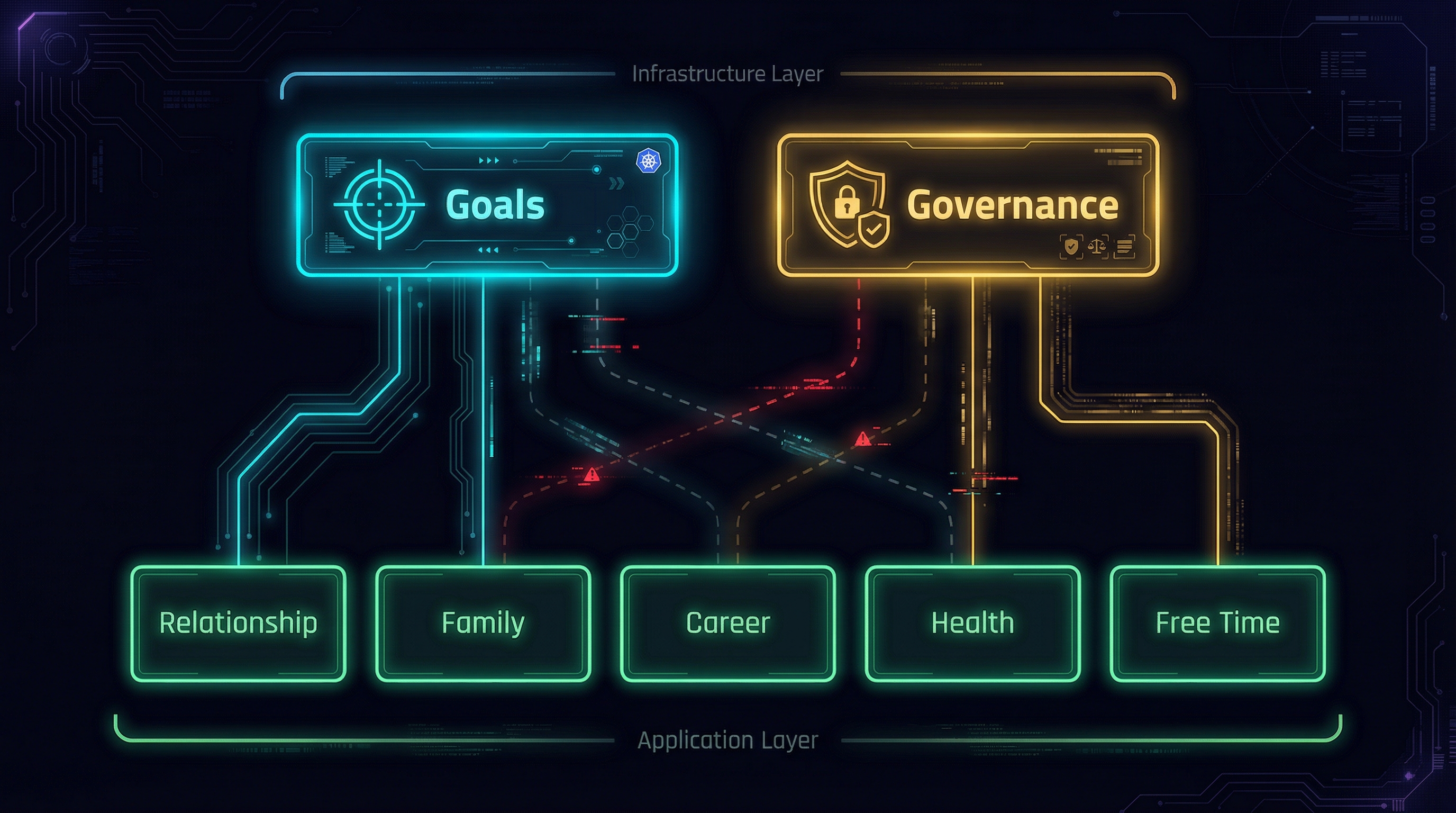
Contents
In the previous post, I argued that the Four Burners theory describes a monolith: four tightly coupled services competing for a shared resource pool, with no infrastructure layer to manage them. The “cut a burner” conclusion isn’t a law of nature. It’s the predictable failure mode of a system with bad architecture.
That raises an obvious question: what does good architecture look like?
It turns out a clinical psychologist mapped it years ago.
Peterson’s Seven Pillars
Jordan Peterson, the psychologist I wrote about in my Three Gurus series as the thinker who made meaning mandatory, outlines seven core areas that require attention for psychological well-being, meaning, and stability.
- An intimate relationship: your partnership, your marriage, the person you build a life with
- Family: your kids, your parents, your siblings, the web of obligation and love that extends beyond your partner
- Career or job: the work that structures your days and gives you economic agency
- Physical and mental health: the body and mind that everything else runs on
- Prudent use of time outside work: how you spend discretionary hours, hobbies, community, reading, rest, friendships
- Regulation of temptation: drugs, alcohol, compulsive behaviors, the things that short-circuit every other domain when left ungoverned
- Constructive, meaningful goals: a direction, a purpose, something you’re building toward that gives the other six domains coherence
At first glance, this looks like “more burners.” Seven instead of four. More things to juggle. Harder to balance.
Look again. It’s not more burners. It’s a different architecture entirely.
What Peterson Decomposes
The Four Burners theory takes four coarse-grained buckets and asks you to allocate a finite resource across them. Peterson’s framework does something structurally different: it separates things that the Four Burners wrongly couples.
“Family” becomes two independent services.
The Four Burners puts your marriage and your kids on the same burner. Peterson separates them: intimate relationship and family. This matters because they have completely different failure modes, different maintenance patterns, and different drift signatures. A father who’s great with his kids but neglecting his marriage looks “fine” on the Four Burners model: the Family burner is on. Peterson’s framework catches what the coarser model misses.
In systems terms: the Four Burners created a coupled service where two independent concerns share a single scaling dimension. When you decompose, each concern gets its own monitoring, its own health checks, its own remediation path. You can invest in your kids and still notice that your relationship needs attention, instead of the coarser model’s false reassurance that “Family” is handled.
“Health” becomes application plus governance.
The Four Burners puts physical fitness and temptation regulation on the same burner. Peterson separates physical/mental health from regulation of temptation. The first is a positive investment: exercise, sleep, nutrition, therapy. The second is a governance mechanism: guardrails that prevent destructive behaviors from cascading into every other domain.
You can be physically fit and still have zero guardrails around alcohol, compulsive spending, or doom-scrolling at 2am. The Four Burners model would show Health as “on.” Peterson’s model catches the governance gap.
This maps directly to something I see in enterprise architecture. Application logic and security policy are separate concerns. You can have a perfectly functional billing service with zero access controls. It works, until it doesn’t, catastrophically. Separating the application tier from the governance tier is how you prevent the catastrophe.
“Friends” becomes discretionary time architecture.
The Four Burners reduces an entire domain (how you spend the hours that aren’t claimed by work, family, or sleep) down to “friends.” Peterson’s prudent use of time outside work is broader: reading, hobbies, community, rest, friendships, creative pursuits. It’s the architecture of discretionary time, not just one relationship category within it.
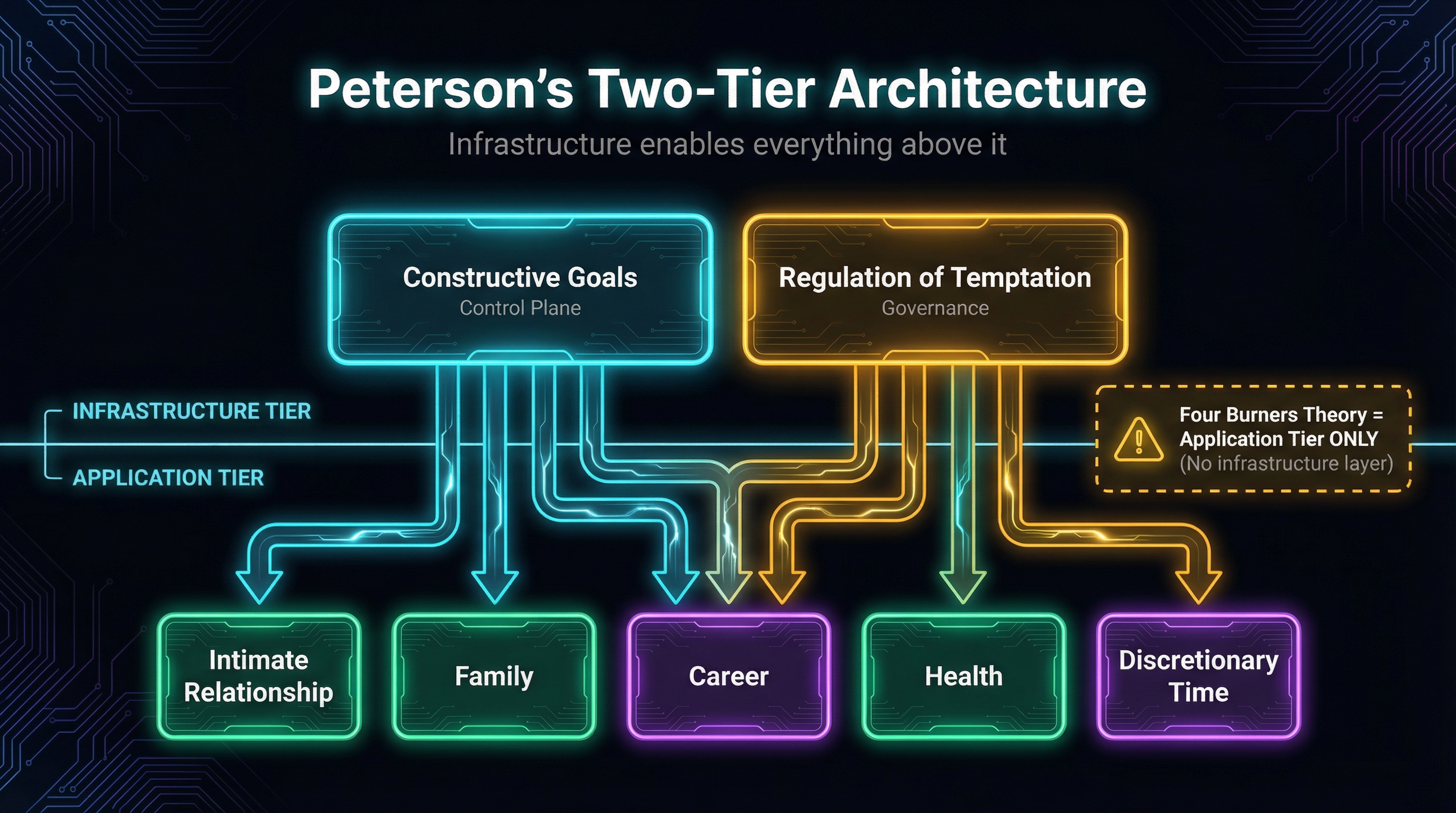
The Two Tiers
Here’s the structural insight that changes everything.
Peterson’s seven pillars don’t live on the same tier. They decompose into two distinct layers, and the difference between the layers is exactly what the Four Burners theory is missing.
Application Tier, the five domains you actively invest in:
- Intimate relationship
- Family
- Career/job
- Physical and mental health
- Prudent use of time outside work
These are the life domains that consume time, attention, and energy. They’re the services that do the work. They’re what the Four Burners theory tried to capture, but at too coarse a granularity, with too much coupling between independent concerns.
Infrastructure Tier, the two meta-functions that govern the application tier:
- Regulation of temptation → governance, guardrails, circuit breakers
- Constructive, meaningful goals → control plane, orchestration, desired state
These two pillars are not life domains you “invest in” the way you invest in family or career. They’re infrastructure. They don’t compete with the application tier for resources. They manage the application tier, directing where resources go and preventing cascade failures when things break.
The Four Burners theory has no infrastructure tier. It’s all application layer. Four services competing for the same gas line with no thermostat, no circuit breakers, no control plane. Of course you have to cut a burner: the system has no mechanism for intelligent multi-domain operation.
Peterson’s framework, whether he intended it this way or not, is the microservices refactor.
The Control Plane: Meaningful Goals
In Kubernetes, the control plane is what makes everything work. It maintains the desired state of the cluster, schedules workloads across nodes, monitors health, and reconciles drift. Without the control plane, you have a collection of containers with no coordination: each competing for resources, crashing into each other, with nobody watching.
Peterson’s constructive, meaningful goals pillar is the control plane for your life.
Without it, you’re adjusting gas valves based on guilt and vibes. “I feel like I should call my parents more.” “I really ought to exercise.” “My career feels stuck.” These aren’t strategies. They’re unprocessed signals with no framework for prioritization.
Meaningful goals provide the desired state. They’re the equivalent of your Terraform HCL or your Kubernetes manifests: the declaration of what “healthy” looks like across all domains. With that declaration in place, every decision becomes a reconciliation question: does this action move actual state closer to desired state, or further from it?
This is exactly what I described in The Reconciliation Loop: define ideal state, measure actual state, close the gap, repeat. Peterson’s goals pillar is the ideal state declaration. Without it, there’s nothing to reconcile against. You’re running terraform plan with no HCL files: the engine has nothing to compare reality to.
The Governance Layer: Regulation of Temptation
If meaningful goals are the control plane, regulation of temptation is the governance layer: the WAF, the security policies, the guardrails that prevent cascade failures.
Every enterprise architect knows: you can build the most elegant application architecture in the world, and one uncontrolled dependency will take it down. An unmonitored third-party API. An unvalidated input field. A privilege escalation path nobody thought to close.
Temptation, in Peterson’s framework, is the uncontrolled dependency. The drink that turns into six. The “quick scroll” that burns two hours. The compulsive behavior that starts in one domain and bleeds into everything. These aren’t application-tier problems. They’re governance failures, and they need governance-tier solutions.
I wrote about this same pattern in Architecture Without Architects: you don’t need a 40-person Enterprise Architecture team. You need five well-maintained artifacts. The same 80/20 principle applies here. You don’t need to micro-manage seven life areas. You need five application domains with reasonable boundaries and two pieces of infrastructure (goals and guardrails) that make the five manageable.
The Three Gurus Mapped
In the convergence post, I wrote that Vivekananda, Peterson, and Hormozi independently arrived at identical conclusions about responsibility, sacrifice, and action across 160 years. Now I can map that convergence onto the architecture.
Peterson is the architect. He designed the system: seven pillars decomposed into two tiers, with the infrastructure layer that makes multi-domain operation possible. He gave you the blueprints: meaningful goals as the control plane, temptation regulation as governance. He tells you what to aim at and what guardrails to build.
Hormozi is the engineer. He builds the execution machine. His Value Equation, his approach to leverage, his systems for scaling output beyond personal time: these are the implementation patterns for closing the gap between desired state and actual state. Peterson defines the architecture. Hormozi builds the CI/CD pipeline.
Vivekananda is the foundation. “Take the whole responsibility on your own shoulders, and know that you are the creator of your own destiny.” In infrastructure terms: you are the executor in your own reconciliation loop. No amount of architecture helps if the executor refuses to run. Vivekananda’s radical personal responsibility is the commitment to actually execute terraform apply on your own life, to close the gaps, not just document them.
Three gurus. Three architectural roles. Same system.
Five Artifacts, Not Fifty
The practical takeaway is the same one I’ve been pushing in enterprise architecture: you don’t need comprehensive perfection. You need the right minimal set.
In Architecture Without Architects, I argued that five well-maintained artifacts get you 80% of what regulators actually ask for, without a dedicated EA team, without full TOGAF implementation. Architecture Decision Records. Application portfolio. Tech radar. Architecture contracts. Data flow inventory.
The same principle applies here. You don’t need to obsessively track seven life domains. You need:
- Enough decomposition to see what’s actually happening: your marriage and your kids as separate health checks, your fitness and your guardrails as separate concerns
- A control plane: constructive goals that give every decision a reference point
- Governance: hard boundaries that prevent one domain’s failures from cascading
- A reconciliation loop: periodic comparison of desired state to actual state, with action items to close the gaps
That’s the infrastructure the Four Burners theory never had. It’s what Peterson mapped, perhaps without the systems vocabulary, but with the same structural intuition.
And it raises one more question: who runs the reconciliation loop?
In infrastructure, it’s the Terraform provider. The Kubernetes controller. The GitOps operator. Deterministic, scoped, tireless.
In your life, it’s been you. Alone. With willpower and a to-do list.
For the first time in history, that might not be the only option.
Peterson gave you the architecture. Your gurus gave you the philosophy. But architecture without an executor is a blueprint. The next post explores what happens when your personal AI agent becomes the executor: not more gas for the stove, but the thermostat that reads the temperature honestly.
This is Post 2 of 3 in Life as Infrastructure. Start with Post 1: The Four Burners Are a Monolith.
Does the two-tier framing resonate? I’d like to hear about it. Find me on X or LinkedIn.
Get the next field note.
Regulated AI, architecture and platform economics — in your inbox as they publish.