The Psychologist Who Made Meaning Mandatory
Beneath the culture war noise is a Jungian clinician asking one question: if life is suffering, how do you make it meaningful enough to bear?

Contents
Clean your room. Tell the truth. Stand up straight.
Not parenting advice. Philosophical scaffolding from a clinician who spent 20 years treating suicidal patients before YouTube made him famous.
In the previous post, I wrote about Swami Vivekananda, a Victorian monk who made weakness the only sin and strength the spiritual path. Jordan Peterson picks up exactly where Vivekananda left off, but translates the message through an entirely different lens. Where Vivekananda spoke of divine nature and Vedantic truth, Peterson speaks of archetypes, shadow integration, and the psychological necessity of meaning.
Same core message. Different century. Different language. Identical conclusion: you are responsible.
He’s my life guru. Here’s why.
The 2016 Moment
September 2016. A psychology professor at the University of Toronto releases a series of YouTube videos criticizing Bill C-16, a Canadian bill that proposed adding gender identity and expression to the list of prohibited grounds of discrimination.
The videos hit 400,000 views within a month.
Peterson argued that the bill could compel speech (forcing the use of specific gender pronouns) and that compelled speech was categorically different from prohibited speech. The response was volcanic. Protests. Media coverage. Senate hearings. Peterson became the most divisive academic in the English-speaking world overnight.
And that’s the problem. Because the culture war noise (the pronoun debates, the political polarization, the endless Twitter fights) buried the actual work underneath.
The actual work is this: Jordan Peterson is a Jungian clinical psychologist who spent two decades in private practice treating depression, anxiety, personality disorders, and suicidal ideation. He maintained roughly 20 clients per week for most of his career. He was one of only three professors at the University of Toronto rated “life-changing” in the student handbook. He taught at Harvard before that.
His contribution isn’t political. It’s a clinical answer to an existential question: if life is suffering (genuinely, unavoidably, baked-into-the-fabric-of-existence suffering) how do you construct enough meaning to bear it?
That’s what 12 Rules for Life is actually about. Not the culture war. Not pronouns. Not even the rules themselves. The question underneath: how do you live without being crushed or corrupted by the weight of existence?
Life Is Suffering, Now What?
Peterson’s framework starts with a premise borrowed from both Buddhism and Christianity: life is suffering. Not occasionally. Not for unlucky people. Fundamentally. Loss, death, betrayal, illness, failure: these aren’t bugs in the system. They’re the system.
Most self-help begins with “how to be happy.” Peterson begins with “you won’t be happy, not consistently, not sustainably, and that’s okay, because happiness isn’t the point.”
The point is meaning.
“The purpose of life, as far as I can tell… is to find a mode of being that’s so meaningful that the fact that life is suffering is no longer relevant.”
This isn’t nihilism. It’s the opposite. It’s saying: suffering is real and unavoidable, so the response can’t be to avoid it. The response has to be building something (a life, a purpose, a set of responsibilities) that makes the suffering worth it.
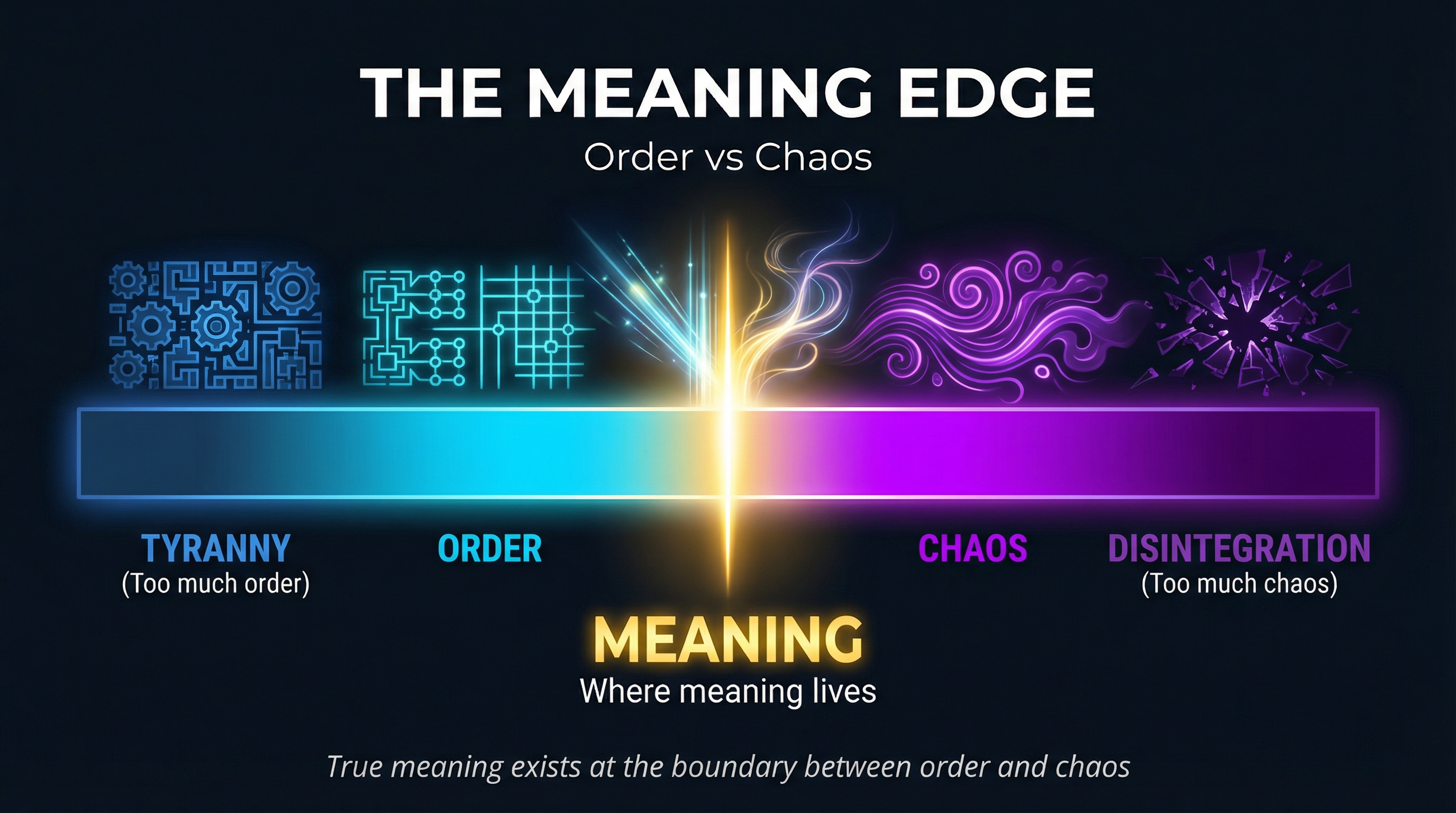
Peterson draws on Carl Jung’s framework to map this terrain. Two primordial forces: Order (the known, the structured, the familiar) and Chaos (the unknown, the novel, the threatening). Too much order becomes tyranny and stagnation. Too much chaos becomes anxiety and disintegration. Meaning exists at the boundary: that narrow edge where you’re extending into the unknown without losing your footing in the known.
The Shadow (Jung’s term for the dark, rejected, unconscious aspects of personality) isn’t something to eliminate. It’s something to integrate. This is where Peterson’s most famous line comes from:
“A harmless man is not a good man. A good man is a very dangerous man who has that under voluntary control.”
Read that next to Vivekananda: “The greatest sin is to think yourself weak.”
Different vocabulary. Identical conclusion. Virtue requires capacity. A person who is “nice” because they lack the capacity for aggression isn’t virtuous; they’re simply harmless. True goodness requires the strength to be otherwise. The monk and the psychologist agree: build the strength first, then choose where to direct it.
Radical Personal Responsibility
Rule 6 from 12 Rules for Life: “Set your house in perfect order before you criticize the world.”
This sounds conservative. It is. But not politically conservative; philosophically conservative. It’s a hierarchy of competence: before you try to fix society, can you fix your own life? Before you protest injustice at scale, have you addressed the injustice in your own behavior?
“If you can’t even clean up your own room, who the hell are you to give advice to the world?”
Peterson isn’t saying large-scale problems don’t exist. He’s saying the order of operations matters. You can’t build stable structures on an unstable foundation. Personal responsibility isn’t the opposite of social responsibility; it’s the prerequisite.
This is the same teaching Vivekananda delivered 120 years earlier, in different language:
“Take the whole responsibility on your own shoulders, and know that you are the creator of your own destiny.”
Where Vivekananda grounded it in karma (cause and effect across lifetimes) Peterson grounds it in clinical observation. Twenty years of treating people who felt powerless, and watching them transform when they took even small steps toward taking responsibility for their own situation.
Not victim-blaming. Agency reclamation. There’s a critical difference. Blaming victims says “your suffering is your fault.” Reclaiming agency says “regardless of whose fault it is, you’re the only one who can do something about it.” One is cruelty. The other is empowerment. Peterson walks this line deliberately, and not everyone thinks he walks it well. More on that later.
Meaning Through Sacrifice
Peterson’s second major contribution: the mechanics of meaning.
“It’s in responsibility that most people find the meaning that sustains them through life. It’s not in happiness. It’s not in impulsive pleasure.”
This is counterintuitive. We’re wired to seek pleasure and avoid pain. Every advertising campaign, every social media algorithm, every consumer product is optimized to deliver immediate gratification. And Peterson says: that’s exactly what makes life feel empty.
Meaning comes from voluntarily accepted burden. From choosing something hard, something that matters, something that will require sacrifice, and shouldering it anyway. Not because it feels good, but because it’s worth doing.
The mechanism is sacrifice. You give up something of value now to create something of greater value later. Delayed gratification at the deepest level: not just saving money instead of spending it, but accepting suffering and limitation now because the alternative (avoiding responsibility) is worse in the long run.
“To stand up straight with your shoulders back is to accept the terrible responsibility of life, with eyes wide open.”
Rule 1. The very first rule. Not “be happy” or “think positive.” Stand up straight (literally and metaphorically accept the weight of existence) and do it with your eyes open to how hard it’s going to be.
Peterson frames this through mythology: the hero’s journey. Every significant myth across every culture tells the same story. A person voluntarily confronts the unknown, suffers, transforms, and returns with something valuable. The suffering isn’t incidental to the story; it is the story. Without it, there’s no transformation and nothing to bring back.
Why He’s My Life Guru
My entry point to Peterson wasn’t the culture war. It wasn’t the pronoun debate. It was this:
“You’re not everything you could be, and you know it.”
That sentence hit like a diagnosis. Because he’s right. I knew it. I think most people know it. There’s a gap between who you are and who you could be, and that gap generates a low-grade anxiety that no amount of comfort or entertainment fully resolves.
Peterson’s reframe changed my orientation. I’d been living in an “avoid suffering” framework: minimize discomfort, optimize for ease, reduce friction wherever possible. Reasonable strategy. Terrible for meaning.
The shift was from “how do I avoid suffering?” to “what suffering is worth choosing?” From “how do I stay comfortable?” to “what burden is meaningful enough to carry?”
That sounds abstract until you apply it. For me, it showed up in a pattern I’d been running for years without naming it: choosing the comfortable path, the one with the least resistance, the one that optimized for “not failing” instead of “actually mattering.” Peterson didn’t tell me what to choose. He gave me the framework for how to choose: pick the thing that’s meaningful, not the thing that’s easy. And once you see that framework, you can’t unsee it. Every decision becomes a referendum on whether you’re moving toward meaning or away from discomfort. Those are not the same direction.
The other thing Peterson gave me was the shadow integration concept. Not the pop-psychology version (“embrace your dark side”) but the clinical version: the parts of yourself you’ve rejected don’t disappear. They operate unconsciously and destructively until you face them, integrate them, and put them under voluntary control.
I was good at being direct. Too good. Bluntness was my default setting, and I wore it like a badge: “at least I’m honest.” But unfiltered directness isn’t honesty. Sometimes it’s laziness. Sometimes it’s cruelty wearing a truth mask. Integrating that “shadow” (developing the capacity for patience, for restraint, for knowing when silence serves better than a well-aimed truth) didn’t make me softer. It made me more precise. Directness became a tool I chose instead of a reflex I couldn’t control. Which, according to both Peterson and Vivekananda, is the actual definition of strength.
The Fighter and the Clinician
I’d be dishonest if I didn’t address this.
Most people who have an opinion about Peterson formed it from his public fights, not his clinical work. The C-16 battle. The political commentary. The willingness to say exactly what he thinks on every platform available, regardless of the professional cost. For a lot of people, that’s all Peterson is: the guy who fights on the internet.
I see it differently. Peterson’s willingness to fight publicly is consistent with his own philosophy. “Tell the truth, or at least don’t lie” isn’t a comfortable rule when the truth costs you your career, your health, and half your reputation. He paid a price most academics wouldn’t even consider risking. You can disagree with every position he’s taken and still respect that he stood for his convictions when it would have been infinitely easier to stay quiet and keep collecting tenure checks.
The people who only see the fights and miss the depth underneath? That’s their loss. This isn’t just a clinician; it’s one of the most prolific public intellectuals of the last decade. Twenty years of treating patients on the edge. Maps of Meaning, a book and university course that spent decades mapping how mythology and narrative structure human psychology. A 15-part Genesis lecture series dissecting Biblical stories through a Jungian lens. A 16-part Exodus series with six scholars exploring freedom, tyranny, and transcendence. Hundreds of podcast episodes going deep on psychology, philosophy, and meaning. And most recently, Peterson Academy, an online university with 80+ courses taught by professors from Harvard, Oxford, and Cambridge, built on the premise that serious education shouldn’t require six figures of debt. It’s all there for anyone willing to look past the noise.
This is an honest admission: following my gurus doesn’t mean endorsing every position they take. But I’d rather follow a man who fights for what he believes (clumsily, publicly, at great personal cost) than one who trims his convictions to protect his comfort.
The test I still apply: does this teaching hold up when stripped of the personality attached to it? “Pursue what is meaningful, not what is expedient.” “Tell the truth, or at least don’t lie.” “Compare yourself to who you were yesterday, not to who someone else is today.”
Yes. Those hold up. And the man who said them put his life on the line for the second one.
What He Represents
Peterson represents something specific in the trajectory of this series: the return of meaning to a culture that had largely abandoned it.
Vivekananda addressed strength in a world of spiritual passivity. Peterson addresses meaning in a world of nihilistic comfort. The connection is direct: strength without purpose is aggression, and purpose without strength is fantasy. You need both.
12 Rules for Life sold over 10 million copies. That’s not marketing; that’s a civilization-scale hunger for someone to say: your life matters, but only if you treat it like it matters. Only if you take responsibility, tell the truth, accept the burden, and aim at something worth the pain.
Peterson tells you what to aim at: meaning, through responsibility and sacrifice. But he doesn’t tell you how to build the systems that execute on it. He diagnoses the illness and prescribes the treatment philosophy. The operational manual? That requires someone else.
Which is exactly where my third guru enters the picture.
Peterson tells you what to aim at. Hormozi tells you how to build the machine. Next: the entrepreneur who treats discipline like a religion.
This is Post 2 of 4 in My Three Gurus.
Agree or disagree on separating the clinician from the pundit? Find me on X or LinkedIn.
Get the next field note.
Regulated AI, architecture and platform economics — in your inbox as they publish.