Series
Life as Infrastructure
The Four Burners theory says you must sacrifice parts of your life to succeed. But what if the real problem isn't competing demands, but bad architecture? A three-part series applying systems thinking to life balance.
3 parts · 31 min total · Mar 2026
After my Three Gurus series, readers started reaching out with a question I didn’t expect: how do you actually apply this stuff? Not the philosophy, the systems thinking underneath it.
I’m not a philosopher, psychologist, or business guru. I’m an enterprise architect who builds reconciliation loops and compliance infrastructure for a living. But I kept noticing the same patterns showing up in life management that I see in distributed systems: coupling failures, drift detection, missing control planes.
The answer I keep coming back to: start by defining your goal (what does “running well” actually look like for your life?) then reverse engineer the infrastructure to get there. This three-part series applies that approach to the oldest productivity question: how do you keep all the important parts of your life running without burning out?
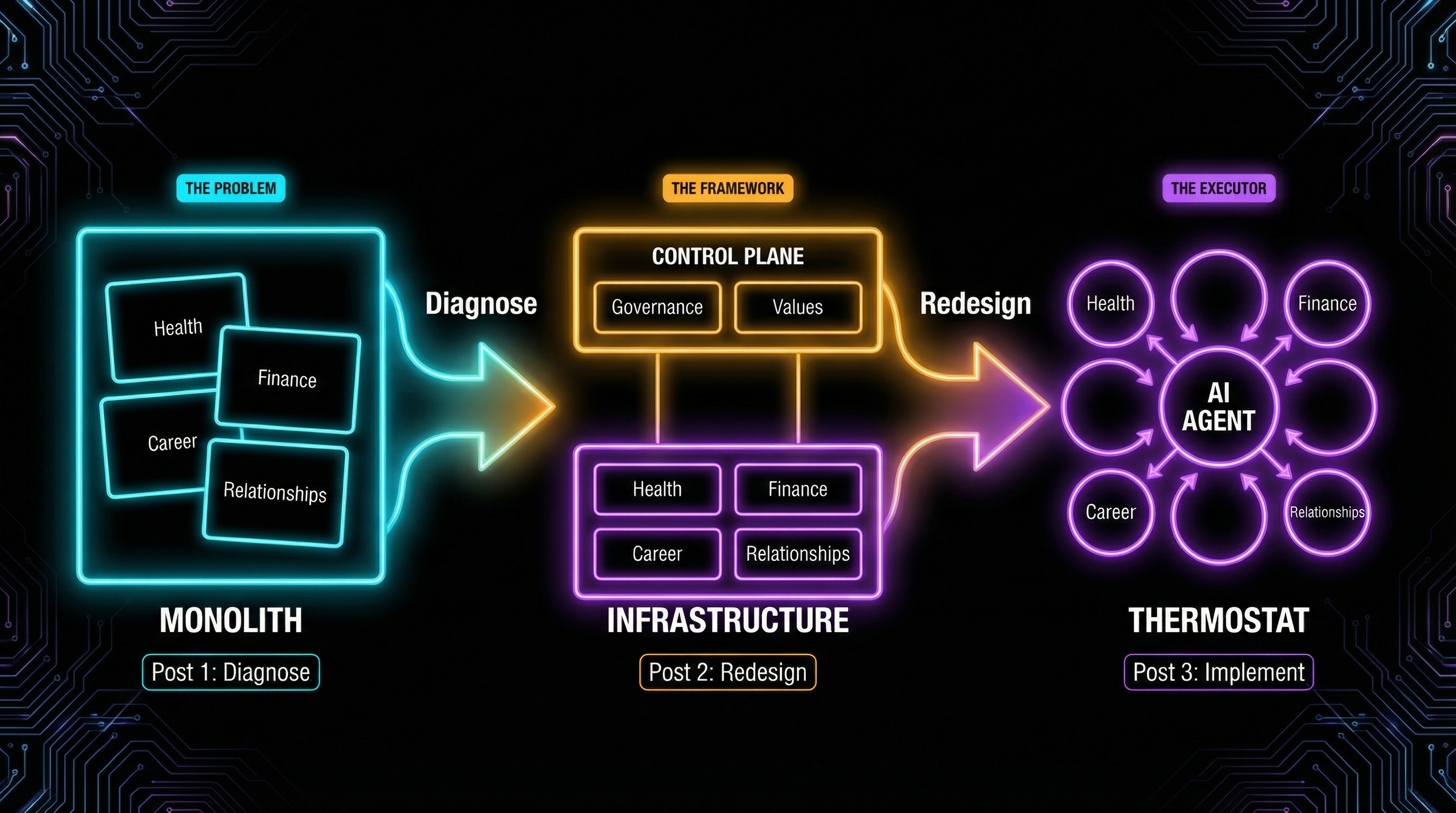
- Part 01 10 min The Four Burners Are a Monolith The Four Burners theory says you must sacrifice parts of your life to succeed. But the 'cut a burner' conclusion isn't a law of nature; it's the predictable failure mode of a badly architected system.
- Part 02 11 min The Infrastructure Your Life Is Missing Jordan Peterson's seven life pillars aren't just 'more burners.' They decompose into two tiers: five application domains and two infrastructure services. The infrastructure tier is what the Four Burners theory never had.
- Part 03 10 min Your Agent Is Not More Gas. It's the Thermostat. The discourse says AI adds cognitive capacity to the Four Burners stove. That's wrong. AI's real value isn't more gas. It's the feedback loop that detects drift and nudges you back toward desired state.
Get the next field note.
Regulated AI, architecture and platform economics — in your inbox as they publish.