Three Men, 160 Years, One Message
A Victorian monk, a Jungian psychologist, and a modern entrepreneur converge on the same truth: radical responsibility, meaningful sacrifice, strength through action.

Contents
Three men walk into a bar.
One is a 19th-century celibate monk who died at 39. One is a 20th-century clinical psychologist who became the most controversial academic on the internet. One is a 21st-century private equity operator who went from $1,036 in his bank account to a $100M+ net worth by 32.
They shouldn’t agree on anything. Different centuries, different countries, different domains, different audiences. A Hindu monk, a Canadian professor, a first-generation Iranian-American entrepreneur. Spirituality, psychology, business. Vedanta, Jung, the Value Equation.
And yet they converge, on the same truth, through radically different languages, across 160 years.
If you haven’t read the individual posts, start with Vivekananda, then Peterson, then Hormozi. What follows is the synthesis: where the threads merge and what the convergence means.
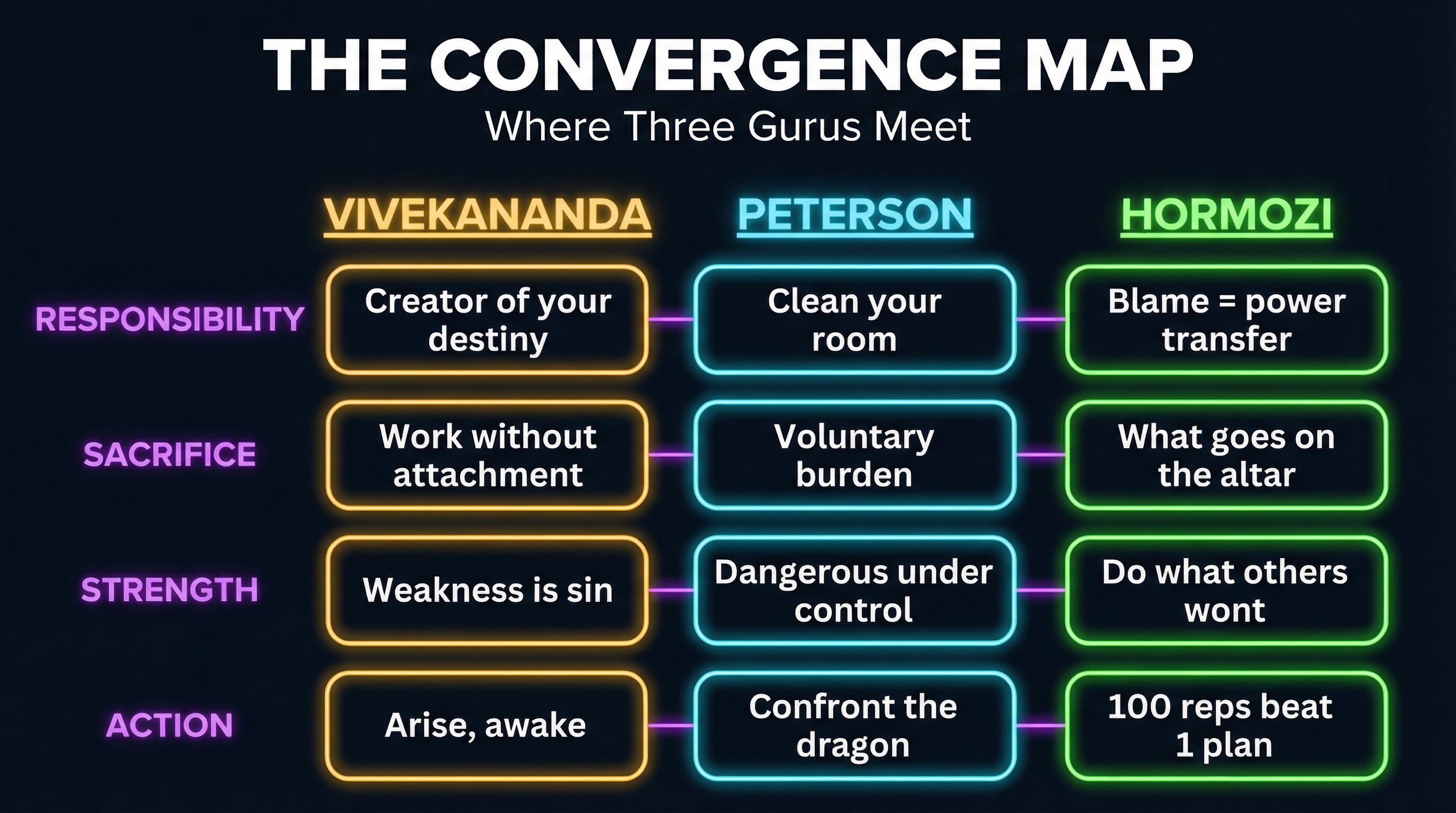
The Impossible Convergence
Let me state the thesis plainly.
Three independent observers, separated by over a century, operating in completely different domains, influenced by completely different traditions, arrived at identical conclusions about what makes human beings effective, fulfilled, and strong.
This isn’t coincidence. When one person says something, it’s an opinion. When two people from different contexts say the same thing, it’s interesting. When three people across 160 years, from three different continents and three different fields, independently converge on the same principles, you’ve found something load-bearing about the human condition.
These aren’t cultural artifacts. They’re structural truths.
Here’s where they meet.
Convergence: Radical Personal Responsibility
The most striking point of convergence. All three men, without referencing each other, without operating in the same intellectual tradition, put personal responsibility at the absolute center of their philosophy.
Vivekananda (1890s): “Stand up, be bold, be strong. Take the whole responsibility on your own shoulders, and know that you are the creator of your own destiny.”
Peterson (2010s): “If you can’t even clean up your own room, who the hell are you to give advice to the world?”
Hormozi (2020s): “Wherever you point the finger of blame, power follows. So until your finger of blame points at your chest rather than someone else’s, you stay a victim of your own making.”
Three different entry points to the same conclusion: blaming external circumstances is psychologically comfortable and strategically disempowering. Taking responsibility, even for things that aren’t your “fault,” is the only path to agency over your own life.
Vivekananda grounds this in karma: you are the creator of your own destiny across lifetimes. Peterson grounds it in clinical observation: people transform when they take responsibility, even in small ways, for their own situation. Hormozi grounds it in business: blame transfers power to whatever you’re blaming. Want the power back? Take the blame.
Different roots. Same flower.
For me, this convergence resolved what felt like separate philosophies into one operating principle. I don’t need to choose between the spiritual, psychological, and practical framings. They’re all saying: agency starts when victimhood ends. Not because victimhood isn’t real (people are genuinely victimized) but because staying in a victim identity, regardless of how justified, cedes control to forces outside yourself.
Convergence: Meaningful Sacrifice
All three men recognize that sacrifice isn’t an unfortunate cost of success. It’s the mechanism.
Vivekananda: “Self-sacrifice, not self-assertion, is the law of the highest universe.” His Karma Yoga teaches work without attachment to results: performing excellent work as an offering, with no expectation of personal reward.
Peterson: “Sacrifices are necessary to improve the future, and larger sacrifices can be better.” His mythological framework: every culture’s deepest stories encode the principle that you must give up something valuable now to create something more valuable later.
Hormozi: “Determine what you are willing to sacrifice on the altar of your goals. Then sacrifice them.” His operational framework: the price always gets paid, either upfront through discipline or later through regret.
The convergence: there is no shortcut. Comfort is not the goal. The path to anything valuable runs through voluntary discomfort.
Vivekananda calls this spiritual renunciation. Peterson calls this the voluntary acceptance of burden. Hormozi calls this the willingness to do what others won’t. Three names for the same act: choosing difficulty because the alternative, choosing ease, produces nothing worth having.
I spent years trying to optimize my way out of this truth. Productivity systems, efficiency hacks, “work smarter not harder” frameworks. They have their place. But they can’t replace the fundamental requirement: you have to be willing to do hard things, for long periods, without immediate reward. That’s not a strategy you can optimize. It’s a capacity you have to build.
Convergence: Strength Over Weakness
All three have a robust philosophy of strength: not aggression, but cultivated capacity under voluntary control.
Vivekananda: “The greatest sin is to think yourself weak.” In Vedanta, calling yourself weak is a metaphysical lie. Your true nature is divine. Weakness isn’t a moral failure; it’s an ontological error.
Peterson: “A harmless man is not a good man. A good man is a very dangerous man who has that under voluntary control.” The Shadow, the dark, aggressive aspects of personality, must be integrated, not eliminated. True virtue requires the capacity for its opposite.
Hormozi: “The people who win are simply willing to do what others won’t.” Strength isn’t dramatic. It’s doing the boring, difficult, unrewarding thing consistently when everyone else quits.
The convergence: weakness is never virtuous. Niceness without strength is not kindness; it’s capitulation. All three men insist that you develop the capacity for hardness, directness, aggression, not to deploy it recklessly, but to have it available when needed.
This was the convergence that changed me most. I’d been raised to value agreeableness, conflict-avoidance, being “nice.” Vivekananda told me that was sin. Peterson told me it was the Shadow unintegrated. Hormozi told me it was the reason I wasn’t scaling.
They were all right.
Building capacity for strength, learning to be direct, to confront, to say no, to hold standards even when it made people uncomfortable, didn’t make me a worse person. It made me a more honest one. And honesty, all three gurus agree, is the foundation everything else is built on.
Convergence: Action Over Theory
The fourth convergence cuts deepest for anyone with an intellectual bent.
Vivekananda: “Practice is absolutely necessary… if you do not practice, you will not get one step further.” His revolution: Practical Vedanta, taking philosophy out of monasteries and into daily work.
Peterson: “Don’t avoid doing what you know you need to do. Expose yourself voluntarily to things you are avoiding.” The hero’s journey requires actually going into the cave. Reading about caves doesn’t count.
Hormozi: “99% of the things I’ve learned, I’ve learned through doing, not thinking.” The Rule of 100. Volume creates skill. You get good by doing it badly a hundred times until you don’t.
Three different men, in three different contexts, all saying: stop reading and start doing. Understanding is not a substitute for action. Philosophy is not a substitute for practice. The map is not the territory.
This convergence has a specific, uncomfortable implication: you can use wisdom as a hiding place. You can read Vivekananda’s nine-volume Complete Works. You can watch every Peterson lecture. You can memorize the Value Equation. And none of it counts until you do something with it.
“Arise, awake, and stop not until the goal is reached.” “Clean your room.” “Do 100 reps.”
Three ways of saying: get off the couch.
Where They Diverge (Honest Complexity)
Convergence is exciting. Divergence is honest. And these three men diverge in important ways.
Source of authority. Vivekananda draws authority from the divine: Vedantic truth exists independently of human observation. Reality is non-dual consciousness, and you can access it directly through practice. Peterson draws authority from evolved human wisdom: myths and religious narratives encode hard-won lessons validated by thousands of years of human survival. Truth is what survives the longest. Hormozi draws authority from empirical results: if it works, it’s true. If it doesn’t generate outcomes, it’s philosophy.
These are fundamentally different epistemologies. Vivekananda would say truth exists whether anyone observes it. Hormozi would say only observable results validate truth. Peterson bridges the gap: myths are true because they’ve been validated by the ultimate test: evolutionary survival.
Material success. Vivekananda explicitly teaches non-attachment to the fruits of action. Work is worship regardless of outcome. Peterson treats material success as an acceptable but insufficient byproduct of meaningful work: pursue meaning and let success follow. Hormozi treats wealth as a direct, legitimate goal worth pursuing deliberately, a scoreboard measuring real value creation.
I’ve resolved this tension for myself, imperfectly. Hormozi is right that money measures value delivery. Vivekananda is right that attachment to money corrupts. The synthesis: build things that create genuine value, measure results honestly, and don’t let the scoreboard become the purpose.
Role of ego. Vivekananda’s Advaita Vedanta sees individual ego as illusion: the goal is dissolution of the separate self into universal consciousness. Peterson’s psychology sees healthy ego development as the goal, a well-integrated self with boundaries, capacity, and shadow under control. Hormozi deploys ego pragmatically: strategic self-interest in service of value creation.
I don’t have a clean resolution for this one. On my best days, I operate with something like Vivekananda’s non-attachment, doing the work without excessive identification with outcomes. On my worst days, ego drives everything. I suspect the honest answer is that these are perspectives on a spectrum, not competing truths. All three would agree that unchecked ego destroys. They disagree on how much ego to keep.
They’re perspectives, not clones. And that’s the point. A guru who agrees with you on everything is a mirror, not a teacher. The value of three gurus is triangulation: they illuminate different facets of the same truths, and where they disagree, they force you to think.
Why These Three?
160 years. Three continents. Three domains.
Colonial India → Cold War academia → digital capitalism.
Saffron robes → tweed jacket → black t-shirt.
The 160-year convergence isn’t just intellectually interesting. It’s functionally useful. When principles survive across three completely different contexts, when a Victorian monk, a Cold War professor, and a digital-age operator all land on the same conclusions, you can trust those principles more than any single source.
Time is the ultimate stress test. And these truths pass it.
Why I needed all three:
Vivekananda gave me the philosophy. The conviction that strength is divine, that weakness is the actual sin, that service is worship, and that the divine is in you already. Stop waiting for someone to confirm it. Without this foundation, the other two are techniques without a worldview.
Peterson gave me the psychology. The understanding that life is suffering, that meaning (not happiness) is what makes it bearable, that the shadow must be integrated, and that responsibility is the source of meaning. Without this layer, the philosophy stays abstract and the execution becomes soulless.
Hormozi gave me the operating system. The discipline framework, the execution bias, the volume-creates-skill principle, and the permission to care about results without apologizing for it. Without this layer, the philosophy and psychology produce a very thoughtful person who never builds anything.
Philosophy + Psychology + Execution. Belief + Meaning + Action. All three. That’s the stack.
What This Means for Building
The synthesis, applied:
Capability over consumption. Vivekananda: build strength. Peterson: develop competence. Hormozi: acquire skills. All three orient toward becoming more, not having more. The common thread: invest in yourself as the primary asset.
Difficult, valuable problems. Vivekananda: “Take up one idea. Make that one idea your life.” Peterson: “Find the largest burden you can bear and bear it.” Hormozi: “The real mountain has no peak.” All three say: choose hard problems worth solving and commit to them fully.
Shipping over theorizing. Vivekananda: “Arise, awake, and stop not until the goal is reached.” Peterson: “Set your house in perfect order before you criticize the world.” Hormozi: “A hundred imperfect actions will always beat one perfect plan.” All three say: do the work. Start now. Don’t wait for readiness.
Service as the engine. Vivekananda: “Be grateful to the man you help, think of him as God.” Peterson: “Treat yourself like someone you are responsible for helping.” Hormozi’s Value Equation: maximize the transformation you deliver to others. All three build on genuine service (not manipulation, not extraction) as the sustainable engine of both meaning and success.
Forward-Looking Close
Your gurus might be different.
Maybe it’s Marcus Aurelius and Seneca instead of Vivekananda. Maybe it’s Frankl and Jung instead of Peterson. Maybe it’s Bezos and Musk instead of Hormozi. The specific figures matter less than the pattern: find independent thinkers from different eras and domains who converge on the same principles. That convergence is signal.
Extend the analysis further (Buddha, Confucius, the Stoics) and you’d find the same conclusions going back 2,500 years. Personal responsibility. Action over theory. Strength over weakness. Sacrifice for meaning. These aren’t trending ideas. They’re load-bearing truths about being human.
The question isn’t whether these principles are correct. 160 years of independent convergence has already answered that.
The question is whether you’ll do anything about it.
Three men, separated by a century and a half, teaching the same lesson:
You are responsible. Suffering is mandatory. Strength is built. Now get to work.
This is Post 4 of 4 in My Three Gurus. Start with Post 1: Vivekananda if you haven’t read the series.
This series came from genuine influence; these are the voices in my head when I make decisions. Who are your gurus? I’d love to know. Find me on X or LinkedIn.
Get the next field note.
Regulated AI, architecture and platform economics — in your inbox as they publish.