Your Size Was Always the Advantage
In February I told my son that being small was an edge in the AI transition, not a liability. Four months and a pile of data later, the edge is real and it is perishable. Individual lawyers and their clients are moving faster than the firms are restructuring, and that gap is the whole risk.

Contents
In February I told my son that a practice his size was built to win this. In May I built him a personal AI agent to experiment with, something he could run on his own to see for himself whether the tools were any good. The data that has landed since says the advantage is real, and that most small practices have not yet moved to claim it.
That gap is the entire point of this post.
When the legal AI plugin wiped $285 billion off software vendors in 48 hours, I told Orestes that a small litigation practice like his held an advantage BigLaw could not match. Then I built him Clerko, a self-hosted agent he could experiment with on his own, one that knows his jurisdiction and reaches him on his phone, to show the capability was buildable in a weekend by a single person. The argument in February was a prediction. The evidence is now in, and it cuts two ways. The advantage is real and measurable. It is also perishable, because the people who decide whether a small firm thrives, namely its clients, are adopting AI faster than the firm is changing how it works.
Size opens a window. Inaction closes the same window. Those are not two stories. They are one.
The Advantage Is No Longer a Prediction
In February the claim that smaller firms win this transition was a structural argument with no scoreboard. The scoreboard exists now.
Thomson Reuters Institute put the economics plainly: when the work can be done at a lower price point, demand goes up, and AI “democratizes advanced technology access, enabling smaller firms to compete with larger counterparts and adopt innovative delivery models without significant capital investment.” Roughly 90% of corporate legal spend still runs on the hourly model. The firm that can credibly price work differently is standing in front of a very large door.
Bloomberg Law went further and called it speciation: “not a further evolution of legal practice” but “the market splitting into fundamentally different forms.” Their read on BigLaw is the part Orestes should underline. Large firms deploy AI “to protect margins, not pass savings to clients,” because the entire BigLaw engine runs on billing leveraged associate hours for exactly the mechanical work AI now does in minutes. The lower-leverage middle-market firm carries none of that. The economics that once made it less profitable than BigLaw “become an advantage.”
This is no longer theory you have to take on faith. Thomson Reuters profiled five small and midsize firms with the numbers attached. Firms with an actual AI strategy saw 3.9 times higher ROI and recovered close to 10% of capacity, up to 12 hours a week per attorney, with no new headcount. Bochetto & Lentz, thirteen lawyers, took a fifty-page report review and drafting job from half a day to under an hour. Laffey Bucci D’Andrea cut research time by roughly 80%. Valiant Law did the most interesting thing of all: it expanded into practice areas it used to avoid because the research load made them uneconomical. That last move is the one to sit with. AI did not just make existing work cheaper. It made previously impossible work possible.
And small firms can already do the thing BigLaw cannot do without tearing up its partnership agreement. They can reprice. Per Clio’s 2025 report on solo and small firms, 75% of solos and 65% of small firms already offer flat fees, and 80% of solos use them for entire matters. The pricing flexibility I described in February is not a leap. For most small firms it is a muscle they already use.
But the Clients Are Already Moving
Here is the part that turns the February optimism into June urgency. While small firms have been deciding whether to adopt, their clients have decided.
The most rigorous number comes from the Association of Corporate Counsel and Everlaw’s 2025 survey of in-house legal teams. Active generative AI use inside corporate legal departments jumped from 23% to 52% in a single year. Sixty-four percent expect to rely less on outside counsel. Sixty-one percent plan to push their firms to change how legal work is delivered and priced. Only 24% are satisfied with how cost-effective their firms’ AI use is today. The client is not waiting for the firm to modernize. The client is modernizing, and intends to bring the bill down with them.
The adoption gap between the two sides is now measurable. In-house teams use AI at around 81%, while firm attorneys sit near 55%, a 26-point gap that runs the wrong direction for anyone who sells legal services.
And the cruelest statistic is internal to the profession. Individual lawyers have adopted AI fast: the 2026 industry report covered by LawSites shows individual-practitioner use jumping from 31% to 69% in a year, while 54% of firms still provide no AI training and have no plans to add it. Clio’s data sharpens the same point: only about 8% of solo firms and 4% of small firms have adopted AI “widely or universally.” Read those two findings together. The tools are already in the lawyers’ hands. The practices have not restructured around them. Individual lawyers are quietly using AI to get through the day, while the firm keeps billing, pricing, and staffing as if nothing changed.
That is exactly the wrong way to spend an advantage. The window that your size opens is the same one that inaction closes, and the clients are the ones holding the timer.
The Risk Is Not the AI. It Is Skipping the Discipline.
Every honest version of this argument has to confront the thing that scares lawyers, and it should. The risk is real. It is just not the risk most people name.
A running database of court decisions involving AI-fabricated citations now holds hundreds of entries, the large majority from the last year. The genre began with Mata v. Avianca, where a New York judge sanctioned two lawyers and their firm $5,000 for a brief built on six cases ChatGPT invented. It did not stay a curiosity. In 2025 a federal judge in Colorado sanctioned the attorneys defending MyPillow’s Mike Lindell $3,000 each for a filing with roughly thirty defective citations. In Alabama, three lawyers at a large firm were removed from a case and referred to the state bar over fabricated citations. The sanctions are escalating, from a few thousand dollars into the tens of thousands.
The bar saw this coming. The ABA’s Formal Opinion 512 made clear in July 2024 that competence, confidentiality, candor to the court, and supervision all apply to AI use, and that a lawyer cannot hand professional judgment to a model. The Florida Bar’s Opinion 24-1 is more specific for Orestes: get the client’s informed consent before a third-party AI tool touches confidential information, and supervise the tool the way you would supervise an inexperienced nonlawyer.
Notice what those rules actually are. They are not a brake. They are a description of the product. Thomson Reuters argues that hallucinations are “easily avoidable” with ordinary diligence, and that better lawyering, not better technology, is the cure. The lawyer who verifies every citation, surfaces every jurisdictional assumption, and puts their name and their malpractice coverage behind the result is selling the one thing the model structurally cannot provide: accountability. It is why I built Clerko privilege-gated and off the cloud by default, with every output marked draft-for-review and every citation flagged for verification. Those are the right defaults for anyone who eventually points a tool like this at real matters. Verification is not the friction that slows the small firm down. It is the moat. In a market drowning in confident, unaccountable text, the signature that means someone is responsible becomes the scarce asset.
Five Ways to Actually Spend the Advantage
So what does a small firm do on Monday, beyond “use AI more”? The most useful map I have seen comes from Carolyn Elefant’s five AI-powered business models for solos and smalls. Read through a litigation lens, they stop being abstract.
Sell judgment, not speed. Price the high-craft work, the appellate brief, the bet-the-company counsel session, on the quality of the thinking, with AI working silently behind it. The client is paying for the call you make, not the hours the research took. When mechanical work collapses toward zero, judgment is the only thing left to charge a premium for. This is the moat in a single engagement.
Make human-validated review the product. Let AI sort and flag documents at a scale a person never could, then sell the attorney validation on top as the deliverable. The accountability is the upcharge, and it is one clients will pay for precisely because the unsupervised version keeps showing up in sanctions orders.
Resell your own leverage. A solo who buys one premium research or discovery tool can productize its output, multi-jurisdiction surveys, research memoranda, for other small practices who cannot justify the subscription. The expensive tool stops being overhead and becomes a revenue line.
Capture the knowledge layer before it walks out the door. Encode a senior or retiring attorney’s judgment, their precedents, their decision trees, their hard-won sense of a local court, into an agent. This is the strongest version of the argument I made with Clerko: own your context, do not rent it. A firm’s accumulated judgment is its most valuable and most fragile asset, and right now most of it lives in one person’s head and leaves when they do.
Run an AI-forward offshoot. Spin up a separate, lower-overhead entity for the productized work, free to price and staff without disturbing the core practice’s existing economics. It is the speciation Bloomberg described, done deliberately and on your own terms.
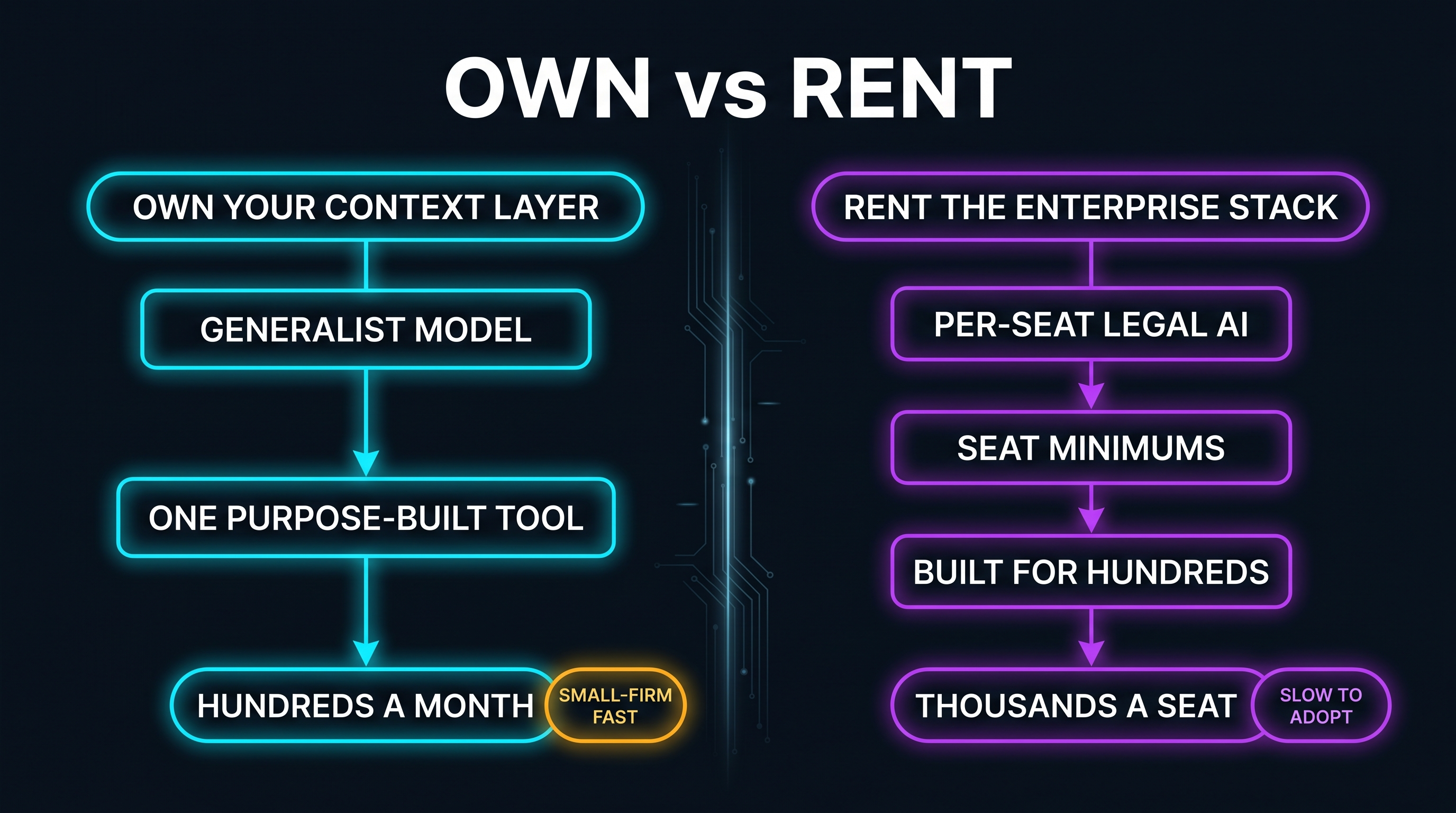
Underneath all five is one decision: build-vs-buy. The purpose-built legal AI platforms are mostly sold on enterprise terms, sales-qualified, seat minimums, four-figure-per-seat pricing built for firms with hundreds of lawyers to amortize it across. The small firm has a cheaper and more durable path. A generalist model at roughly $25 to $30 a seat covers most of what lawyers actually need day to day, paired with one purpose-built tool for your single highest-volume task, Spellbook for contract work, Gavel for document assembly. Call it two to five hundred dollars a month total against the multi-thousand-per-seat enterprise stack. The owned context layer, the part that knows your jurisdiction and your matters, is the part that compounds, and it is the part a vendor will never build for you. The BigLaw firm cannot move this fast. One decision-maker at a small firm can stand the whole thing up this quarter. The five-hundred-lawyer firm will still be in committee defending its leverage model.
The build-vs-buy frame hides a third path, and for some firms it is the strongest one: partner with a local AI shop. A growing class of small, regional technology firms now organize around an AI-employee-first model. They do not sell you a seat. They build you a domain-specific agent that behaves like a hire who already knows your practice, and they keep building it with you as your matters accumulate. That is precisely the work a national vendor will not do and a competitor cannot copy: a context layer co-built by people in your own market who understand your jurisdiction and sit close enough to iterate every week. It still lands on the owned side of the ledger, because what you keep is the agent and the judgment encoded into it, not a license that lapses the month you stop paying. The off-the-shelf stack is available to everyone. An AI employee trained on your firm’s accumulated judgment is available only to you. That is what a moat actually is.
What I Still Cannot Promise
I owe the same honesty I gave Orestes in February. I am a technologist, not a lawyer. I can read the economics and the technology and the survey data. I cannot stand in a Miami-Dade courtroom and read a judge, and the implementation of everything above has to come from practitioners who live inside constraints I only see from the outside.
The timeline is genuinely uncertain. The regulatory picture is still forming, and the firm that adopts carelessly courts the sanctions above just as surely as the firm that refuses to adopt courts irrelevance. There is no risk-free posture here. There is only the choice of which risk to carry, and the data says the cost of standing still is now the larger one.
What I am confident about is the shape. The advantage was always there in the size. The only new variable is the clock, and for the first time it is being held by someone other than you.
The window your size opens is real. Your clients are the ones deciding how long it stays open. Move while it is still yours to move through.
If this is the first you are reading of this thread, start with When the Plugin Hits Home, the answer to my son’s original question, and the post where I built him a personal agent to experiment with. This is what four months of data did to that argument.
If you are running a small practice and actually restructuring around this, not just using the tools but changing how you price and staff, I want to hear how it is going. Find me on X @orestesgarcia or LinkedIn /in/setsero.
Get the next field note.
Regulated AI, architecture and platform economics — in your inbox as they publish.