The Second Brain Doesn't Ship
I argued markdown scales from a personal second brain all the way up to a company lattice, that the format never changes and only the graph grows. I was measuring one axis and missed a second. There are two axes of scale, not one, and the moment other people log in, plain files stop working. Here is where the second brain breaks, and the database-shaped thing that replaces it in production.
Contents
A month ago I made a clean claim: markdown is the knowledge layer, and it scales without changing shape. The same plain files in git that hold your personal second brain hold a team brain for a department and the lattice for a whole company. The format never changes. Only the graph grows.
I still believe that, for the axis I was measuring. But there is a second axis I glossed over, and the line it draws is one I have not been able to unsee since. The moment your agent stops serving you and starts serving strangers who log in, the plain-files answer does not just need tuning. It has to become a different thing entirely. Not a bigger wiki. A database.
That distinction is the whole post, and it matters most exactly where I sit, in a regulated shop deciding what a customer-facing agent is allowed to run on.
Two species of agent, not one
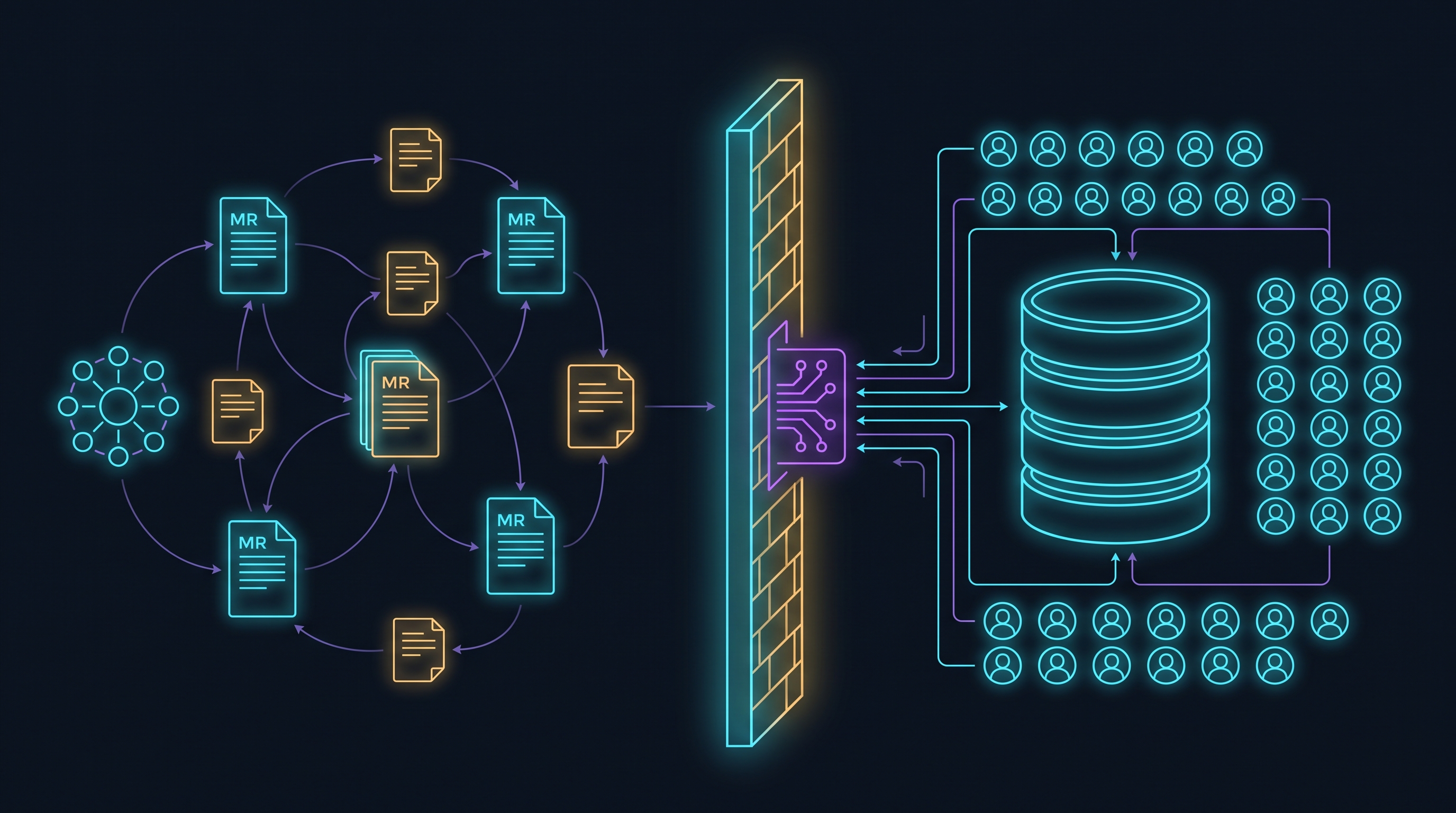
The cut I keep reaching for is this. There are two completely different species of AI agent, and the industry talks about them as if they were one. The personal agent lives on your machine, holds your knowledge, answers to you. The production agent ships inside a platform to people you will never meet, each of whom logs in, brings their own data, and expects the thing to remember them.
Everyone is fixated on the first one right now, and for good reason. A second brain applies to anyone. It manages your job, your notes, your life. But the business value lives in the other lane, the agent shipped to a thousand customers inside a product. And the setup that makes a great second brain is not a starting point you scale up for that. It is the wrong architecture, and no amount of tuning fixes it.
Why the personal one is all markdown
Start with why plain files win for yourself, because the reasons are exactly the reasons they fail later.
Everything in a personal agent is markdown driven. You grow the knowledge base by having conversations with it, and it writes what it learns back to disk. The whole thing stays local, as fast and accessible as your own filesystem. This is Karpathy’s LLM wiki pattern: index documents, tag them, extract entities, cross-link the lot, and let the model maintain the bookkeeping so the base never rots. I built one of these for my son’s law practice in Clerko, and its entire memory is a markdown graph the model compiles and queries.
Here is the load-bearing detail. For yourself, you genuinely do not care about governance. No access control, because there is one user. No audit trail, because there is one hand on the keyboard. No multi-tenant isolation, because there is one tenant. Every hard problem that a database exists to solve, you get to skip, because you are a population of one. Markdown wins precisely because it ignores the things that do not exist yet.
The wall is the login screen
Now ship it to other people, and every skipped problem arrives at once.
Many users, live data, at the same time. A personal wiki is a snapshot you curate. A production agent answers questions against data that changes while it reads, for many people concurrently. Files do not do concurrency or freshness. Databases were invented for exactly this, and there is a reason we have them in the first place.
Access control and audit. The instant there are two users, “who is allowed to see this” becomes a question the store has to answer, not the honor system. A flat directory of markdown has no concept of a tenant boundary or a permission, and in a regulated seat that is not a gap, it is a disqualification.
Retrieval at scale. Making the agent read whole markdown documents to find one fact is fine when the corpus is yours and the reader is you. Across thousands of users and millions of records it is a token bonfire. No prompt-engineering trick saves you when the base case is “load the document and skim.” Search and organization at that size is what an index does, and files do not have one.
The licensing wall, which is the one people forget. A second brain usually runs on a coding-agent SDK against your personal subscription. That subscription is licensed for personal use. Take the same setup to production, charge customers for it, and you legally cannot lean on it anymore. This is not a performance footnote. It is a hard line between the two species, and in banking it is the kind of line that ends a project in the first architecture review.
I said the format never changes as you scale. That is true along one axis: more authors reading a shared corpus, the second brain becoming a team brain becoming a lattice. It is false along the other axis: the same knowledge served to many isolated strangers, live, under governance. Two axes. I was only looking at one.
The production blueprint: one store, two jobs
The goal does not change. You still want everything a second brain gives a person, their memories and well-organized retrieval, delivered to every customer. You just build it on different bones. Think of the whole thing as a thin context layer sitting on top of a database, and the database has to do two distinct jobs.
Job one is business data. A context retriever that knows the shape of your records and can query them efficiently on the agent’s behalf.
Job two is agent memory. Short-term and long-term memory, per user, so the agent remembers each customer the way your second brain remembers you.
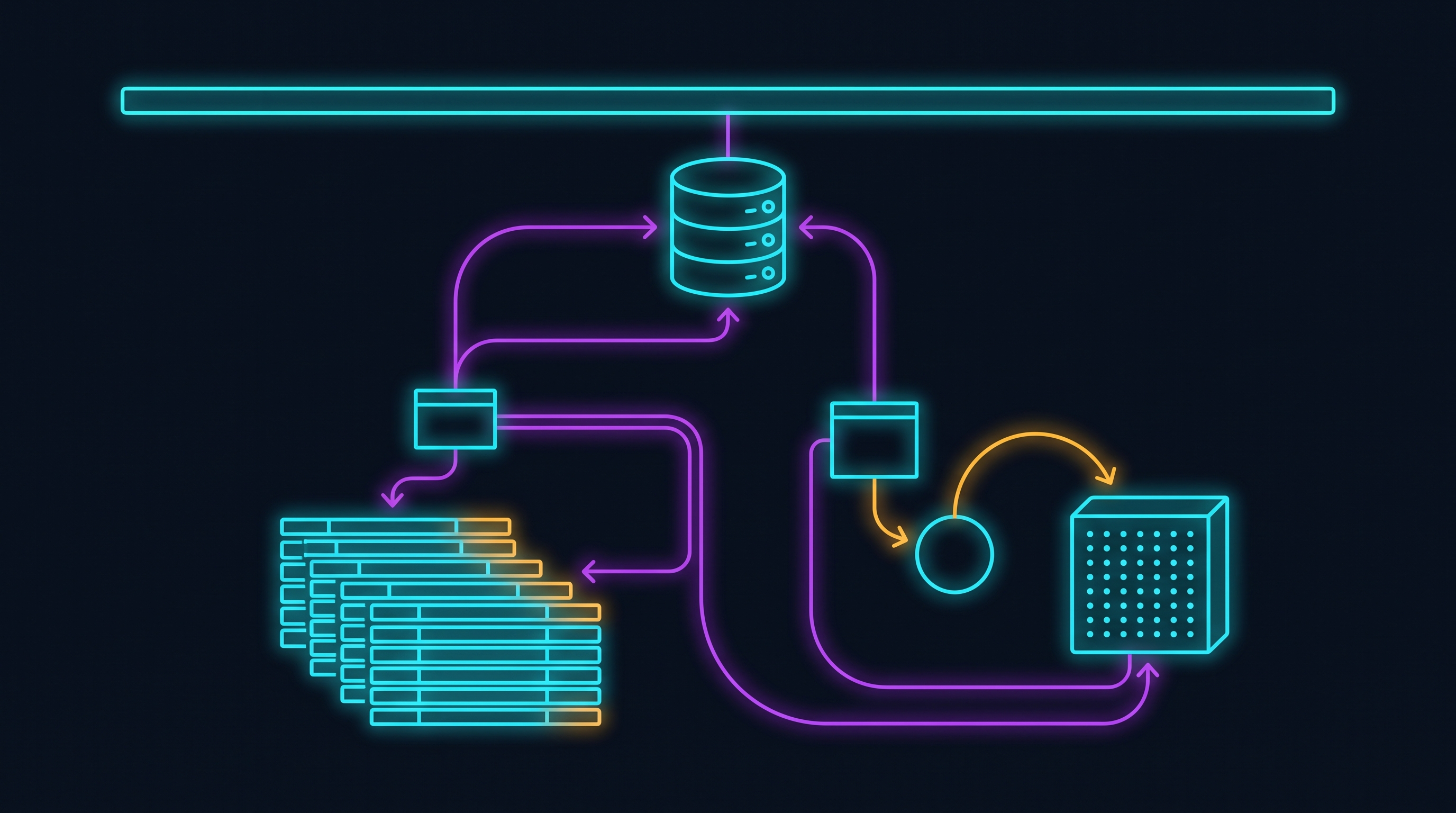
Medin’s demo runs on Redis, and I am going to use it as the concrete example because it makes both jobs legible. The ideas port to anything you build on. Redis is the illustration, not the prescription.
Context retriever: schema for a schemaless world
Raw Redis is key-value pairs. Flexible, fast, and completely opaque to an agent, which has no idea what lives in there or how to ask for it. Point a language model at a bare keyspace and it is blind in a sea of strings.
The context retriever is the layer that fixes that. You document the structure, define your entities, customer, product, order, mapping them almost one-to-one to your underlying records. From those definitions it auto-generates an MCP server: a tool for basically every attribute you declared. Filter customers by city. Look one up by email. Full-text search the free-text fields to find a keyword inside a product description or a customer note. The agent no longer reads documents to find things. It calls a typed tool that returns exactly the rows it asked for.
The line that connects this straight back to the personal side: it is kind of like the metadata in a Karpathy LLM wiki, the tags and entities and index, except built for scale and served by a query engine instead of a file crawl. Same idea, different bones. In his demo one analytics question, “which orders are delayed,” hit five records with a single MCP call, no index-document crawling and no schema guessing.
This is the same argument I made in An ERD Is the Floor. An agent handed a schemaless blob cannot design a query any more than a solution team handed a materialized view can design a system. Captured structure is what turns a store into something an agent can reason over. The retriever is where the schema you always needed gets handed to the model.
Agent memory: keep the golden nuggets, not the transcript
The second job is the one that actually feels like a second brain, and it is built in two tiers.
Every conversation’s short-term memory gets stored. That is the baseline buffer, the running context of the current session. Then a background process quietly reads that short-term memory and promotes the important parts to long-term. This is the exact trick a second brain does with its memory.md, where you extract the key findings worth keeping and drop the rest, and it is the same short-term-to-long-term promotion that agent-memory systems have done since MemGPT. One phrasing stuck with me: you are trying to extract the golden nuggets out of conversations, then recall them later.
Long-term memory is traditional retrieval, semantic search over vector embeddings. Each user can hold millions of memories and the agent still surfaces the right handful, because you are querying by similarity, not scanning a file. And the extraction matters more than it sounds. Users almost never spell out the fact they want remembered. The demo nugget was “user prefers reshipments over refunds for delayed orders,” a preference the customer never stated as a rule. The background extractor inferred it from how the conversation went and filed it. Start a fresh session, ask about preferences, and it comes back. That is the proof the memory survived the conversation that created it.
The payoff shows up on a loaded question like “why is my order late, and can you handle it the way I asked last time.” That single ask needs memory to decode “last time” and business data to find the customer’s actual orders. The agent fires a handful of tools, search memories, get customer, find orders, get shipment, assembles the whole context, and answers completely, without spending anything close to the token budget that reading raw documents would have burned. Two jobs, one store, one clean answer.
The banking translation
Here is where this stops being a product demo and becomes an architecture decision I actually have to make.
Multi-tenant memory is the requirement, not a feature. A customer-facing agent that remembers people has to isolate each customer’s memory behind their identity, with the same rigor you apply to their account balance. Per-user namespaces with access control on retrieval is the floor. A shared markdown graph cannot express that boundary at all, which is the clearest possible reason it never ships to production in a bank.
Retrieval has to be auditable. When an agent surfaces a memory or a record to answer a customer, you need to be able to say later what it saw and why. A query against an indexed store leaves a trace. A model skimming a document does not. In a regulated shop the loud, logged failure beats the silent, plausible one every time, the same point I made about captured semantics in Markdown Is the Knowledge Layer.
The token economics are a real operating cost. At personal scale, reading whole documents is invisible. At customer-support volume, it is a line item. An indexed retriever that returns five rows instead of five documents is not an optimization, it is the difference between a unit economics that works and one that does not.
And the licensing wall is non-negotiable. You cannot ship a customer-facing agent running on a personal coding-subscription. The blunter version is worth hearing: do not use a coding-agent SDK for production at all, because tools like the Claude Agent SDK and Codex SDK are built for long agentic coding tasks and are slow and token-heavy for a shipped product. One recommendation is Pydantic AI for the production agent itself. You do not have to take that specific framework to take the principle: the thing you built for yourself is the wrong runtime for the thing you sell.
This is the production edition of the argument I made in The Clone Problem. Your personal AI cannot follow you to work, not because the knowledge is wrong, but because the governance, the licensing, and the isolation it never had to think about are the entire job on the other side of the login screen.
What I got right, and what I under-drew
I want to be precise about my own earlier claim rather than quietly walk it back. Markdown Is the Knowledge Layer holds. Along the axis of authorship, more people contributing to one shared corpus, the format genuinely does not change, and the second brain really is the same shape as the team brain and the lattice. That was and is the right call.
What I under-drew is the other axis. Serving one corpus to many isolated strangers, live, under access control and audit, is not “the same format with a bigger graph.” It is a database problem wearing a knowledge-layer costume, and pretending markdown covers it would have been the kind of tidy-but-wrong claim I try not to make. The two axes are orthogonal. You can be far out on one and at the origin on the other. The mistake is assuming that moving along the authorship axis carries you along the multi-tenant one for free. It does not.
The practical takeaway cuts both ways, which is the part I like. Do not over-engineer the personal side. For your own second brain, plain markdown in a git repo is genuinely ideal, and reaching for a database there is solving problems you do not have. But do not under-engineer the production side either. The day real users log in, you owe them a context retriever over your business data and per-user agent memory in a real store, because the thing that made your second brain great, ignoring governance, is the exact thing you are no longer allowed to do.
Where I land
The second brain is the best possible personal tool and the wrong production architecture, and both of those are true at the same time. Markdown scales beautifully along the axis I measured and not at all along the one I skipped. The moment you ship to strangers, you trade a directory of files for a store that does two jobs, retrieval over business data and memory over people, and you accept the governance you were previously allowed to ignore.
If you are building a second brain, keep it in plain files and let the model do the bookkeeping. If you are shipping an agent to customers, start from the database and the two jobs, not from the wiki you already love. The hard part was never the knowledge. It was everything the login screen turns on.
The companion read is Markdown Is the Knowledge Layer, the post this one refines. That one made the case that plain files scale up. This one marks the axis where they stop.
If you are drawing this line in your own stack, personal second brain on one side, a production agent with real users on the other, I want to compare notes on where the boundary actually falls. Find me on X @orestesgarcia or LinkedIn /in/setsero.
Get the next field note.
Regulated AI, architecture and platform economics — in your inbox as they publish.