The $100M Entrepreneur Who Teaches Discipline Like a Religion
Alex Hormozi's philosophy: discipline beats motivation, execution beats ideas, and volume creates skill. Every single time.

Contents
“The only way to get what you want is to deserve it.”
Not from a Stoic philosopher. Not from a self-help guru with a stage and a headset. From a private equity operator who built a $100M+ portfolio by age 32, starting from a bank account that hit $1,036 in December 2016.
If Vivekananda gave me the philosophy (strength is divine, service is worship, weakness is the only sin) and Peterson gave me the psychology (meaning trumps happiness, responsibility is the source of both, and the shadow has to be integrated) then Alex Hormozi gave me the operating system.
The execution layer. The part where ideas become reality or die.
He’s my business guru. Here’s why.
From Gym Owner to $100M Portfolio
The origin story matters because it’s not what you’d expect.
Alex Hormozi: first-generation Iranian-American. Father was a doctor who fled Iran. Only child. Graduated Vanderbilt magna cum laude in three years with a degree in Human & Organizational Development. Vice-president of the university powerlifting team.
After graduation, he worked in management consulting. Then space cyber intelligence for the U.S. government. These were prestigious, well-paid positions. The kind of jobs your parents brag about.
He left to open a gym.
In 2013, he poured his $60,000 in savings into United Fitness. By 2016, he’d grown to six locations. And then, in December 2016, his bank account hit $1,036.
That’s the turning point. Not the success. The failure. Six gyms, wiped out. The moment most people would go back to consulting. The moment most people would say “I tried, it didn’t work.”
Hormozi didn’t go back. He went deeper.
He pivoted from owning gyms to teaching gym owners how to fill their gyms, founding Gym Launch as a turnaround consulting business. The licensing model took off: 4,500+ gyms, $30 million in revenue within 20 months. Then Prestige Labs ($1.7M/month within six months). Then ALAN (lead automation). Then Acquisition.com as a holding company. Then a partial exit: 66% of Gym Launch and Prestige Labs sold for $46.2 million.
Today, the Acquisition.com portfolio generates over $250 million annually. Hormozi has written three bestsellers totaling 5+ million copies. His YouTube channel has 3.8 million subscribers. $100M Money Models set a Guinness World Record for fastest-selling non-fiction book.
None of this is the point. The trajectory is the point: $1,036 to $100M+, no inheritance, no family money, no lucky break. Just relentless execution and a refusal to stop.
Volume Beats Strategy
The core thesis of Hormozi’s work, the thread that runs through $100M Offers, $100M Leads, and $100M Money Models, is devastatingly simple:
Most people overthink and underexecute.
“A hundred imperfect actions will always beat one perfect plan.”
This isn’t anti-intellectual. Hormozi graduated magna cum laude from Vanderbilt in three years; he’s not dumb. It’s anti-perfectionist. The argument: the information you need to succeed is almost always available. The bottleneck is never knowledge; it’s action. You don’t need another business book, another course, another mastermind. You need to do the thing.
“99% of the things I’ve learned, I’ve learned through doing, not thinking.”
His Rule of 100 operationalizes this: perform a key business activity 100 times daily. 100 outreach attempts. 100 minutes of content creation. 100 cold calls. Not because every attempt succeeds (most won’t) but because volume creates skill. The reps teach you what no course can.
“Extraordinary accomplishments come from doing ordinary things for extraordinary periods of time.”
Read that next to Vivekananda: “Practice is absolutely necessary… if you do not practice, you will not get one step further.”
Read it next to Peterson: “Don’t avoid doing what you know you need to do. Expose yourself voluntarily to things you are avoiding.”
Three men. Three centuries. Three ways of saying: the doing is the learning. Stop preparing to start and start.
Discipline as Competitive Moat
Hormozi’s most countercultural teaching: motivation is a scam.
Not that motivation doesn’t exist; it does. But building anything meaningful on motivation is like building a house on weather. It comes and goes. It’s unreliable. It’s a terrible foundation for sustained performance.
“The difference between success and failure is doing the work when you don’t feel like it.”
Discipline, the ability to keep promises to yourself regardless of how you feel, is the actual competitive advantage. Not intelligence, not creativity, not connections. Discipline. Because most people quit when the feeling fades.
“We don’t rise to the standards we have when others are watching; we fall to the standards we have when no one is.”
This is the same teaching Peterson delivers through mythology: the hero continues into the dragon’s cave not because it feels good, but because it must be done. And the same teaching Vivekananda delivers through Karma Yoga: work without attachment to how you feel about the work. Three different frames for one truth: your feelings are not a reliable guide to what needs doing.
Hormozi’s framing is the most operationally useful because it’s the most blunt. There’s no mythological wrapper. No philosophical context. Just: discipline beats motivation. Systems beat inspiration. Boring consistency beats creative bursts. Do the work whether you feel like it or not.
Grand Slam Offers
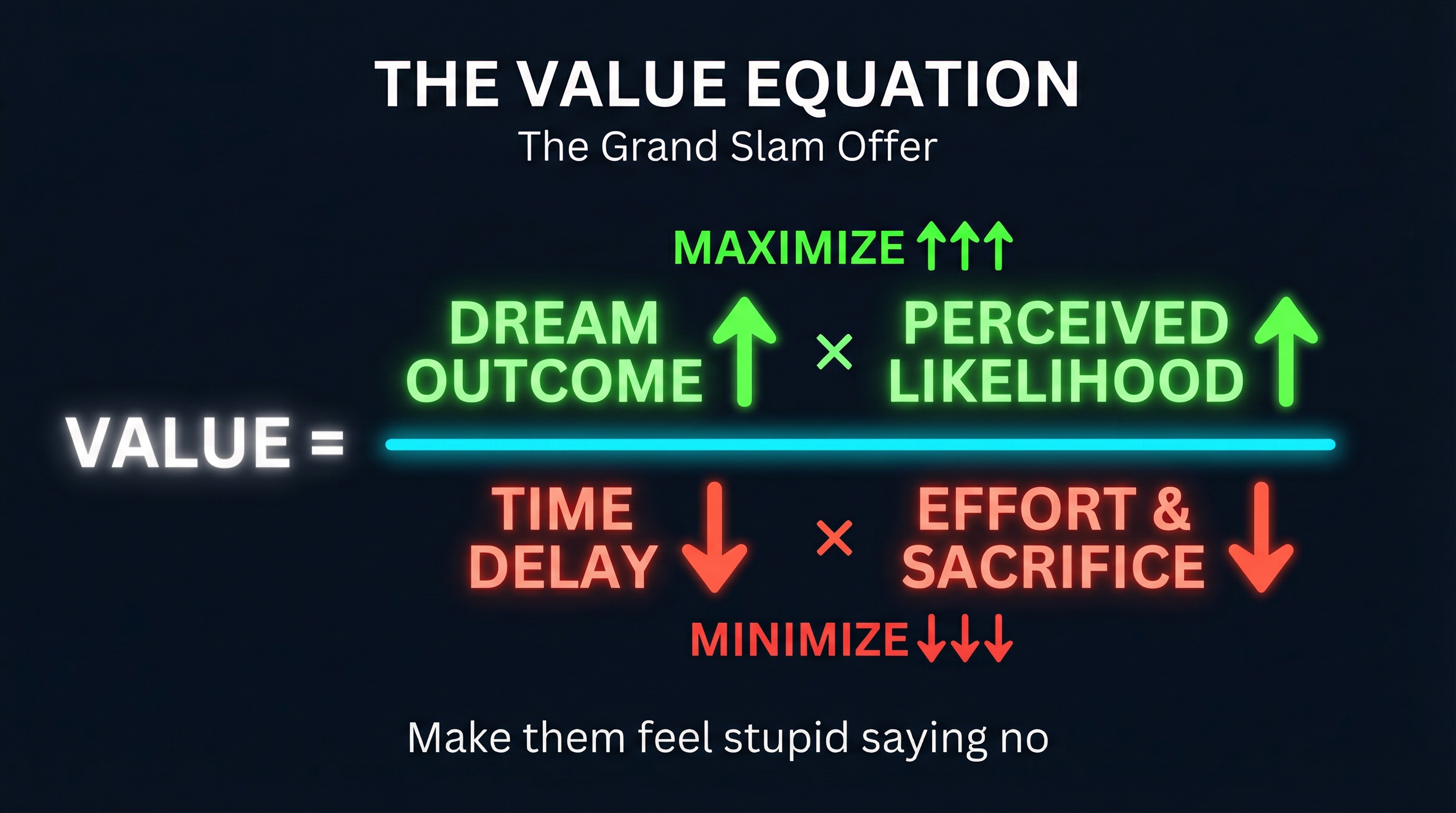
Hormozi’s intellectual contribution, the part that goes beyond motivational speaking, is the Value Equation:
Value = (Dream Outcome x Perceived Likelihood) / (Time Delay x Effort & Sacrifice)
A Grand Slam Offer maximizes the top of the equation (big dream outcome, high perceived likelihood of achieving it) and minimizes the bottom (fast results, low effort from the customer). An offer so compelling that customers feel stupid saying no.
This isn’t manipulation. It’s alignment. If you genuinely deliver a dream outcome quickly and easily, the offer should be compelling. The framework forces you to think about value from the customer’s perspective: not “what can I sell?” but “what transformation am I delivering, and how do I remove every obstacle between my customer and that transformation?”
The three primary markets (Health, Wealth, Relationships) strip business down to its essentials. Every business exists to solve a problem in one of these three domains. If you can’t connect your product to a real problem in one of them, you don’t have a business. You have a hobby.
What makes this relevant to the guru thesis: Hormozi’s business framework is built on creating genuine value. Not extraction. Not manipulation. Value creation as the engine of wealth. This puts him closer to Vivekananda (“be grateful to the man you help, think of him as God”) than to the Gordon Gekko school of business.
Why He’s My Business Guru
I found Hormozi at a specific moment: not a lack of action, but a lack of scale.
I’m 54 years old. I’ve started businesses that failed. I’ve built systems inside companies as an employee, and built them for dozens of clients as a consultant. I’ve shipped, launched, pivoted, and walked away from things that weren’t working. Decades of doing.
What I hadn’t done was compound a business the way Hormozi describes: taking something that works and relentlessly scaling it through volume, offers, and operational leverage. I had the reps. I didn’t have the playbook for what to do once the reps started paying off.
Then I found Hormozi, and the frameworks clicked instantly. Not because they were new ideas (any experienced operator recognizes the principles) but because Hormozi thinks the way my brain already works. Models. Systems. Frameworks you can apply across domains. The Value Equation isn’t just a pricing tool; it’s a thinking tool. The Rule of 100 isn’t just a hustle metric; it’s a forcing function for consistency. Everything he teaches maps to a mental model, and that’s exactly how I process the world.
“You don’t need more information. You need more execution.”
That landed differently for me than it does for the 25-year-old who hasn’t started yet. I didn’t need permission to start; I’d been starting things for decades. I needed permission to stop perfecting and start scaling. Permission to care about revenue growth without feeling like it compromised the spiritual or psychological framework. Permission to measure compounding, not just intentions.
This was the missing piece. Vivekananda told me what to believe. Peterson told me what to aim at. Hormozi gave me the operating system to execute at scale.
The specific Hormozi insight that changed my operating behavior: the relationship between volume and skill. My trap wasn’t “I’ll start when I’m ready”; I was past that. It was “I’ll scale when I’ve perfected it.” Hormozi flipped it: you perfect by scaling. You don’t wait until the offer is flawless to do volume. You do volume until the offer becomes flawless. Completely different problem, same solution.
“The longer you can keep going without seeing results, the bigger you’ll be able to win in life.”
That sentence gave me patience I didn’t have. Not passive patience; active patience. The willingness to keep executing without validation, trusting that the reps compound even when you can’t see it yet.
The Materialism Question
I’d be dishonest if I didn’t address the obvious tension.
Hormozi is unapologetically capitalist. His books are about making money. His portfolio exists to generate wealth. His metrics are revenue and profit, not enlightenment or meaning.
This sits uncomfortably next to Vivekananda’s “work without attachment to fruits” and Peterson’s “pursue what is meaningful, not what is expedient.”
The resolution I’ve found: Hormozi treats wealth as a scoreboard, not the game. The game is building capability, creating value, solving problems at scale. Money is how you measure whether you’re actually delivering value or just talking about it.
“Stop trying to get rich. Get better. Getting rich will happen as a consequence.”
That’s not materialism. That’s Karma Yoga in a business suit. Focus on the work, let the results take care of themselves. Vivekananda wouldn’t have used the same language, but I think he’d recognize the principle.
The honest tension: Hormozi’s world is more transactional than Vivekananda’s. Service in the Vedantic sense is unconditional: you serve because service is worship, regardless of whether it generates revenue. Service in Hormozi’s sense is value-for-value: you serve because delivering value creates profitable businesses.
Both are valid. Neither is complete. That’s why you need more than one guru.
What He Teaches That Others Don’t
Hormozi fills a gap that spiritual teachers and psychologists don’t touch: the operational layer.
Vivekananda tells you that work is worship. Peterson tells you that meaning comes through responsibility. Neither tells you how to build a lead generation system, price an offer, or scale a service business.
Hormozi does. And he does it without the spiritual or psychological scaffolding, which means his advice is accessible to people who’d never pick up the Bhagavad Gita or Maps of Meaning. “Do 100 reps a day” doesn’t require any philosophical framework. It just requires doing it.
“The people who win are simply willing to do what others won’t.”
If there’s a single sentence that captures what Hormozi adds to the Three Gurus synthesis, it’s this one. Vivekananda tells you that strength is divine. Peterson tells you that responsibility creates meaning. Hormozi tells you that none of it matters unless you’re willing to do what others won’t (consistently, boringly, without applause) for as long as it takes.
The operating system.
Philosophy. Psychology. Execution. What happens when all three converge? That’s the final post: Three Men, 160 Years, One Message.
This is Post 3 of 4 in My Three Gurus.
Thoughts on whether wealth and spirituality can coexist? Find me on X or LinkedIn.
Get the next field note.
Regulated AI, architecture and platform economics — in your inbox as they publish.