The Victorian Monk Who Made Spirituality Dangerous
Swami Vivekananda brought Vedanta to the West in 1893, but his real legacy isn't philosophy; it's the radical idea that weakness is the only sin and strength is the path to the divine.
Contents
“If there is a sin in the world, it is weakness.”
Not from a fitness influencer. Not from a motivational poster in a CrossFit gym. From a 30-year-old Hindu monk standing on a stage in Chicago in 1893, addressing seven thousand strangers at the Parliament of World Religions.
Swami Vivekananda said those words over 130 years ago, and they hit harder than anything I’ve read since. Because most spiritual teaching goes one of two ways: either it’s soft (all forgiveness and passivity and “let go of your desires”) or it’s toxic masculinity wrapped in religious language. Vivekananda cuts through both. He built a philosophy where strength is the spiritual path, where service is worship, and where calling yourself weak is the actual sin.
He’s my spiritual guru. Here’s why.
The 1893 Moment
September 11, 1893. The World’s Columbian Exposition in Chicago. Seven thousand people packed into the Hall of Columbus for the Parliament of World Religions, the first formal gathering of Eastern and Western spiritual traditions in history.
A young Indian monk, unknown outside a small circle of disciples, stepped to the podium. He had no prepared speech. No notes. No institutional backing. He opened with five words:
“Sisters and Brothers of America.”
The audience erupted into a two-minute standing ovation. Before he said anything else. Before he explained Vedanta or Hinduism or the nature of reality. Five words of genuine connection, addressing strangers as family, and seven thousand people felt it.
What followed over the next several days was a systematic dismantling of Western assumptions about Eastern religion. Hinduism wasn’t primitive idol worship. It was a sophisticated philosophical tradition, Advaita Vedanta, arguing that ultimate reality (Brahman) and individual consciousness (Atman) are not separate. That every human being is, at their core, divine. Not metaphorically. Not aspirationally. Actually.
This speech is now recognized as the birthdate of the worldwide interfaith movement. Vivekananda didn’t just introduce Hinduism to the West; he reframed the entire conversation about what religion could be.
Weakness Is the Only Sin
Here’s where Vivekananda diverges from every spiritual teacher you’ve probably encountered.
Most religious traditions define sin as a moral transgression. You did something wrong. You violated a commandment. You failed to follow the rules. The solution is repentance, forgiveness, atonement.
Vivekananda flipped it completely. Sin isn’t transgression; it’s incapacity. The greatest sin is to think yourself weak. Not to do wrong, but to be weak. To lack the strength, courage, and will to act on what you know is right.
“Stand up, be bold, be strong. Take the whole responsibility on your own shoulders, and know that you are the creator of your own destiny.”
This isn’t self-help platitude. This is metaphysical claim. In Vedanta, if your true nature is divine, if Atman is Brahman, then calling yourself weak is literally a lie about the nature of reality. You’re denying what you actually are.
“All power is within you; you can do anything and everything. Believe in that.”
The Victorian context makes this even more striking. In 1893, India was under British colonial rule. Indian identity was being systematically diminished. And here was a young Indian man standing on a Western stage telling the world (and, implicitly, his colonized countrymen) that weakness is the only sin and strength is the only virtue.
This wasn’t ivory tower philosophy. It was revolutionary.
Practical Vedanta
Vivekananda’s most radical contribution wasn’t any specific teaching. It was where he applied them.
Before Vivekananda, Advaita Vedanta was largely the province of monastics and scholars. Ancient, profound, and locked away in ashrams and forest retreats. Beautiful philosophy that ordinary people encountered through ritual and priesthood, not through direct application.
Vivekananda dragged it into the streets.
He called it Practical Vedanta: the application of non-dual philosophy to everyday work. His argument: if all reality is one, then there’s no separation between spiritual practice and daily work. Serving your customer is serving the divine. Building something useful is worship. The factory floor is a temple if you approach it correctly.
This shows up most powerfully in his teaching on Karma Yoga, the yoga of selfless action:
“To work we have the right, but not to the fruits thereof.”
Sound familiar? It should. Strip the Sanskrit terminology and this is the same principle that every serious operator eventually discovers: focus on the work, not the outcome. Control the inputs, release attachment to outputs. Do excellent work because excellent work is its own justification.
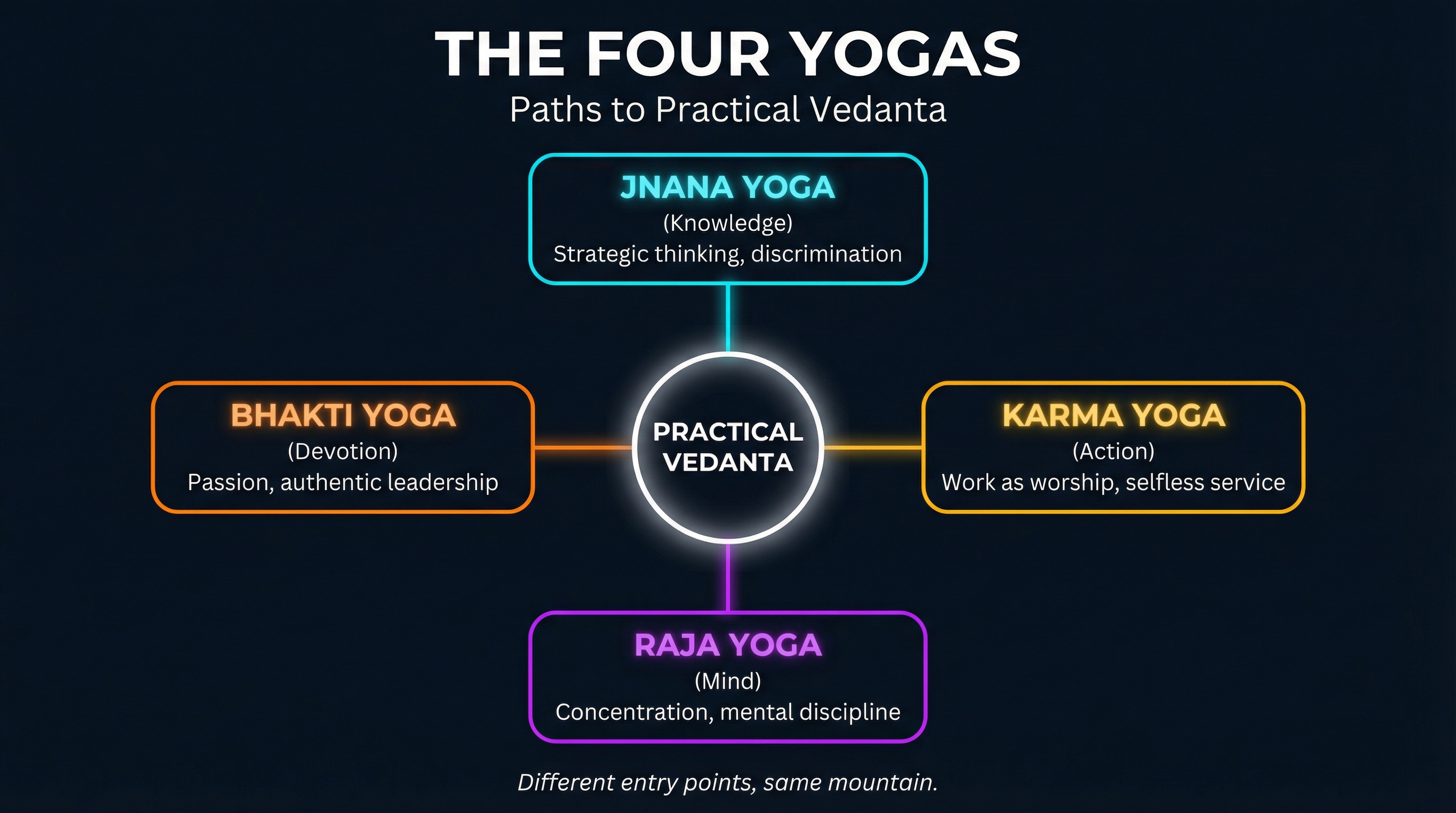
The Four Yogas (Karma for action, Bhakti for devotion, Raja for mind control, Jnana for knowledge) weren’t competing paths. They were different entry points for different personalities. Prefer analysis? Jnana. Prefer emotion? Bhakti. Prefer discipline? Raja. Prefer just getting things done? Karma. Same mountain, different routes.
What made Vivekananda dangerous to the establishment was this democratization. You don’t need a priest. You don’t need a guru (ironically). You don’t need permission. The divine is in you already. Stop waiting for someone to confirm it and get to work.
Man-Making Religion
Vivekananda had a phrase that captures his entire project: “man-making religion.”
Not man-making in the gendered sense; he was equally fierce about women’s education and empowerment. Man-making as in: building character. Building capacity. Building people who can stand on their own feet and shoulder responsibility without flinching.
“We want that education by which character is formed, strength of mind is increased, the intellect is expanded, and by which one can stand on one’s own feet.”
He wasn’t interested in producing devotees. He wanted to produce capable humans. People who could think clearly, act decisively, serve others, and take responsibility for their own lives.
“You are the makers of your own fortunes. You make yourselves suffer, you make good and evil, and it is you who put your hands before your eyes and say it is dark.”
This is the same message you’ll hear from the best executive coaches, leadership programs, and psychology practices in 2026. Take agency. Stop blaming. Own your situation. Vivekananda was saying it in 1896, in Sanskrit-inflected English, to audiences in London and New York, and it landed then for the same reason it lands now.
Because it’s true.
Why He’s My Spiritual Guru
I found Vivekananda the way most people find him: not through academic study, but through a quote that stopped me cold.
“Take up one idea. Make that one idea your life: think of it, dream of it, live on that idea. Let the brain, muscles, nerves, every part of your body, be full of that idea, and just leave every other idea alone. This is the way to success.”
I was scattered. Too many projects, too many interests, too much intellectual restlessness disguised as curiosity. This quote was a brick through the window. Not because it was new information (everyone knows you should focus) but because of who was saying it. A 19th-century monk. A man who renounced worldly possessions. And his advice for success sounded like the best startup advice I’d ever heard.
That contradiction cracked something open. I started reading the Complete Works, all nine volumes. And I kept finding the same pattern: teachings that sounded like they were written yesterday, by someone who understood modern life, wrapped in 130-year-old language.
What changed for me? Two things.
First, the framework of strength as spiritual path. I’d always compartmentalized: be strong in business, be gentle in spirit. Vivekananda collapsed that boundary. Strength isn’t worldly; it’s divine. Being strong isn’t in tension with being good. Being weak is.
Second, the idea that service is worship. Not charity. Not obligation. Actual worship: approaching every person you help as a manifestation of the divine. “Be grateful to the man you help, think of him as God. Is it not a great privilege to be allowed to worship God by helping our fellow men?” That reframe changed how I think about work, about clients, about building things for people.
The Victorian Paradox
There’s an irony in Vivekananda that I find endlessly generative.
He was a celibate monk, a man who renounced family, wealth, and worldly attachment, teaching radical self-empowerment. Teaching people to build, to strive, to become strong. How does renunciation produce a philosophy of strength?
Because Vivekananda understood something that most people miss about renunciation: it’s not escape. It’s focus.
A monk doesn’t renounce the world because the world is bad. He renounces distraction. He strips away everything non-essential so that the essential can burn at full intensity. Vivekananda’s celibacy wasn’t withdrawal; it was concentration. All that energy that could diffuse into a hundred pursuits, focused into one.
“Take up one idea. Make that one idea your life.”
He lived his own advice. And the result was a compressed, impossibly productive 39 years that most lifetimes can’t match.
What He Left Behind
Vivekananda died on July 4, 1902. He was 39 years old. He had predicted he wouldn’t live to see forty, and he was right.
In those 39 years, he:
- Delivered the speech that launched the global interfaith movement
- Founded the Ramakrishna Mission, now operating 221 centers worldwide
- Established over 1,200 educational institutions
- Built 17 hospitals, 147 dispensaries, and 64 mobile medical units
- Wrote the foundational texts on four yogic paths
- Influenced Nikola Tesla, William James, Mahatma Gandhi, and generations of Indian independence leaders
- Made National Youth Day in India: his birthday, January 12, is a national celebration
Thirty-nine years. Most people don’t accomplish this in eighty.
The Ramakrishna Mission alone is staggering: a global organization built on the principle that serving humanity is serving God. Not fundraising galas and awareness campaigns. Hospitals. Schools. Dispensaries. Actual service, at scale, sustained for over a century.
This is what Practical Vedanta looks like when you follow through.
Strength isn’t just physical; it’s psychological. What happens when a Jungian clinician picks up where a Victorian monk left off? That’s the next post: Jordan Peterson and the case for making meaning mandatory.
This is Post 1 of 4 in My Three Gurus.
Thoughts on Vivekananda’s relevance today? Find me on X or LinkedIn.
Get the next field note.
Regulated AI, architecture and platform economics — in your inbox as they publish.