The Stack Nobody Designed
Jensen Huang called OpenClaw the operating system for personal AI. Builder after builder arrived at the same architecture from below: memory, skills, heartbeat. The convergence is the signal. Here's what it means.
Contents
Jensen Huang stood on the GTC 2026 stage and declared OpenClaw “the operating system for personal AI.” He compared it to Windows, Linux, and HTTP: foundational infrastructure for a new computing paradigm. He told every CEO in the audience to develop an OpenClaw strategy. NVIDIA’s stock moved. Cloudflare’s stock moved. The framing was bold and the market responded.
The framing is also wrong in an interesting way.
OpenClaw isn’t the operating system. It’s one distribution. The operating system, the actual architectural pattern, keeps getting rediscovered independently by builder after builder. And the fact that they all arrive at the same answer is a stronger signal than any keynote.
Convergent Evolution
In biology, convergent evolution is when unrelated species independently develop the same trait. Eyes evolved independently in vertebrates, cephalopods, and arthropods, not because they copied each other, but because the problem of navigating a light-filled environment has an optimal solution. The constraint space has an attractor.
Technology does this too. Five independent teams built message queues arriving at producers, consumers, topics, and durable delivery. Nobody convened a standards body. The problem shaped the solution. The same thing happened in personal AI infrastructure: builder after builder converged on the same three-pillar architecture. That convergence tells us something Jensen’s keynote didn’t.
The Two I Run
I’ve spent the most time with two projects that sit at opposite ends of the design spectrum.
Daniel Miessler started from philosophy. His Personal AI Infrastructure (PAI) project began with a question most builders skip: how should a human actually work with AI? Not which model is best. Not which features to ship. How should the relationship work? He built a framework (skills, memory, hooks, a structured algorithm for task execution) and open-sourced the pattern. PAI is a design philosophy that happens to have an implementation, not the other way around.
Peter Steinberger started from frustration. After exiting PSPDFKit, he wanted a local AI assistant that connected to his actual digital life: messages, calendars, workflows. He built OpenClaw, and the world showed up. 150,000+ GitHub stars. The fastest-growing open source project in history. A marketplace of community-contributed skills. His philosophy was explicit: “Build for models, not humans.” Speed over ceremony. Ship code you don’t read.
Different motivations. Different audiences. Different tech stacks. Same architecture.
The Pattern Keeps Showing Up
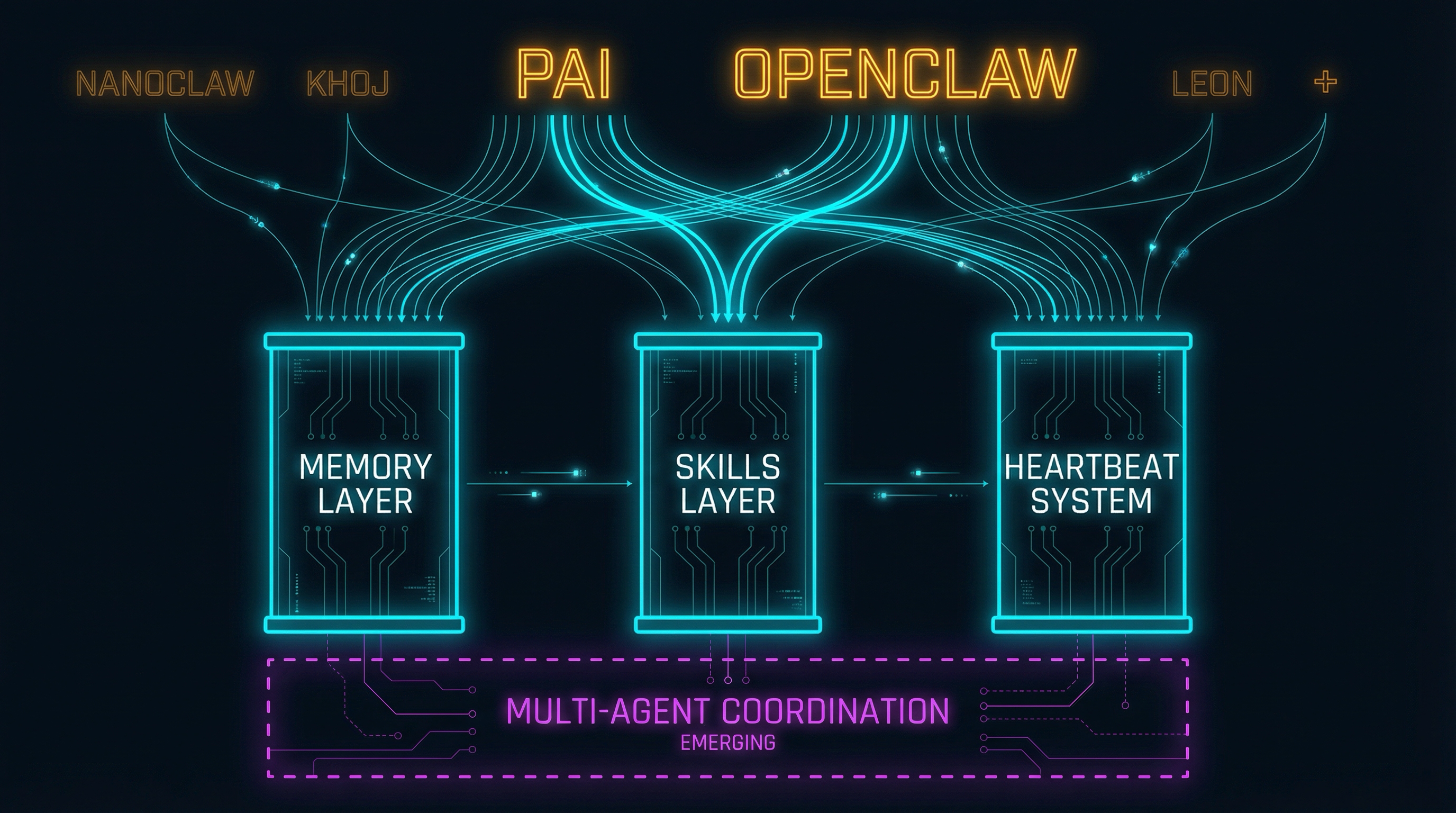
PAI and OpenClaw aren’t alone. The same three-pillar pattern appears across the landscape: NanoClaw (container-isolated, ~500 lines of TypeScript), Khoj (self-hostable AI second brain with scheduled automations), Leon (one of the earliest OSS personal assistants with a “proactive pulse”), and Cole Medin’s custom second brain (rebuilt from OpenClaw’s patterns in days with Claude Code, then documented as a teachable framework). Each built independently. Each landed on persistent memory, composable skills, and proactive automation.
Pillar 1: The Memory Layer
Every project converges on markdown-based persistent memory loaded at session start. OpenClaw uses soul.md, user.md, and memory.md: agent identity, user profile, accumulated knowledge. PAI uses CLAUDE.md for project rules, a MEMORY/ directory for learnings, steering rules, and learning signals. NanoClaw uses per-group CLAUDE.md files. Khoj indexes documents into persistent memory. Medin adopted OpenClaw’s pattern and added daily logs with a promotion workflow. Different implementations, same bones: persistent files that give the agent identity and accumulated knowledge.
Andrej Karpathy articulated why this works: in the era of LLM agents, you share “idea files” rather than specific code: the agent customizes and builds from context. That’s exactly what these memory layers are. The soul.md or CLAUDE.md file is the idea file. The agent builds from it every session.
The convergence is striking. Nearly all of them implemented it in plain markdown, not a vector database, not a knowledge graph. Markdown files that humans can read and machines can load. This maps directly to what I described as Building Blocks 1 (Identity), 3 (Memory Architecture), and 6 (Injection) in Context Engineering Is Infrastructure, Not a Skill. The divergence is in compaction: how you manage memory as it grows. OpenClaw leaves it manual, PAI uses hooks and a PRD system, Medin adds automated curation.
Pillar 2: The Skills Layer
Every project converges on skills as the capability primitive: composable, file-based units that extend what the agent can do. This pillar has something the others don’t: a formal standard.
Anthropic developed Agent Skills for Claude Code, then released it as an open standard: a SKILL.md markdown file with YAML frontmatter, bundled with optional scripts in a directory. Over 30 agent products adopted the same format: Cursor, VS Code, GitHub Copilot, Gemini CLI, OpenAI Codex, Databricks, Snowflake, JetBrains, and more. When Google and OpenAI both implement the same skill format that Anthropic designed, the standard isn’t Anthropic’s anymore; it’s the industry’s.
OpenClaw built ClawHub, a marketplace with 700+ community-contributed skills. The marketplace scales capability fast, but as I covered in OpenClaw and the Trust Ladder, it also scaled attack surface: hundreds of malicious packages. PAI takes the opposite approach: curated, personal skills in a structured directory. No marketplace, complete control.
One pattern shows up in nearly every implementation: self-referential skill creation. The agent has a meta-skill that teaches it how to build new skills: describe a capability conversationally, and it generates a properly structured skill file. This is present in PAI, Claude Code, OpenClaw, and most custom builds. Once the format is simple enough, the capability layer becomes self-replicating.
The convergence: composable, file-based capability units with a formal open standard. The divergence: the trust boundary, whether marketplace, curated, or container-isolated. The architecture is settled. The security model is not.
Pillar 3: The Heartbeat
The third pillar is proactive, scheduled automation: agents that do things without being asked.
OpenClaw has a built-in heartbeat running on 30-minute cycles: wake up, assess what needs attention, act, go back to sleep. PAI achieves proactive behavior through its hooks system (lifecycle events that fire at session start and tool use) with emerging heartbeat capabilities through the Claude Agent SDK. NanoClaw has scheduled jobs. Leon has its “proactive pulse.” Khoj runs scheduled automations. Medin calls the heartbeat “the single biggest time-saver in the entire second brain.”
The convergence: agents that act proactively, using accumulated context to decide what’s worth doing. The divergence: scope of autonomy. OpenClaw gives the heartbeat broad authority. PAI constrains it through hooks and permission models. Others apply zero-trust: the agent can read but not post, can draft but not send.
The Emerging Fourth Pillar
The three pillars (memory, skills, heartbeat) are where the convergence is solid. But there’s a fourth pillar forming at the edges: multi-agent coordination.
A community member named cristbc published a triad setup guide, a template for running PAI and OpenClaw together on separate machines as a hub-and-spoke system. In PAI Discussion #542, the community reached organic consensus: PAI excels at interactive, deep collaborative work; OpenClaw excels at autonomous, routine task execution. They’re complementary, not competitive.
Miessler is already thinking beyond personal infrastructure. His Lattice System extends the same architectural thinking to organizational scale: standardized APIs broadcasting work specifications across company, department, team, and individual tiers so agents can coordinate transparently. I’ll dig into the Lattice in a future post, but the direction is clear: the personal AI stack is the atomic unit, and multi-agent coordination is how those units compose.
The unsettled questions remain: How do agents delegate? How does inter-agent trust work? What’s the shared memory model? Nobody has standardized this yet. The triad guide is the closest reference implementation, and it’s a template, not a product.
Jensen Got It Half Right
Back to the GTC stage. “OpenClaw is the operating system for personal AI.” “Probably the single most important release of software, probably ever.” “Every company needs an OpenClaw strategy.” Bold claims. The market believed them.
What Jensen got right: personal AI infrastructure IS as significant as he claims. The comparison to Linux and HTTP is directionally correct: this is foundational infrastructure, not a feature. His mandate to CEOs reflects genuine urgency. When he says “every SaaS company will become an Agent-as-a-Service company,” the convergence across a half-dozen independent projects supports the thesis. The pattern is real.
What he got wrong: calling OpenClaw “the OS” conflates one implementation with the underlying pattern. OpenClaw is Ubuntu, not Linux. The actual operating system, the architectural pattern that makes personal AI work, is memory plus skills plus heartbeat. That pattern exists in PAI, NanoClaw, Khoj, Leon, and every custom build spun up in a weekend. It’ll exist in whatever comes next, because the constraint space has an attractor.
Jensen’s framing is top-down: a CEO declares the standard. The builder convergence is bottom-up: project after project discovers the pattern independently. When both point at the same thing, that’s the strongest possible signal. NVIDIA shipped NemoClaw to address the security gap, but as I wrote in that post, the sandbox solves Layer 1: the organizational layers remain unsolved.
What the Convergence Tells Us
The pattern is real. Memory, skills, and heartbeat are the personal AI stack the same way compute, storage, and networking are the cloud stack. The abstractions are settling.
The stack is learnable. NanoClaw shipped in ~500 lines of TypeScript. Medin rebuilt it in days. The barrier to entry for building your own personal AI infrastructure is a few thousand lines of code and markdown.
The security model is the differentiator. The three pillars are converged. How you secure them, whether through marketplace trust, curated trust, or zero-trust, is where your values show.
Multi-agent is next. The fourth pillar is forming but hasn’t converged yet. The triad guide is early, but it’s directionally right.
Nobody designed this standard. Jensen recognized it after OpenClaw proved the demand. Miessler discovered it building PAI. Steinberger built what he needed and the world showed up. That’s how real standards emerge: not from committees but from convergent evolution. I wrote about the personal AI wars two months ago as a tool comparison. The interesting story isn’t which tool wins. It’s that the architecture underneath them all converged before anyone noticed.
Sources
Projects: PAI by Daniel Miessler · OpenClaw by Peter Steinberger · NanoClaw by Qwibit · Khoj · Leon
Community: Triad Setup Guide by cristbc · PAI Discussion #542
Standards: Agent Skills · Agent Skills spec (Anthropic, open standard)
References: Andrej Karpathy on idea files · Daniel Miessler, The Lattice System · Jensen Huang, GTC 2026 keynote · Cole Medin: Safer OpenClaw Alternative, AI Second Brain with Claude Code
If the convergent architecture angle resonates, the companion piece is Context Engineering Is Infrastructure, Not a Skill: the seven building blocks that these three pillars map onto.
Find me on X @orestesgarcia or LinkedIn. I write about what happens when AI infrastructure meets regulated reality.
Get the next field note.
Regulated AI, architecture and platform economics — in your inbox as they publish.