Salesforce Put Its CRM Inside Claude
Salesforce and Anthropic shipped Salesforce in Claude, a plugin that lets sellers act on live CRM data without opening the app. Strip the demo away and it is a bet about which layer holds the value: the interface Salesforce built, or the governed data underneath it. Here is what it is, what each side gets, and the case for staying skeptical.

Contents
Salesforce did something this week it had never done before. It put its own “force” suffix on another company’s product. Reuters and CNBC both noted it is the first time the company has ever hung that brand on someone else’s surface, and the someone else is Anthropic. The umbrella name is Claudeforce. The first shipping piece is called Salesforce in Claude.
The demo is easy to describe and easy to underrate. The part worth your attention is the design decision underneath it, because that is where the company is telling you what it thinks its moat is.
What Salesforce in Claude is
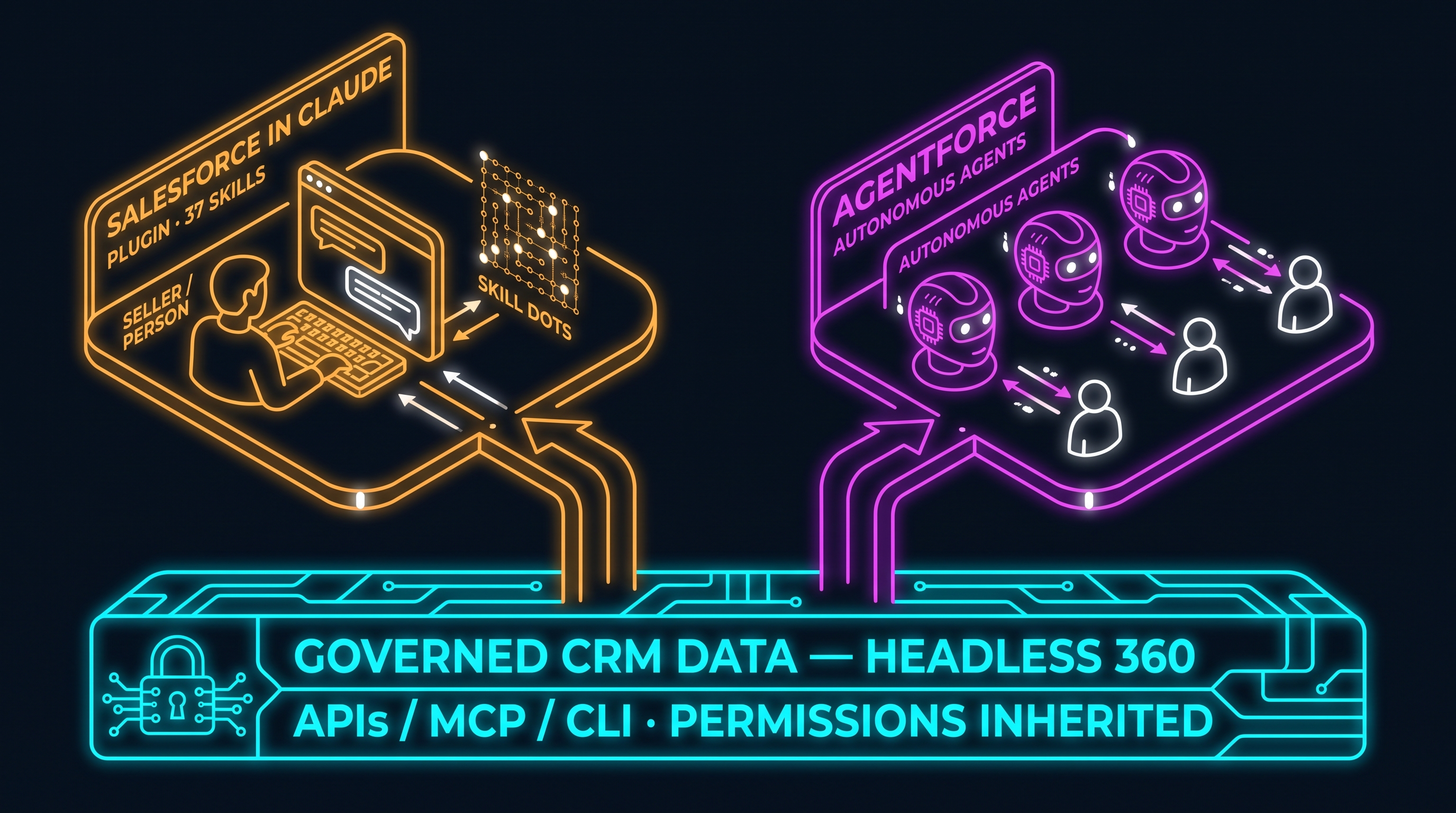
Announced on August 26, Salesforce in Claude is a plugin for Claude that ships with 37 prebuilt sales skills: meeting prep, deal-health review, pipeline review, and the rest of a seller’s daily grind. A rep can reason over live revenue context, update pipeline, and take governed action on CRM records without ever opening Salesforce itself. It is with pilot customers now, with an open beta scheduled for September and more skills arriving later in the year.
Mechanically it grew out of Headless 360, the push Salesforce made at TDX in March to expose the platform through APIs, MCP servers, and CLI tools rather than only through its own screens. Salesforce in Claude rides that plumbing. The design choice that matters is the permission model: an admin connects it once, authentication and permissions stay managed centrally, and the underlying MCP server inherits each user’s existing Salesforce permissions. As Salesforce’s Patrick Stokes put it in VentureBeat’s writeup, if you cannot see a record in Salesforce, the MCP server cannot either. The intelligence moves to where the user is. The governance stays where the data is.
If you read my previous piece on Claude reaching into Microsoft 365, this shape is familiar. Same pattern, different estate: a permission-mirroring connector that pulls on demand, inside the user’s existing rights, from the system of record. Salesforce in Claude is the CRM instance of an argument the industry is now making in two places at once.
Why Salesforce would hand over its front door
The obvious question is why a company whose business is its interface would help you skip that interface. The answer Salesforce is giving is that the interface was not the moat.
Stokes framed it bluntly. A seller’s morning triage, the ritual of opening record after record and stitching the picture together by hand, is “like 10,000 clicks” inside Salesforce. In the demo, that collapsed to roughly 30 seconds in Claude. A second demo had Claude generate a bespoke sales dashboard on the fly, coded as a local HTML file, which points at the more radical idea buried in this launch: people building their own views against trusted, governed data instead of accepting the screen someone else designed for them.
Give a seller that and they stop caring whether the pixels came from Lightning. So Salesforce is betting the thing it owns is not the pixels. It is 27 years of accumulated data, metadata, workflow logic, and governance. A frontier model with none of that context is, in the company’s own framing, a genius who has never seen your deals. The wager is that owning the governed substance beats owning the surface, and that it is safer to lead the disintermediation of your own UI than to have someone do it to you.
I have made a version of this argument before, that in a regulated shop the durable value sits in the governed context layer, not the agent on top of it. Salesforce is now making the same bet with its own franchise on the table. That is either conviction or necessity, and the market has opinions about which.
Why Anthropic wants it
For Anthropic the deal is cleaner, and the motive is not subtle. It buys distribution and it drives consumption.
Distribution first. Salesforce in Claude lands Claude in the daily workflow of a very large population of sellers, at companies that already trust Salesforce with their most sensitive commercial data. That is a shortcut into the enterprise that money mostly cannot buy, because the trust relationship already exists and Anthropic is inheriting it rather than rebuilding it.
Then consumption. Every one of those 10,000-clicks-to-30-seconds sessions is tokens, and Stokes said out loud that token usage is part of why Anthropic is excited. The relationship has been deepening for a while. Bloomberg reported in June that Salesforce’s stake in Anthropic was valued at around 5 billion dollars, and Claude is now the default model across Slack, powering Slackbot, Claude Tag, and Slack Code. Salesforce has cited very high internal adoption of the Claude-powered Slackbot, on the order of most of its workforce, though I would treat the precise figure as a company number rather than an audited one.
For everyday Claude users the interesting artifact is the pattern itself. A plugin that carries a pack of domain skills and reaches into a system of record through a permissioned MCP server is a template, not a one-off. If it works for CRM, the same shape fits ERP, ITSM, and every other enterprise system with a governance story to protect. This is the same distribution thesis I wrote about in Claude Is Already in the Building, now with a marquee logo attached.
How this differs from Agentforce
It is easy to assume Salesforce competed with itself here, so it is worth being precise. Salesforce in Claude and Agentforce are aimed at different work.
Salesforce in Claude is for a knowledge worker sitting inside Claude, doing their own reasoning and taking governed actions with the model as a copilot. Agentforce is for autonomous work and work that touches the end customer, agents running processes rather than a person driving. And Claude also runs inside that platform as a preferred reasoning model. So the honest read is complementary layers, not a bake-off. I compared the two development styles in Agentforce Vibes vs Claude Code, and the split holds here: one surface is for the human in the loop, the other is for the loop that runs without one.
That is the tidy version. The skeptical version is less comfortable.
The skeptical case
Give the doubters their turn, because the risk in this deal is real and it is not evenly distributed.
Pricing power follows whoever owns the intelligence. If the interface commoditizes and the model becomes the thing people value, power drifts toward the party that owns the model. Salesforce sells seats. Consumption-priced AI sits on top of, and could eventually erode, that seat logic. The danger is that consumption replaces seat revenue faster than it adds margin. This is the seat-to-consumption question every SaaS incumbent is now dodging in public and modeling in private.
The stock is already pricing fear. CRM has traded at a steep discount to the market this year, down roughly a quarter, at a forward multiple some analysts read as a value trap: cheap because the AI-disruption story might be true, not cheap by mistake. This is the “SaaSpocalypse” narrative, and Benioff spent the announcement swinging at it. He called the whole narrative “such nonsense,” arguing that frontier models depend on CRM data and context rather than replacing them. He may be right. That he had to say it at all is the tell.
Read the earnings print carefully. Salesforce reported a strong quarter alongside the news, and the headline number deserves an asterisk. In Q2 of fiscal 2027, the quarter ended July 31, non-GAAP earnings came in at 5.90 dollars a share, more than double a year earlier, and the company raised its full-year guidance. But about 2.53 dollars of that per-share figure came from a gain on strategic investments, a chunk of it tied to the very Anthropic stake at the center of this story, with the rest of the lift helped by buybacks shrinking the share count. Revenue of 11.35 billion, up around 11 percent, is the real operating line. If you read the EPS pop as pure business momentum, you are reading an investment gain as an operating result.
The house had its own doubts. Earlier reporting from The Information described internal worry that Claude features could weaken Salesforce’s own Slackbot and hand influence to a third-party AI layer. And the cautionary anecdote is already circulating: a small firm that ditched Salesforce entirely for a cheaper build stitched together with Claude and Replit, trading a six-figure annual contract for a few hundred dollars a month. One anecdote proves nothing. It is also the exact shape of the trend the discount fears.
And the value may not show up. The implicit promise here is that the AI payoff was a deployment-friction problem all along, and that meeting people inside Claude removes the friction. Maybe. McKinsey’s ongoing State of AI research keeps finding that most organizations still struggle to turn AI pilots into bottom-line impact, with only a minority reporting real enterprise-level earnings effect. Removing clicks is not the same as moving the P&L, and the gap between the two is where a lot of enterprise AI money has gone to die.
What it settles
Here is the balanced read, and it is two-sided.
For Anthropic this is close to pure upside. Distribution it could not buy, consumption that fuels the business, and a marquee enterprise proof point right as it courts the enterprise. The downside is small and mostly reputational.
For Salesforce it is a calculated gamble, and the calculation is explicit: that owning the governed data layer beats owning the interface, and that leading the disintermediation of your own UI is safer than resisting it. If the bet is right, Salesforce becomes the trusted, governed substrate every model has to reach through, and the surface war stops mattering. If it is wrong, it taught its most valuable customers to work somewhere else and handed the pricing power to the model vendor while doing it.
We cannot settle that from the press release. The thing to watch is the beta, and specifically whether consumption revenue starts to stand in for seats or merely stacks a new bill on top of the old one. That answer arrives with usage, not with a keynote. The through-line I keep coming back to still holds: when the interface opens up, the durable value migrates down to whoever governs the data underneath. Salesforce has bet its franchise that the migration lands on its side of the wire.
The direct companion is Microsoft’s Claude Looks Cheaper Until You Read the Prerequisite, the same permission-mirroring connector story playing out inside Microsoft 365. For Anthropic’s broader move into both enterprise estates, see Claude Is Already in the Building, and for the platform version of who governs every agent, The Agent Control Plane War.
Find me on X or LinkedIn. I write about what happens when AI infrastructure meets regulated reality.
Get the next field note.
Regulated AI, architecture and platform economics — in your inbox as they publish.