Microsoft's Claude Looks Cheaper Until You Read the Prerequisite
Microsoft says its Copilot Cowork runs Claude 30 to 40 percent cheaper than going direct. The number is real. It also assumes you already bought a thirty-dollar-a-seat license you may not need. Here is the actual cost math for putting Claude to work over Microsoft 365, and what you trade away going direct.

Contents
Microsoft says its version of Claude is cheaper than Anthropic’s. In the post announcing that Copilot Cowork went generally available, Microsoft reported its own testing: Cowork ran 30 to 40 percent cheaper than Claude Cowork wired to Microsoft 365, on the same Opus 4.8 model. Same model, same work, a third less money. If you are deciding how to put Claude to work over your company’s mail and files, that reads like the end of the conversation.
It isn’t. It’s the start of one, because the comparison assumes you have already paid an entry fee that a lot of buyers didn’t need to pay.
I want to answer the two questions an architect cares about here. Which route is cheaper, and what do you give up to get the cheaper one. To do that I have to untangle the branding first, because the pitch blurs three separate things into one, and the confusion is where the money hides.
Three things the pitch blurs together
The word doing the most damage is “Cowork,” because there are two of them. Microsoft has Copilot Cowork, a multi-agent feature inside Copilot. Anthropic has its own Claude Cowork, the agentic tool it shipped earlier this year. They are different products from different vendors that happen to share a name, and Microsoft’s benchmark is one running against the other.
“Work IQ” is Microsoft’s too, not something you buy from Anthropic. It is the Copilot capability that reads your tenant’s people, mail, meetings, and documents. If you were wondering whether you pay for Work IQ separately, the answer is that you pay Microsoft for a Copilot entitlement and Work IQ comes inside it. There is no standalone Work IQ invoice, and there is no Anthropic SKU by that name.
And the choice is not “Microsoft or Anthropic if you want Claude.” Claude runs on both sides. Anthropic’s models are a first-class option inside Copilot and inside Microsoft Foundry now. So this is not a fight over who gets to run Claude. It is a fight over who owns the bill, the governance, and the data path when Claude reads your Microsoft 365.
With that cleared up, the comparison is apples to apples: two ways to point Claude at your tenant.
Two routes, one destination
Route A, through Microsoft. Copilot Cowork requires the Microsoft 365 Copilot license as a prerequisite, the roughly thirty-dollars-per-user-per-month seat that also unlocks Copilot in Word, Excel, Outlook, Teams, and Work IQ. On top of that seat, Cowork bills on consumption. Microsoft meters it in Copilot Credits at one cent per credit on pay-as-you-go, with volume commitments for a discount, and the cost of a given task rises with the model, the context it pulls, the tools it calls, and how long it runs. So the shape is a fixed floor plus a variable meter.
Route B, direct with Anthropic. The Microsoft 365 connector for Claude is Anthropic’s official bridge into SharePoint, OneDrive, Outlook, and Teams. It reads within each user’s existing permissions, on demand, and can optionally write mail, calendar, and files when an admin turns that on. The part that matters for cost: the connector is available on every Claude plan, including the free one. It carries no separate fee. What you pay for is the Claude plan underneath it. On the published pricing, Claude Team is twenty dollars per seat per month billed annually, with usage included and no separate meter. Claude Enterprise is twenty dollars per seat plus usage billed at API rates, and it adds the governance surface: role-based access, SCIM, audit logs, a compliance API, and a HIPAA-ready option.
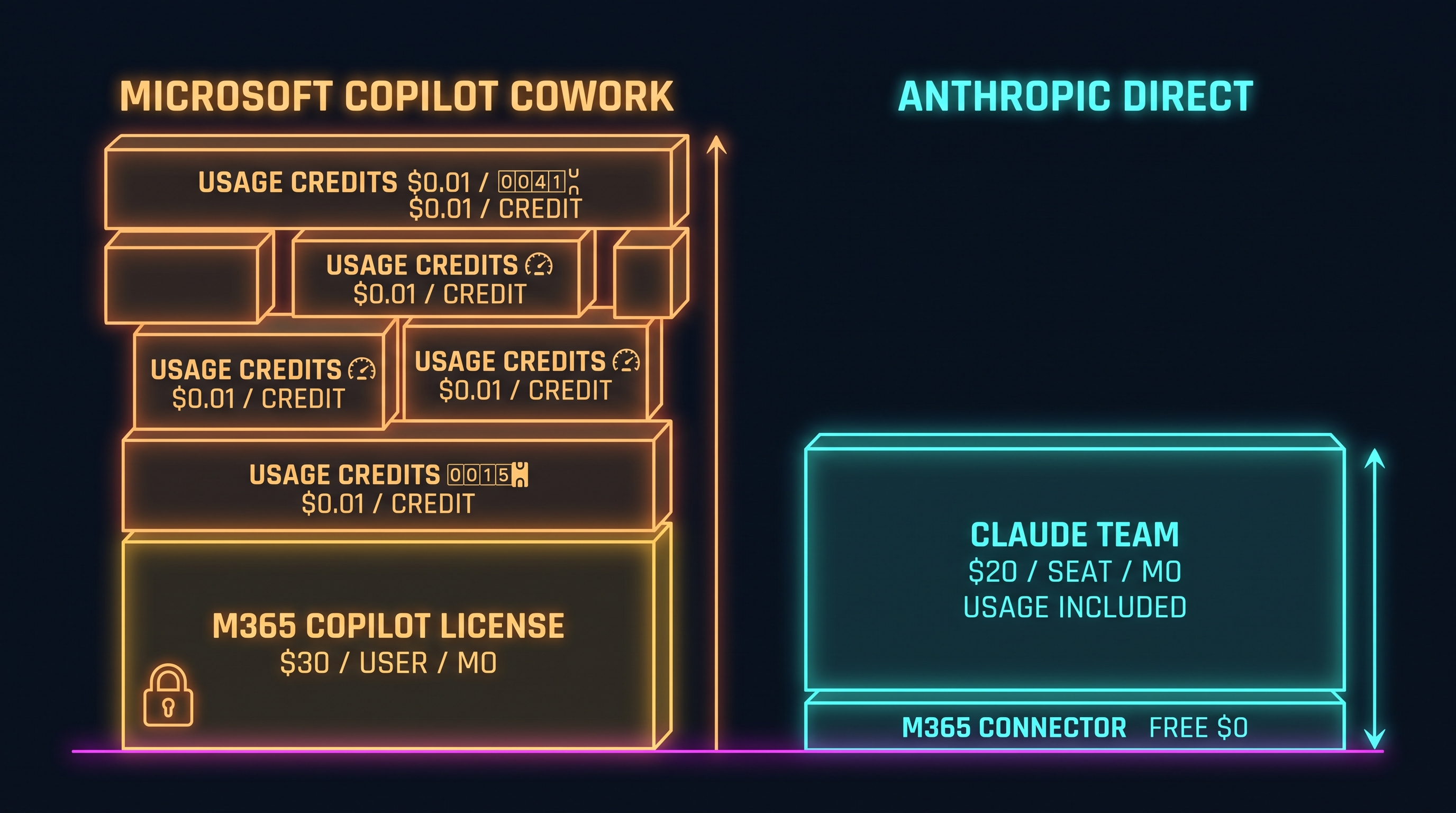
Line those up and the difference is not the model. It is the shape of the bill. Microsoft’s route is a mandatory floor with a meter running on top. Anthropic’s Team tier is a flat seat with the meter switched off. Enterprise turns the meter back on, but you choose that tier for the audit trail, not the price.
Read the prerequisite
Now the 30 to 40 percent. I believe the number. It is Microsoft’s own test, on their own infrastructure, and per task it is plausible that Cowork is tuned to run Claude more cheaply inside the Microsoft stack than a connector reaching in from outside does. A new lower-cost Cowork model is on the way to widen exactly that gap.
But it is a per-task number, and it is measured after the entry fee. The comparison starts counting once both sides are already paying for a seat. What it leaves out is that one side has to buy the Copilot license before the meter ever starts, and the other does not. That license is around three hundred sixty dollars per user per year, whether or not anyone runs a single Cowork task. For a team that wants Copilot across all of Office, that floor is a feature you were buying anyway. For a team that wants Claude over its documents and nothing else, that floor is the entire cost, and shaving 30 percent off the meter on top of it does not get you back to zero.
A discount on the second charge is a strange reason to sign up for the first one.
So which one is cheaper
It splits cleanly, and the split is the answer.
If you are already all in on Copilot. You have the licenses, your people live in Word and Teams, and Copilot is the daily surface. Then the prerequisite is a sunk cost and Cowork’s metered credits are the marginal price of adding agentic work. In that world Microsoft’s 30 to 40 percent is real money and Route A is the cheaper way to run Claude. Buy what you are already standing on.
If you want Claude specifically. Your goal is Claude reading and acting on your Microsoft 365 content, and you do not need the full Copilot suite to justify itself. Then Route B wins outright, because it skips the license floor entirely. A flat twenty-dollar Team seat with usage included, plus a connector that costs nothing to add, undercuts a thirty-dollar prerequisite before the credit meter even turns on. You are not saving 30 percent. You are removing a whole line item.
Most of the “should we go direct” conversations I see are the second case wearing the first case’s assumptions. Someone benchmarks the meter and forgets to ask whether they needed the seat the meter sits on.
What going direct costs you
Cheaper is not free of trade, and I would rather name the bill than pretend Route B is strictly better.
You give up native governance depth. Inside Microsoft, agents live under one control plane, with tenant-wide policy, and the audit and compliance tooling Copilot already carries. Going direct, your governance is whatever Claude Enterprise gives you plus whatever you wrap around it. That is a real surface, but it is not the same as agents governed by the platform your data already sits in.
You accept a data path that leaves the tenant. The connector reaches into your Microsoft 365 from Anthropic’s side. It mirrors each user’s existing permissions, pulls on demand rather than crawling in the background, and does not cache the content it reads, which is a responsible design. It is still an outbound path across a tenant boundary, and in a regulated shop that is a conversation with your risk team, not a checkbox.
You watch the meter at scale. Team’s included usage is the genuine flat cap in this story, but it is a cap with ceilings, sized for teams up to a hundred and fifty seats. Move up to Enterprise for the governance and the usage meter comes back at API rates, scaling with model and task. Neither Anthropic tier is a blank check you can forget about. Direct is cheaper at the entry, not automatically cheaper at the top end.
None of these is disqualifying. They are the price of the cheaper door, and you should walk through it knowing what it costs.
Own the bill
Strip the branding away and this is the same argument I keep landing on. The model is a rental you don’t control, and the layer worth owning is the one wrapped around it. Routing Claude through Microsoft’s meter is convenient, and if you already pay the Copilot rent it is the right call. Routing it direct keeps the bill flat, the seat count legible, and the decision about which model and which cloud in your hands instead of your platform vendor’s.
For a Claude-first organization, direct is cheaper and the trade is governance, not dollars. That is a trade an architect can plan for, budget for, and reverse. A prerequisite you bought to earn a discount on the charge above it is harder to walk back.
Read Microsoft’s number. Then read the line above it.
The companion read is You’re Renting the Model. Own the Harness., which makes the case that the wrapper is the only layer you keep. For why Claude already lives inside the Microsoft and Salesforce estate rather than beside it, see Claude Is Already in the Building, and for the control-plane version of this same coexistence question, Foundry and Fabric, Not Foundry or Fabric.
Find me on X or LinkedIn. I write about what happens when AI infrastructure meets regulated reality.
Get the next field note.
Regulated AI, architecture and platform economics — in your inbox as they publish.