Jev Decides. You Still Own the Call.
The most interesting model of the month never writes a sentence. Jev hands back a typed verdict and a confidence number in milliseconds, for a fraction of a cent. The new primitive is a calibrated, structured, auditable decision, not another chatbot. Here is where it actually fits in a regulated stack, how it drops into a Java shop, and the enterprise gate the cheap-and-fast pitch still has to clear.

Contents
The most interesting model this month never writes a sentence. You hand Jev an input and a set of questions, and it hands back a verdict: pick one of these categories, rate this on my scale, or give me the odds this is true. Every answer carries a confidence number. It comes back in milliseconds, for a fraction of a cent, and there is no paragraph to read because it does not generate text at all.
That is worth slowing down on, because the reflex is to benchmark it against a chatbot and it is not one. The genuinely new primitive here is a calibrated, structured, auditable decision at near-zero cost and latency. Whether that primitive is useful to a regulated shop is a different question from whether it is impressive in a demo, and the honest answer has a few sharp edges.
What Jev actually is
Jev comes from a startup called Type-Safe AI, launched into early access in mid-September 2026. It reads language the way a language model does, but it emits only a typed decision, never prose. It evaluates the questions in a request in parallel rather than one token at a time, which is where the speed comes from. The company describes the training method as reinforcement learning for calibrated decisions, a technique it has named but not disclosed: no weights, no public leaderboard, no paper. The founder is a co-author on the InstructGPT work that underpins the RLHF line of models; the louder “co-inventor of ChatGPT” phrasing you will hear in the launch videos is his own framing, not an independent designation.
The pricing is the part that makes people sit up: input is listed at about four cents per million tokens and output is free, because there is no output to speak of. Treat that as launch pricing, since a promo end date was attached to it. It is available today through the Vercel AI Gateway and OpenRouter, with a waitlist for the direct API. Independent coverage exists, but as the German outlet heise noted, the performance evaluations still come from the startup itself.
A decision, not an essay
The reason this matters architecturally is that most of us have been faking decisions with the wrong tool. You want a classifier, so you take a reasoning model, wrap it in a JSON-mode prompt, beg it to return one of three labels, and then write glue to parse what comes back and retry when it drifts. You pay for the tokens of a rationale you did not want, you strip that rationale off, and you cross your fingers that the first token did not derail the answer.
Jev is the other shape of that problem. The output is typed by construction, so there is no parsing glue and no format to police. This is the distinction I drew in The Model Decides, the Code Controls: there is a clean line between the place where a model makes a judgment and the place where deterministic code carries it out. A model that only ever returns a judgment, in a fixed shape, with a confidence score, sits exactly on that line. One writeup put it well: it is not an LLM, and that may be the point.
A personal aside, because I have followed Karpathy’s thinking for years and this is where Jev landed for me. Back in 2017, writing as Tesla’s AI director, he called it Software 2.0: a growing class of programs would stop being hand-written instructions and instead be learned as the weights of a neural network, where you specify the outcome and optimization finds the program. He has since moved the story forward to Software 3.0, large language models you program in plain English, and the whole industry sprinted that way, toward making everything a thing you talk to. Jev, to me, is a deliberate step back to the 2.0 idea. It does not talk. It is a learned decision function you query, the accelerate-or-brake call from his self-driving stack, sold as a REST endpoint. I am not speaking for him about any of this. That is just how it resonated with me.
It’s a REST call, not a rewrite
Here is the part that matters for anyone running a Java and Spring estate, which is most of the regulated world. There is no Java SDK yet, and it does not matter, because Jev is one HTTP call. You POST to a system1 endpoint with a bearer token and a JSON body of three things: the state (your input), the model, and a list of questions, each tagged as one of three primitives: Null (its null/boolean type, which returns the odds a statement is true), Choice (pick from options you define), or Score (rate on a rubric you define). Every answer carries a confidence number. The response is the model, a map of answers, and a usage record. That is the entire integration surface.
In Spring that becomes a small, boring, correct piece of code: a typed client built on RestClient, the base URL and key bound through @ConfigurationProperties and pulled from the environment, and Java records modeling the request and response. Nothing exotic. And the efficiency win is that a single request can ask all three primitives about the same input at once, so one round trip runs a Null, a Choice, and a Score together. In a walkthrough from Dan Vega, a support-ticket call came back in around half a second with a Null urgency probability, a Choice of department, and a severity Score in one shot.
The architect’s point is the one I keep making about the Java platform’s AI moment: you do not need the vendor’s framework to adopt the vendor’s capability. You wrap the endpoint in a typed client behind your own interface, and the rest of your system depends on your abstraction, not on Type-Safe AI. No SDK, no lock-in, one governed call.
The harness pattern
The most useful thing published so far is not a benchmark, it is a shape. LangChain’s harness writeup wires Jev in as a classifier in the middle of an agent loop and puts it to two jobs. First, a model router: a request arrives, Jev instantly decides whether it needs a small model, a balanced one, or a frontier one, and the expensive model only runs when the cheap decision says it should. Second, a pre-execution guardrail: before a tool call fires, Jev scores whether it is safe to run and blocks the risky ones.
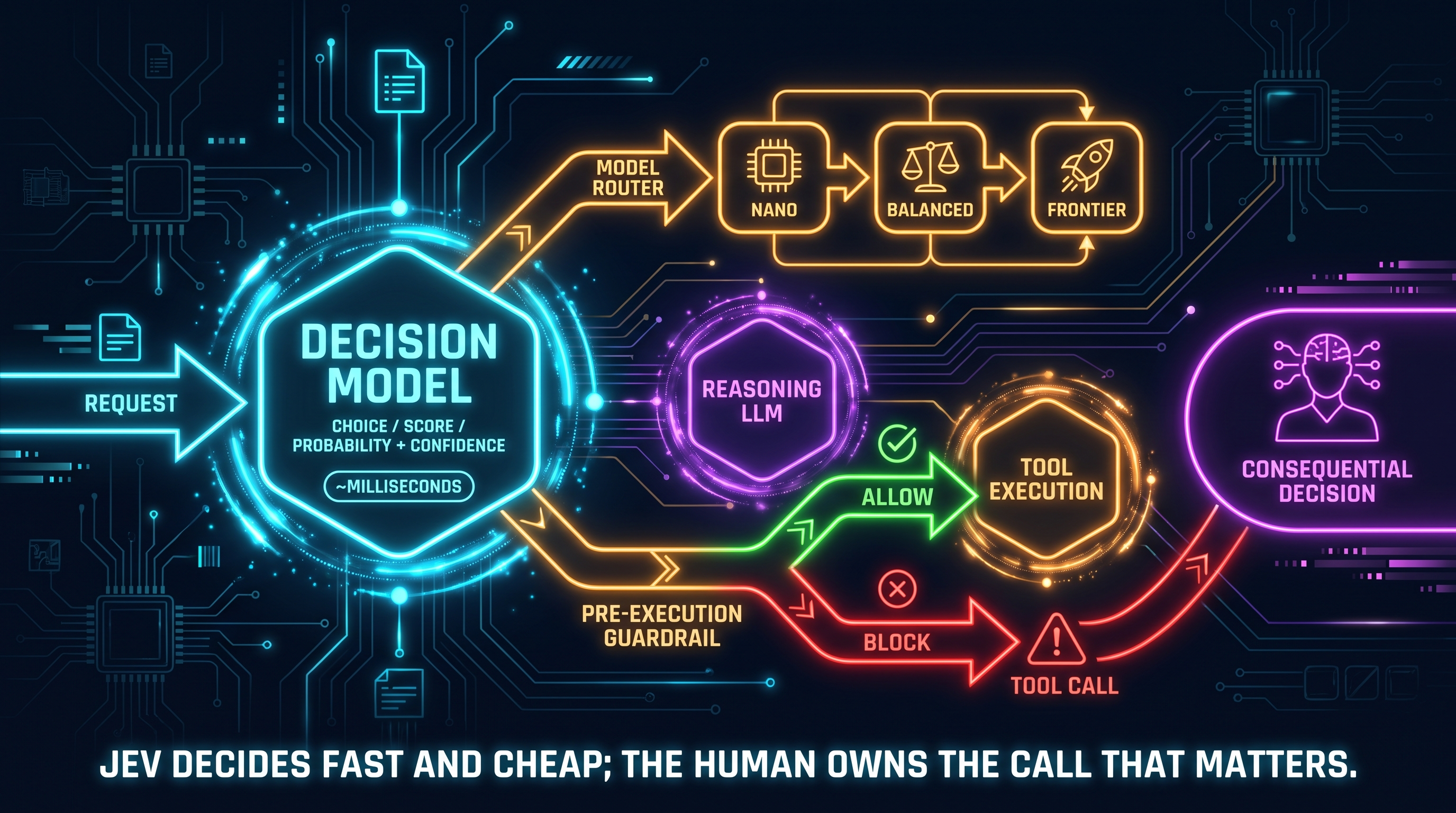
That guardrail is not a new idea, it is a fast, cheap instance of one I have written about before. A confidence-scored check that runs before an action and can stop it is exactly the validation hook pattern, and it lives at the pre-action seam I described in Identity Isn’t Intent, the place where you decide whether an authenticated request should actually be allowed to do the thing it is asking to do. Jev makes that seam cheap enough to put in front of every request instead of the expensive few.
The regulated read
So where does a confidence-scored classifier earn its place in a regulated stack? As an advisory and triage layer: routing inbound work, pre-screening for fraud flags, moderating content, deciding which model handles a request. It is architecturally cleaner than JSON-mode-on-an-LLM for all of them. On the trust ladder, it sits low on purpose, advising and pre-sorting, never owning the consequential decision, which stays with a human whose judgment is the actual moat. Find a queue of inbound information that is expensive to sort by hand, put a fast decision at the front of it, and keep the person on the calls that carry weight.
But there is a gate the cheap-and-fast pitch has to clear before any of this is real in a regulated shop, and it is the one nobody in the launch videos mentions. “Available on Vercel AI Gateway and OpenRouter” means available to a hobbyist. In a bank-grade environment those are usually not approved model-access channels at all. The question that actually decides adoption is whether it arrives in Azure AI Foundry, or whatever sanctioned gateway sits inside your trust boundary, with data residency, procurement sign-off, and the audit path already wired. Until a decision model reaches you through that channel, it does not matter how cheap it is, because you cannot legally put it in the path. That is the same boundary I drew for the on-platform-versus-off question in Draw the Boundary Before You Buy Deeper, and it applies here in full.
The skeptic’s checklist
Before it touches anything that matters, run the caveats honestly. “Cannot hallucinate” is a framing, not a proof; a model with no text to hallucinate can still be confidently, calibratedly wrong, and by the creators’ own demos it is weak at genuinely hard judgment and did badly wired to a market-trading signal that a slower reasoning model beat by reading the news. Calibration is the entire value proposition, and the method behind it is undisclosed, with no weights and no independent leaderboard, so the one property you are buying is the one you cannot yet inspect. The two-hundred-times-faster and four-hundred-times-cheaper figures are the vendor’s internal peak numbers; the one independent test I could find, second-hand, saw far smaller multipliers. And model-risk validation does not get a pass because the model is small and fast. A calibrated classifier whose training is a black box is exactly the kind of thing model-risk guidance exists to make you validate before you trust it. Two of the loudest early videos are sponsored, which does not make them wrong, only worth reading as marketing.
What I’d do with it
The primitive is real and the architecture is clean, and I do not say that about most launches. Treat Jev as a fast advisory, triage, routing, and guardrail layer. Wrap it behind your own interface, validate its calibration against your own labeled data before you believe the confidence numbers, keep a human on every consequential decision, and wait for independent evaluations before you trust the reliability claims.
And watch one signal above the rest. This is what the model layer looks like when it specializes: decision models sitting beside reasoning models, each shaped for the job it does. That specialization is genuinely useful. But whether your regulated shop can use this particular instance of it comes down to a single, unglamorous question, and it is not the price or the latency. It is whether Jev shows up in your sanctioned enterprise channel, not just on the public gateways. Jev can decide all it wants. You still own the call, and right now, so does your procurement team.
If this resonated, read The Model Decides, the Code Controls, on the line between judgment and execution, and Validation Hooks, on the pre-execution gate this pattern is a fast instance of.
Find me on X @orestesgarcia or LinkedIn /in/setsero.
Get the next field note.
Regulated AI, architecture and platform economics — in your inbox as they publish.