Certify the Pipeline, Not the Change
Speed and control stop being a trade-off once the pipeline itself is the control. A practitioner's map of the standards that govern enterprise deployment, from DORA and trunk-based development to SLSA, OpenFeature and ITIL 4, worked through a MuleSoft API and a JHipster app.

Contents
No single standard governs how software reaches production in an enterprise. There are about fourteen of them, and most organizations adopt them one audit finding at a time.
That is the problem. It is also the opportunity, because once you see how the pieces fit, the old argument between shipping fast and staying in control mostly goes away.
The Meeting That Slowed Everything and Caught Nothing
Picture the weekly change advisory board. Twenty changes on the agenda, most of them config tweaks and dependency bumps, each with a slide. The people approving them did not write the code, did not review it, and cannot see the test results. They approve almost everything. The few they push back on get bundled into next week’s release, which is now bigger and riskier.
DORA has been measuring this for years, and the finding has not moved. External approval processes have a negative impact on software delivery performance (opens in new tab), and the research found no evidence that a more formal external review lowers change failure rates. Slow gates create big batches, and big batches fail more often.
Both sides of this argument have a real point, and I want to give each its due.
The delivery side. Teams want to merge daily, release by flag, and recover in minutes instead of waiting for a window. For the people using the system, that is the difference between a fix landing today and landing in three weeks. DORA’s central finding backs them up: teams that deploy more often also tend to fail less and recover faster.
The control side. Someone has to be able to prove who approved a change, what exactly was shipped, how it was built, and that no single person could push it to production alone. Auditors ask for this under SOX, SOC 2, ISO 27001 and PCI DSS, and they are right to. “Trust us, we move fast” is not evidence.
The way out is to stop treating the pipeline as a delivery tool and start treating it as the control. Every check the board was supposed to perform gets encoded, enforced and recorded by the pipeline on every change. Then you certify the pipeline once, and changes that pass through it are pre-approved. The control is still there. It just runs on every commit instead of once a week.
The 2025 DORA report gives this added urgency. It was retitled State of AI-assisted Software Development (opens in new tab), and its headline is that AI is an amplifier. Teams with loosely coupled systems and fast feedback get faster. Teams with slow processes just generate code that waits in a queue. Everything in this post is the precondition for getting value from AI-assisted development. I wrote about the gap between promised and real AI productivity in The Compliance Tax, and a lot of that tax is paid at the deployment gate.
The Map: Fourteen Questions, One Standard Each
Each standard answers a different question. I group them into four layers.
Measure
- Are you getting better? DORA metrics.
- How reliable should it be? SRE practice: SLIs, SLOs, error budgets.
Integrate
- How should you branch? Trunk-based development and continuous integration.
- How do you separate deploy from release? OpenFeature and its remote protocol, OFREP.
- How should a cloud app be built? The Twelve-Factor App.
- How do you describe and version APIs? OpenAPI 3.x (or RAML) with Semantic Versioning 2.0.
Secure
- How do you secure the build? SLSA and NIST SSDF (SP 800-218).
- What is inside the artifact? An SBOM in SPDX or CycloneDX.
- Who built this artifact? Sigstore signing and in-toto attestations.
- Is the API secure? OWASP API Security Top 10 and ASVS.
- How do you harden the platform? CIS Benchmarks.
Operate
- How do you declare and reconcile environments? OpenGitOps principles.
- How do you see what production is doing? OpenTelemetry.
- How are changes governed? ITIL 4 Change Enablement.
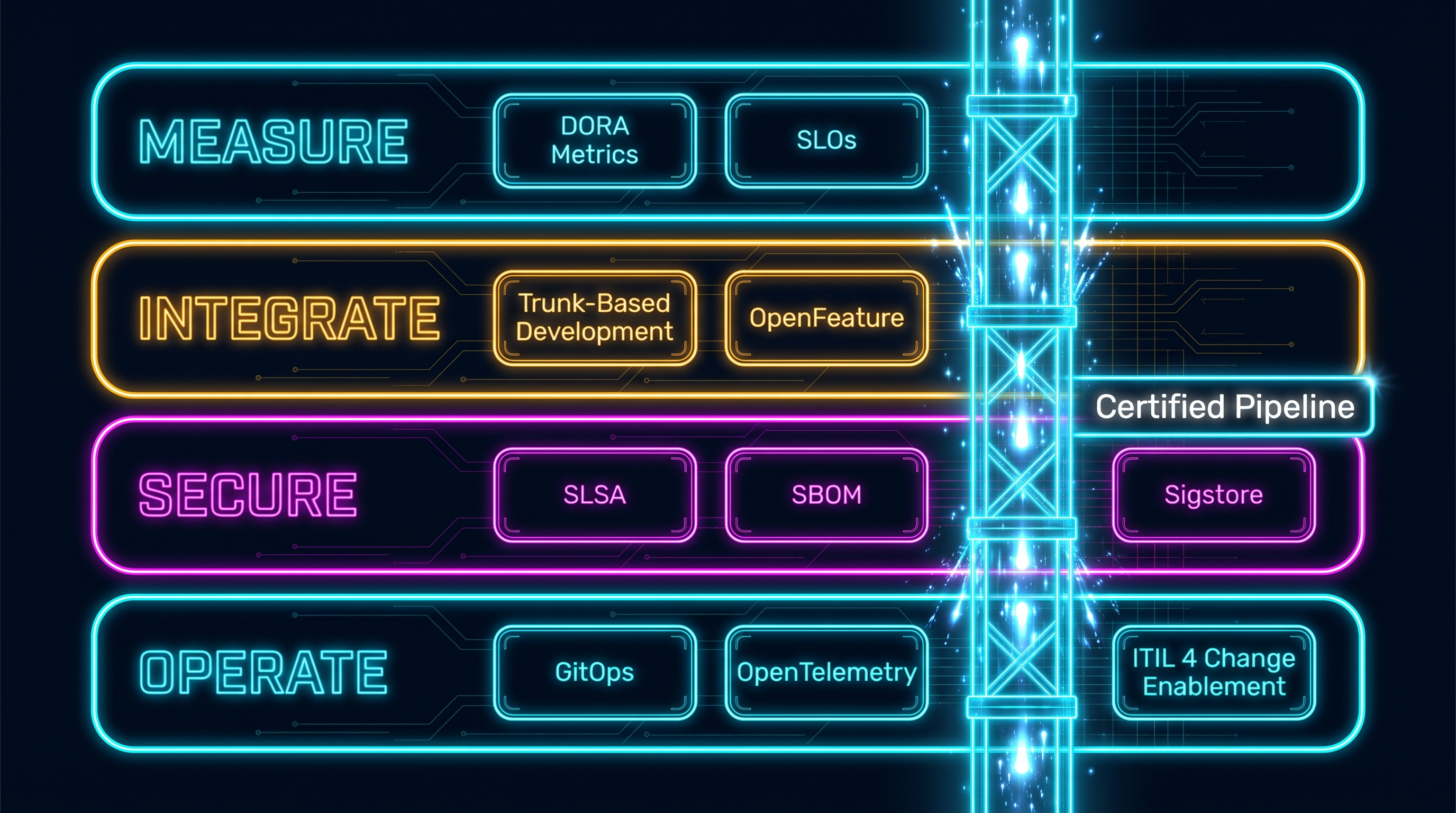
Image description
A four-layer stack with a vertical pipeline running through it. Measure: DORA Metrics, SLOs. Integrate: Trunk-Based Development, OpenFeature. Secure: SLSA, SBOM, Sigstore. Operate: GitOps, OpenTelemetry, ITIL 4 Change Enablement. The pipeline spine is labeled Certified Pipeline
To keep this concrete, I’ll work every layer through one of the most common enterprise pairings I know: a Mule 4 REST API on CloudHub 2.0 or Runtime Fabric, in front of a JHipster / Spring Boot app running in Kubernetes. The two halves behave very differently under these standards, and the differences are where the lessons are.
Measure Without Gaming It
DORA’s classic four metrics are now five (opens in new tab), in two groups.
Throughput
- Deployment frequency: how often you deploy to production.
- Change lead time: commit to running in production.
- Failed deployment recovery time: how long it takes to recover from a bad deployment (what used to be called MTTR).
Instability
- Change fail rate: the share of deployments that need immediate intervention.
- Deployment rework rate: the share of deployments that are unplanned fixes for incidents in production.
Rework rate was first measured in 2024, and it earns its place now. AI-assisted code can inflate throughput numbers while the defects show up weeks later as unplanned patches. Change fail rate misses that. Rework rate catches it.
The 2025 report also dropped the elite, high, medium and low tiers in favor of seven team profiles, built from cluster analysis across delivery, burnout, friction and product outcomes. I think that is the right call. Chasing “elite” turned the metrics into a leaderboard. Improving your own trend is the useful question.
Three rules I hold to:
- Measure from systems, not surveys. Pull the numbers from version control, CI/CD and incident tooling, so they are continuous and hard to fudge.
- Measure per service, report per value stream. An organization-wide average hides the one bottleneck that matters.
- Never make DORA an individual target. Reward people for deployment frequency and you will get a lot of very small deployments.
For this stack: Mule deployment events come from your pipeline or the Runtime Manager audit log, counting only production deployments of the API. On the JHipster side, if Argo CD or Flux deploys it, the GitOps controller’s sync history is your deployment record. For both, tag every incident with the ID of the deployment that caused it. Without that link, change fail rate is a guess.
Trunk Is the Rule, Flags Are the Permit
Trunk-based development (opens in new tab) is the branching model DORA associates with high performance, and its rules fit on an index card. Everyone integrates into main at least daily. Feature branches live hours, maybe a day or two. main is always releasable, so a red build gets fixed or reverted immediately. Release branches, if you need them, are cut just in time, take only cherry-picked fixes, and are never merged back.
GitFlow, with its long-lived develop branch, is still everywhere in the enterprise. It is fine for products shipped as versioned releases to customers. For a continuously deployed service, it is a queue with extra steps.
The repository controls that make trunk safe are well known:
- Branch protection:
mainrequires passing checks and at least one approving review. No direct pushes. - CODEOWNERS: reviews route to the team that owns the code.
- Conventional Commits: so changelogs and SemVer bumps can be automated.
- Signed commits: SSH, GPG or Sigstore gitsign, for repositories where provenance matters.
- Squash or rebase merges: a linear trunk where every change can be reverted cleanly.
For this stack, keep the Mule API and the JHipster app in separate repositories, or at least separate pipelines. They release on different cadences to different runtimes. Then pull the API specification out as its own versioned artifact in Anypoint Exchange, so both sides depend on the contract instead of on each other.
Feature flags make trunk possible
Trunk only works if incomplete work can be merged without being released. That is the job of feature flags, and the standard to build on is OpenFeature (opens in new tab), a CNCF incubating spec. Your code calls a vendor-neutral SDK. A pluggable provider talks to whatever flag system you run: flagd, Unleash, Flagsmith, LaunchDarkly, Datadog. Switching vendors becomes a configuration change.
The part I find most useful for MuleSoft is OFREP (opens in new tab), the OpenFeature Remote Evaluation Protocol. There is no OpenFeature SDK for Mule’s DSL, and I would not write custom Java to get one. OFREP defines flag evaluation over plain HTTP with an OpenAPI definition, so Mule can use a standard HTTP Request:
<!-- Illustrative: evaluate one flag via OFREP, fall back to the safe default -->
<sub-flow name="evaluate-new-pricing-flag">
  <try>
    <http:request method="POST" config-ref="ofrep-config"
                  path="/ofrep/v1/evaluate/flags/new-pricing-engine"
                  responseTimeout="500">
      <http:body><![CDATA[#[output application/json ---
        { context: { targetingKey: vars.tenantId } }]]]></http:body>
    </http:request>
    <set-variable variableName="newPricing" value="#[payload.value default false]"/>
    <error-handler>
      <on-error-continue>
        <set-variable variableName="newPricing" value="#[false]"/>
      </on-error-continue>
    </error-handler>
  </try>
</sub-flow>
Wrap that in a cache scope backed by an Object Store with a short TTL (15 to 60 seconds) so you are not calling the flag service on every request. On the JHipster side, use the OpenFeature Java SDK with the same provider, and expose an allow-listed set of evaluated flags to the frontend through a REST endpoint.
Two cautions. OpenFeature is still pre-1.0. The core spec reached v0.9.0 in 2026 with breaking changes, including an overhaul of fractional bucketing that moves users between rollout cohorts, so pin your SDK versions. OFREP itself is at 0.3.0, which added server-sent events for push updates, but the project notes that SSE is still unimplemented in six ecosystems. Most OFREP clients still poll.
Flag governance
Flags rot faster than any other code, so the governance matters more than the tool:
- Every flag has an owner, a type and an expiry date. Release flags live days to weeks. Kill switches are permanent. Experiments last as long as the test. Entitlement flags are long-lived.
- Safe defaults. If the provider is unreachable, the default must preserve current behavior. The fallback in the snippet above is the whole point.
- One source of truth across Mule and Spring, with the same targeting key on both sides, so a percentage rollout puts the same tenant in the same bucket everywhere. Otherwise a feature ends up half on across the stack.
- Flag changes are production changes. Require approval for production flips and stream flag events into your audit log.
- Test both states of every active release flag in CI, and fail the build when a flag passes its expiry date.
- Flags never break the contract. A flag may change behavior behind the published OAS. A breaking contract change is a new API version, not a flag.
Build Once, Prove What You Shipped
The most violated rule in enterprise CI is also the simplest: build once, promote many. The exact Mule JAR or container image you tested in lower environments is the one that goes to production. Rebuild it per environment and you have tested something else.
That implies immutable, versioned artifacts. Use Exchange or a Maven repository for the Mule app, and a container registry referenced by digest for JHipster, because a tag like :1.4 can be moved. Keep the commit stage under ten minutes. And the pipeline is the only path to production. No laptops, no console uploads.
The test portfolio for this pairing:
- Unit: MUnit with mocked connectors; JUnit 5 and Mockito.
- Component: MUnit flow tests;
@SpringBootTestwith Testcontainers against a real database. - Contract: OAS validation or Pact on the Mule side; Spring Cloud Contract or Pact on the Spring side.
- Integration: both deployed to a test environment or namespace.
- End-to-end: critical journeys only, with the Cypress suite JHipster generates or Playwright.
- Performance: JMeter or Gatling against the API; JHipster can generate Gatling tests.
If I could add only one layer, it would be contract tests at the Mule-to-Spring boundary. Broad end-to-end tests tell you something broke. Contract tests tell you which side broke it, in seconds.
Security scanning goes in the same pipeline: secret scanning (Gitleaks), SAST (Semgrep, SonarQube, CodeQL), dependency scanning (OWASP Dependency-Check, Snyk, Renovate), container scanning (Trivy, Grype), IaC scanning (Checkov), DAST (OWASP ZAP against test) and API linting (Spectral, or Anypoint API Governance). Gate by severity: critical findings block, high findings block unless someone records a time-boxed exception, everything else becomes a ticket.
Supply chain: provenance is the new perimeter
After a few high-profile supply chain attacks, the question changed from “is our code secure?” to “can you prove what you shipped and how it was built?” The standards for answering it:
- SLSA (opens in new tab) build levels. L1: provenance exists. L2: a hosted build platform signs it. L3: hardened builds where the build’s own steps cannot forge provenance. Aim for L2 quickly and L3 for critical services.
- NIST SSDF (SP 800-218) (opens in new tab), the secure development baseline procurement teams increasingly ask for.
- An SBOM per release, in SPDX or CycloneDX (opens in new tab), generated from the actual build, not from source after the fact.
- Sigstore (opens in new tab) cosign to sign images and attach attestations.
Pin everything (lockfiles, Maven versions without ranges, base images by digest), update through automated PRs, and fetch dependencies through a proxied internal repository instead of the public internet.
For this stack, the two halves split. JHipster is the easy one: CycloneDX Maven plugin, Jib image build, cosign sign, and an admission controller (Kyverno, Gatekeeper or the Sigstore policy-controller) that refuses unsigned images.
Mule on CloudHub 2.0 is harder. Anypoint is a managed control plane, and you cannot put an admission controller in front of it. So the pipeline identity becomes the gate. Only a least-privilege Connected App owned by CI can deploy to production, and the version it deploys must match a scanned, signed artifact in Exchange. You are enforcing the same rule as on Kubernetes, just one step earlier.
Config, Secrets and Fewer Environments
The Twelve-Factor App (opens in new tab) is fifteen years old and still the reference. The factors I see violated most in the enterprise are III (config lives in the environment, not the artifact), V (build, release and run are separate stages), X (keep dev and prod as similar as possible) and XI (logs are event streams, aggregated elsewhere).
Secrets go in a secrets manager (Vault, AWS Secrets Manager, Azure Key Vault, GCP Secret Manager), never in the repository, even encrypted. Rotate them automatically, prefer short-lived dynamic credentials, and give each environment its own CI deploy identity.
One contrarian point: the goal is fewer environments, not more. Every long-lived UAT or SIT environment adds drift, cost and lead time. Feature flags, contract tests and progressive delivery replace most of what those environments were for. Ephemeral preview environments per pull request are cheap for JHipster on Kubernetes. On CloudHub they are expensive, because of vCore cost and the time it takes to provision each app.
For Mule: one properties file per environment, selected by an env property at deploy time. Use the Secure Configuration Properties module for sensitive values, with the decryption key supplied as a secure property in Runtime Manager, and declare those properties in mule-artifact.json so they are masked.
Then pin the runtime deliberately. MuleSoft ships two release channels (opens in new tab) on Java 17: Edge, up to three times a year with short support, and LTS, every February with at least 18 months of standard support. Production should normally run LTS. Read the fine print, though. From Mule 4.7 on, CloudHub apps still on an end-of-life runtime are force-upgraded during the monthly upgrade window. Staying put is not an option, so you need an upgrade process you have tested.
<!-- pom.xml: Mule Maven Plugin, CloudHub 2.0 deployment (illustrative) -->
<cloudhub2Deployment>
  <uri>https://anypoint.mulesoft.com</uri>
  <provider>MC</provider>
  <environment>${env.name}</environment>
  <target>${ch2.target}</target>
  <muleVersion>${mule.version}</muleVersion>
  <releaseChannel>LTS</releaseChannel>
  <javaVersion>17</javaVersion>
  <connectedAppClientId>${ap.client.id}</connectedAppClientId>
  <connectedAppClientSecret>${ap.client.secret}</connectedAppClientSecret>
  <connectedAppGrantType>client_credentials</connectedAppGrantType>
  <replicas>2</replicas>
  <vCores>0.2</vCores>
  <properties>
    <env>${env.name}</env>
  </properties>
  <secureProperties>
    <secure.key>${secure.key}</secure.key>
  </secureProperties>
  <deploymentSettings>
    <updateStrategy>rolling</updateStrategy>
  </deploymentSettings>
</cloudhub2Deployment>
Check the parameter names against the Mule Maven Plugin docs (opens in new tab) for your plugin version. They do shift.
For JHipster: use Spring profiles (dev, prod) for behavior, and environment variables or mounted config for values. A profile per environment (staging, uat) quietly breaks build-once-promote-many. Pull secrets through Spring Cloud Vault or the External Secrets Operator.
GitOps, and GitOps by approximation
I made the case in The Domino That Already Fell that infrastructure was the first enterprise deliverable to earn a governed lifecycle. The OpenGitOps (opens in new tab) principles describe it: desired state is declarative, versioned and immutable, pulled automatically by agents, and continuously reconciled.
JHipster on Kubernetes fits this naturally. Turn the generated manifests into Helm or Kustomize, keep them in an environment repository, and let Argo CD or Flux reconcile. CI’s job ends when it commits the new image digest.
Mule on CloudHub 2.0 cannot be GitOps in the strict pull-based sense. So approximate it. Keep every deployment parameter in the repository, deploy only from the pipeline, and run a scheduled job that compares Runtime Manager state against the declared state through the Anypoint Platform APIs and alerts on drift. Script the rest of Anypoint too: environments, business groups, API Manager policies, Connected Apps. Runtime Fabric, which runs on Kubernetes, gets you much closer to the JHipster model.
Deploy Is Not Release
This is the distinction I most wish every team internalized. Deployment puts new code on servers. Release exposes new behavior to users. Once you separate them, most deployment fear goes away.
The strategies, briefly:
- Recreate: stop old, start new. Downtime. Fine for batch jobs nobody watches.
- Rolling: replace instances gradually. Low cost, medium rollback speed. The default for stateless services.
- Blue-green: two full environments, switch traffic. Instant rollback, double cost during cutover.
- Canary: a small share of traffic to the new version, then more. Fast rollback, small blast radius, needs good metrics.
- Shadow: mirror live traffic to the new version and discard its responses. Zero user risk. Good for validating rewrites.
- Feature-flag release: code deployed dark, behavior released by flag. Instant rollback, no infrastructure cost.
Progressive delivery combines a canary or blue-green with automated analysis and automated rollback. Define success before you deploy (error rate, latency percentiles, saturation, a business KPI), promote when it holds, abort when it doesn’t. Use canaries to catch “the build is broken” and flags to manage “the feature is ready.”
For Mule on CloudHub 2.0, rolling updates across replicas are the built-in zero-downtime default. Run at least two replicas in production so a rollout never drops you to zero. For blue-green or canary, deploy the new version as a separate application and shift traffic at a load balancer, gateway or DNS. Check what your Flex Gateway version actually supports for weighted routing before you promise anyone a canary. For most business changes, a flag is cheaper and more precise than an infrastructure canary on Mule.
For JHipster on Kubernetes, native RollingUpdate with correct probes is the baseline, and Argo Rollouts (opens in new tab) or Flagger add canary analysis against Prometheus. The probes and shutdown settings are where most “zero-downtime” claims quietly fail:
# Probe and shutdown config for a JHipster pod
readinessProbe:
  httpGet: { path: /management/health/readiness, port: 8080 }
  periodSeconds: 5
livenessProbe:
  httpGet: { path: /management/health/liveness, port: 8080 }
  initialDelaySeconds: 60
  periodSeconds: 10
lifecycle:
  preStop:
    exec: { command: ["sh", "-c", "sleep 10"] }   # let the load balancer drain
terminationGracePeriodSeconds: 40
Pair it with server.shutdown=graceful in Spring Boot so in-flight requests finish.
The database is where zero downtime goes to die
During any rolling, blue-green or canary deployment, the old and new versions of your app run against the same schema at the same time. If a migration breaks the old version, your zero-downtime deployment just caused an outage.
The answer is expand and contract (opens in new tab), spread across several releases:
- Expand: add the new column or table without removing the old one. Nullable or defaulted.
- Migrate: write to both structures, backfill existing data in a separate job.
- Switch: read from the new structure, optionally behind a flag.
- Contract: drop the old structure in a later release, once nothing uses it.
Every migration must be compatible with the previous app version. No drop, rename or type narrowing in the same release that stops using the old structure. Plan to fix forward. Down-migrations are rarely safe once real data has been written.
JHipster deserves a specific warning. It uses Liquibase and generates changelogs for entities, and regenerating an entity can produce drop-and-recreate changes that are harmless in development and destructive in production. Review generated changelogs like any other code. In production, run Liquibase as a separate Kubernetes Job before the rollout, not at app startup. Otherwise several replicas fight over the migration lock, and one failed migration crash-loops every pod.
The Mule API usually does not own a schema. If it reads tables another team owns, agree a compatibility contract with that team, or better, consume their API instead of their tables.
Contracts and Signals
APIs and observability are where a deployment either earns trust or loses it.
The API standards: OpenAPI 3.x as the default description format (RAML is still supported in Anypoint, but OAS has broader tooling). SemVer 2.0: major for breaking, minor for additive, patch for fixes. The Deprecation header (RFC 9745 (opens in new tab)) and Sunset header (RFC 8594 (opens in new tab)) to announce retirement. RFC 9457 Problem Details (opens in new tab) for machine-readable errors. And the OWASP API Security Top 10 (opens in new tab) as the review baseline.
Work design-first. Write the contract, lint it, publish it to Exchange with a version, generate mocks so consumers start in parallel, then implement and validate against it in tests.
What counts as breaking is less obvious than people think:
- Safe (minor): an optional request field, a new response field, a new endpoint. Consumers must ignore fields they don’t know.
- Breaking (major): removing or renaming anything, making an optional field required, changing a type or its meaning, changing error codes clients depend on.
For a breaking change, run the new major version beside the old one, send Deprecation and Sunset headers on the old one, watch consumer traffic in API Manager analytics, and retire it only when the traffic has moved. Apply API Manager policies (client ID enforcement, rate limiting, JWT validation) through automation, so they are versioned too.
The signals: OpenTelemetry (opens in new tab) for traces, metrics and logs, with the W3C traceparent header carrying one trace from the consumer through Mule into Spring and its database. Recent Mule runtimes make this native: from Mule 4.11, the runtime can export traces and logs over OTLP (opens in new tab) on CloudHub 2.0 and Runtime Fabric, and it puts trace and span IDs into the logging context. On older runtimes, the Anypoint Monitoring telemetry exporter covers 4.6 and later. Spring Boot 3 gets there through Micrometer Tracing with an OTLP exporter, or the OpenTelemetry Java agent.
Then define reliability the SRE way: an SLI (the share of requests succeeding within 300 ms), an SLO (99.9% over 28 days), and an error budget, the 0.1% you are allowed to fail. When the budget runs out, reliability work goes ahead of features. Alert on burn rate (opens in new tab), not raw thresholds. And put deployment markers and flag-change events on your dashboards, so the first question in every incident (“was it a deploy or a flag?”) takes five seconds to answer.
Certify the Pipeline
Here is where the control side gets everything it asked for.
ITIL 4 renamed change management to change enablement, and the rename matters. The emphasis moved from gatekeeping to flow. Its three change types map cleanly onto a modern pipeline:
- Standard: low-risk, pre-authorized, repeatable. Any change that goes through the approved, automated pipeline.
- Normal: needs risk assessment and authorization. Peer review plus automated risk scoring, with the board reserved for genuinely high-risk changes.
- Emergency: must happen now. An expedited path with a retrospective review.
The pattern follows. Certify the pipeline, not each change. Once the pipeline enforces review, testing, scanning and approval gates, everything that passes through it is a standard change. The pipeline creates the change record in ServiceNow or Jira Service Management automatically, linked to the PR, test results, SBOM and deployment ID. The board’s attention goes to what the pipeline cannot judge: major architectural changes, data migrations with business impact, changes during a declared freeze.
Segregation of duties is the hard part, because the traditional reading (“developers must not deploy to production”) conflicts directly with continuous delivery. The interpretation that holds up:
- No one ships alone. A second person approves every PR, enforced by branch protection.
- The pipeline deploys, not people. Production deployment runs under the pipeline’s identity.
- Human production access is break-glass only: time-limited and logged.
- The evidence is automatic and immutable: approvals, pipeline logs, artifact signatures, change records.
For this stack, that means Runtime Manager production permissions are read-only for humans and only the CI Connected App can deploy, with the Anypoint audit log as part of the evidence. Under GitOps, the environment repository’s merge history becomes the change record for JHipster, so restrict who can approve merges to the production overlay. Production flag flips in the flag tool get the same treatment.
One instruction I won’t soften: agree this interpretation with your internal audit function before you rely on it. Written down, signed off, before the first audit. This is the same move I described in Compile the Policy: take a control that lives in a document and a meeting, and make it run in the pipeline, where it executes the same way every time and leaves evidence behind.
Rollback Is a Hypothesis Until You Rehearse It
When something goes wrong, the order of preference is short:
- Feature misbehaving: turn off the flag. Fastest, lowest risk.
- Build broken, no schema change: roll back to the previous artifact.
- Build broken, schema already expanded: roll back the app. Expand and contract keeps the old version compatible, which is the reason you did it.
- Bad data written: roll forward with a fix and a data repair. Restore from backup only as a last resort.
The resilience patterns are standard: a timeout on every outbound call, retries with exponential backoff and jitter only for idempotent operations, circuit breakers and bulkheads, idempotency keys on anything that creates or moves value, and ops flags to shed non-essential features under load. Mule gives you Until Successful and reconnection strategies (always with explicit limits), plus rate-limiting and spike-control policies. JHipster apps get Resilience4j.
Define RTO and RPO per service with the business, pick a recovery pattern that matches (backup and restore, pilot light, warm standby, active-active), and test it on game days. CloudHub 2.0 private spaces are region-bound, so multi-region means deploying to several regions with traffic management in front, and checking that your Object Stores and queues actually meet your RPO. For JHipster, database replication and backups dominate RPO. Rehearse the restores, not just the backups.
Where to Start
Nobody adopts all of this at once. This is the order I’d follow:
- Foundations: one pipeline per service, build once and promote, secrets out of repositories, baseline DORA metrics. Result: no manual production deployments and a starting point you can measure.
- Safe integration: trunk-based development, OpenFeature flags, contract tests at the Mule-to-Spring boundary, expand-and-contract migrations. Result: daily integration without breaking production.
- Secure supply chain: SBOMs, signing, security gates, SLSA Build L2. Result: artifact integrity you can prove, and evidence ready for audit.
- Progressive delivery: SLOs, burn-rate alerts, canary or blue-green with automated analysis. Result: release separated from deployment, rollback automated.
- Governance by automation: pipeline-certified standard changes, automatic change records, GitOps for Kubernetes, drift detection for Anypoint. Result: the board focuses on real risk, and compliance costs less effort.
Track DORA metrics and SLO attainment the whole way. If throughput rises while change fail rate and rework rate hold or fall, it is working.
A condensed readiness check. If any of these is not true yet, that is your next piece of work:
- Everyone integrates to
mainat least daily, behind branch protection and CODEOWNERS - Every release flag has an owner and an expiry date, and both states are tested
- One immutable artifact is promoted through every environment
- Contract tests run in both the Mule and JHipster pipelines
- Secret, SAST, SCA and container scans gate the pipeline
- Every release has an SBOM, and artifacts are signed and verified before deploy
- Only the pipeline holds production deploy credentials
- Mule runs on LTS with a tested upgrade path
- At least two replicas and graceful shutdown in production
- Every schema change follows expand and contract
- Every production API has an SLO and an error budget
- One trace runs from the consumer through Mule into JHipster
- Change records are created by the pipeline
- Rollback and DR were rehearsed within the last year
What I Don’t Have a Clean Answer For
The Mule half of this stack is the awkward half. You cannot put an admission controller in front of CloudHub, you cannot do pure GitOps against a managed control plane, and preview environments cost real vCores. The workarounds I described (pipeline identity as the gate, drift detection by API) are good. They are still workarounds, and they depend on discipline more than enforcement.
OpenFeature is the right bet, but it is a pre-1.0 bet. A bucketing change that moves users between cohorts is not a minor version bump when those users are customers in the middle of a rollout.
And the segregation-of-duties reading in this post is widely accepted, but your auditor has never signed it. Until they do, it is just a plan. Bring them in early, and bring the evidence trail with you.
Where This Lands
The standards are not the hard part. Each one is documented, most are free, and the tools are mature. The hard part is accepting that the control your organization needs and the speed your teams want come from the same place. A pipeline that enforces review, proves provenance, separates deploy from release and writes its own change records is faster than a board, and it gives better evidence.
Next I want to take the Mule half further: what a real drift detector against the Anypoint Platform APIs looks like, and how close Runtime Fabric gets you to the JHipster model. When I have it running, I will write it up.
Prefer to watch? The video version is on YouTube (opens in new tab).
If this resonated, read The Domino That Already Fell: it makes the case that infrastructure already proved the governed lifecycle works, and this post is that lifecycle applied to every deployment.
Find me on X @orestesgarcia (opens in new tab) or LinkedIn (opens in new tab).
Get the next field note.
Regulated AI, architecture and platform economics — in your inbox as they publish.