The Developer Experience You Can Bring Yourself
Salesforce Agentforce Vibes blends copilot completion with vibe coding. Claude Code takes a different approach entirely. Here is what I found trying both before TDX, and which parts of the Salesforce dev AI bundle look optional.
Contents
I’ve been preparing for TDX by doing something I suspect Salesforce would rather I didn’t: trying to replicate the Agentforce Vibes developer experience using Claude Code instead. Not as a stunt, but as a genuine architectural question. In the first dispatch of this series, I mapped which Salesforce infrastructure layers look optional for an Azure-invested architect. This one narrows the lens to the developer experience layer specifically.
Salesforce launched Agentforce Vibes as their enterprise vibe coding platform: a VS Code-hosted environment with inline code completion, natural language-to-feature generation, and an AI agent called Vibe Codey that understands your Salesforce org’s metadata. I’ve been spending time with it. I’ve also been doing the same Salesforce development work in Claude Code. The experiences are different in ways that matter more than the feature lists suggest.
Two Different Animals
The first thing I noticed is that Agentforce Vibes and Claude Code aren’t really competing on the same axis, and conflating them misses the point.
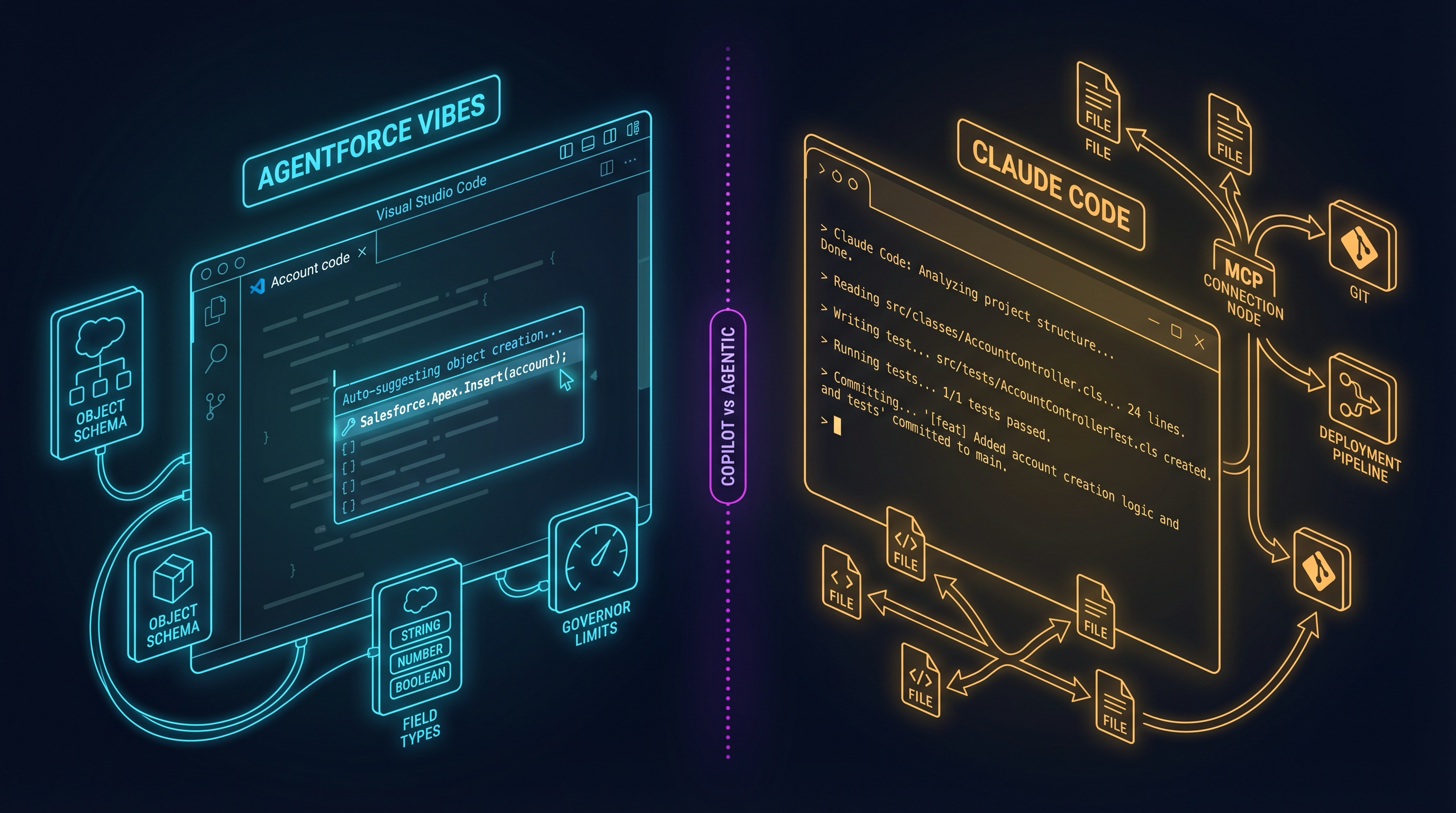
Vibes is a copilot hybrid. It blends two modes: inline code completion that fires as you type, and a prompt-to-feature workflow where you describe what you want in natural language and Vibe Codey generates Apex, LWC, or Flow components. Salesforce positions it as a “pair programmer”: it suggests, it generates, and it stays within the bounds of your Salesforce org’s schema and governor limits while it does it.
Claude Code is agentic. It doesn’t complete lines while I type. It reads context across the entire project, plans multi-step changes, executes across files, runs tests, and iterates on failures. When I hand it a Salesforce development task, it doesn’t suggest an Apex class. It writes the class, writes the test, checks governor limit patterns, and commits the result. The interaction model is fundamentally different: I’m not pair programming, I’m delegating.
I compared Claude Code to Copilot CLI earlier this year and landed on a similar distinction. The copilot model helps you write faster. The agentic model helps you think less about the writing and more about the outcome. Vibes sits in the copilot camp with stronger Salesforce-specific context than anything I’ve tested. Claude Code sits in the agentic camp with broader reach and deeper autonomy.
My experience after several weeks: Vibes feels like a smarter autocomplete that can occasionally scaffold a feature. Claude Code feels like handing a task to a junior developer who has read the whole project and will come back with a working implementation or an explanation of why it doesn’t work yet.
Where Vibes Has a Real Edge
I don’t want to pretend this is one-sided. Vibes does things that are genuinely hard to replicate.
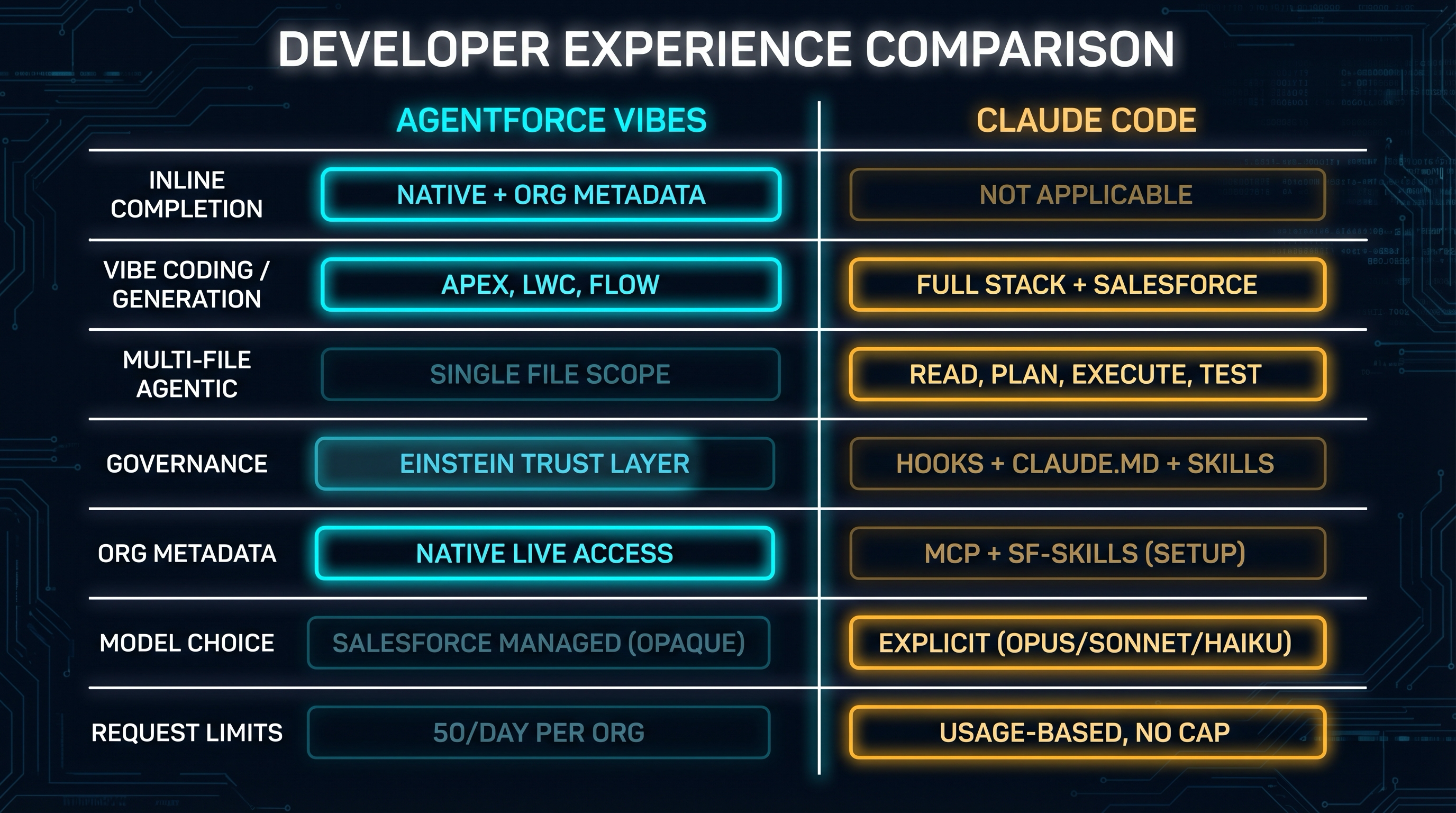
Org metadata awareness is native. Vibe Codey understands your Salesforce org’s metadata, schema, object relationships, coding standards, and existing assets. When you start typing an Apex method, the inline suggestions know which custom objects exist, which fields are available, and which relationships are valid. That context is live and automatic: no setup, no configuration files, no MCP servers to connect.
Code Analyzer and ApexGuru run inside the generation loop. Vibes integrates static analysis that catches security vulnerabilities, governor limit violations, and runtime efficiency issues as part of the generation process, not as an afterthought. For Salesforce-specific patterns (bulk API compliance, sharing rule violations, SOQL injection risks) this is ahead of anything Claude Code does natively.
Zero configuration for Salesforce-native work. Connect to your org, open VS Code, start typing. No CLAUDE.md, no skills files, no MCP server setup. For a quick Apex trigger or a straightforward LWC component, the path from idea to working code is genuinely shorter in Vibes.
Where Claude Code Changes the Equation
Where the two diverge is on everything that extends beyond a single-file generation task.
Multi-file agentic workflows. When I need to refactor a service class, update the corresponding test class, adjust the LWC that consumes it, and verify the integration, Claude Code handles that as one task. Vibes would require me to prompt each piece independently and stitch the results together. The agentic approach shines whenever the unit of work is larger than a single file.
Custom skills and governance hooks. The sf-skills library provides 14 Salesforce-specific skills with over 420 validation points: bulkified Apex patterns, governor-limit-aware SOQL, modern LWC conventions. More importantly, the hooks system I described in Claude Buddy v5 gives me pre- and post-execution gates, project-specific rules via CLAUDE.md, and the regulated guardrails I first built for banking environments. Vibes has the Einstein Trust Layer for PII masking and code scanning. Claude Code’s governance is more flexible and extensible; the tradeoff is that you have to build it rather than configure it.
Cross-stack reach. Vibes is scoped to Salesforce: Apex, LWC, Flow, and the metadata ecosystem. Claude Code works across the entire stack. When the task involves Salesforce on one side and Azure infrastructure, MuleSoft configurations, Terraform definitions, or deployment scripts on the other, Vibes can’t follow me there. In the opt-out architecture I described in Part 1, the developer experience needs to span the seam between vendors, not stop at one vendor’s boundary.
No artificial request cap. Vibes allocates 50 premium requests per day per org, or one million tokens, whichever runs out first. You can stretch to 250 daily by using five scratch orgs. In a real development sprint, that budget doesn’t last a morning. Claude Code’s cost is usage-based: the spend is real and visible, but I control the ceiling, and there’s no point where the tool stops working because a counter hit zero.
The Cost and Lock-In Question
Vibes runs on Salesforce-managed models. You don’t choose the model, tune it, or audit which version generated your code. It’s opaque by design. TechCrunch’s coverage frames this as enterprise trust, but it’s also enterprise lock-in. When Salesforce decides to change the underlying model, your development experience changes with it.
Claude Code runs on Claude explicitly: Opus, Sonnet, or Haiku, your choice per task. The skills and workflow infrastructure around it isn’t model-locked in principle. If the model layer shifts, the governance layer, the project rules, and the skills survive. CIO Dive reported that Salesforce is betting on vibe coding as a retention strategy: making the developer experience good enough that switching costs compound over time. That’s a valid business strategy. It’s also a signal that the lock-in is intentional, not incidental.
Neither tool is free. Vibes is bundled with Salesforce licensing plus a future paid tier for premium request volume. Claude Code is API-spend-based. The difference that matters architecturally: one cost model is controlled by the vendor’s allocation decisions, the other by your usage decisions.
The Honest Admission
Stripping Vibes out of the Salesforce developer experience costs you something real. The inline-while-typing experience with native org metadata awareness is something Claude Code doesn’t replicate natively. You can get there with MCP servers, the sf-skills library, and Salesforce CLI integration, but it’s a setup-and-configure path, not a zero-config one. Community guides for using Claude Code with Salesforce exist and they’re getting better, but they prove the point: there’s a ramp.
And tool capability doesn’t matter if the org can’t adopt it. Some teams will be better served by Vibes’ lower adoption barrier: install the extension, connect to the org, start prompting. The overhead of building a Claude Code-based Salesforce development workflow is a real investment. It pays off at scale and complexity. It doesn’t pay off for a team building one-off triggers.
What I’m Curious About at TDX
Three things I want to find out on the floor this week. Whether Vibes’ upcoming premium model tier changes the capability ceiling enough to close the gap with agentic tooling. Whether there’s any MCP integration roadmap that would let Vibes talk to external systems the way Claude Code already does. And whether the “vibe coding” framing survives contact with teams doing real agentic engineering, or whether the category splits into “vibe” and “agentic” the way “AI assistant” already split into “chatbot” and “agent.”
This is the second dispatch in the TDX series. The first one asked which infrastructure layers are optional. This one found that the developer experience layer has genuine value in the bundle, but the parts that matter most (the agentic workflow, the cross-stack reach, the governance flexibility) are the parts you can bring yourself.
Sources
Salesforce: Agentforce Vibes, Enterprise Vibe Coding · Salesforce Developers Blog: Unleash Your Innovation with Agentforce Vibes · Agentforce Vibes Developer Guide: Overview · Agentforce Vibes Developer Guide: Inline Auto Completion · SalesforceBen: Salesforce Launches Agentforce Vibes · TechCrunch: Salesforce Launches Enterprise Vibe-Coding Product · CIO Dive: Salesforce Bets on Enterprise Vibe Coding · GitHub: sf-skills, Salesforce Skills for Agentic Coding Tools · SalesforceBen: 10 Lessons Using Claude Code for Salesforce Flows · Salesforce: Your Guide to TDX 2026, Vibe Coding Edition
The infrastructure opt-out analysis is in Salesforce Without the Full Buy-In. The Claude Code governance model is in Claude Buddy v5.
Find me on X or LinkedIn. I write about what happens when AI infrastructure meets regulated reality.
Get the next field note.
Regulated AI, architecture and platform economics — in your inbox as they publish.