The Practical Value of a Salesforce Certification
A classmate holds twenty-three Salesforce certifications. Another holds thirteen. I hold two architect-track certs and I keep asking the same question: what is any of this actually worth inside a corporate org where nobody asks about your Trailhead ranger status in the Monday standup?

Contents
A classmate holds twenty-three Salesforce certifications. Another holds thirteen. I have two, Platform Integration Architect and Platform Data Architect, and I’m booked for MuleSoft Platform Integration Architect next month. That’s it. Two on the wall, one in the queue, and a growing suspicion that the size of the stack is not the thing that matters.
The question I keep coming back to isn’t how many certs should you collect. It’s a blunter one. What is a Salesforce certification actually worth inside a corporate org, where nobody asks about your Trailhead ranger status in the Monday standup and the account executive still controls the roadmap? That question has a real answer. It just has two completely different real answers depending on which side of the invoice you happen to be sitting on.
The Two Economies of a Salesforce Certification
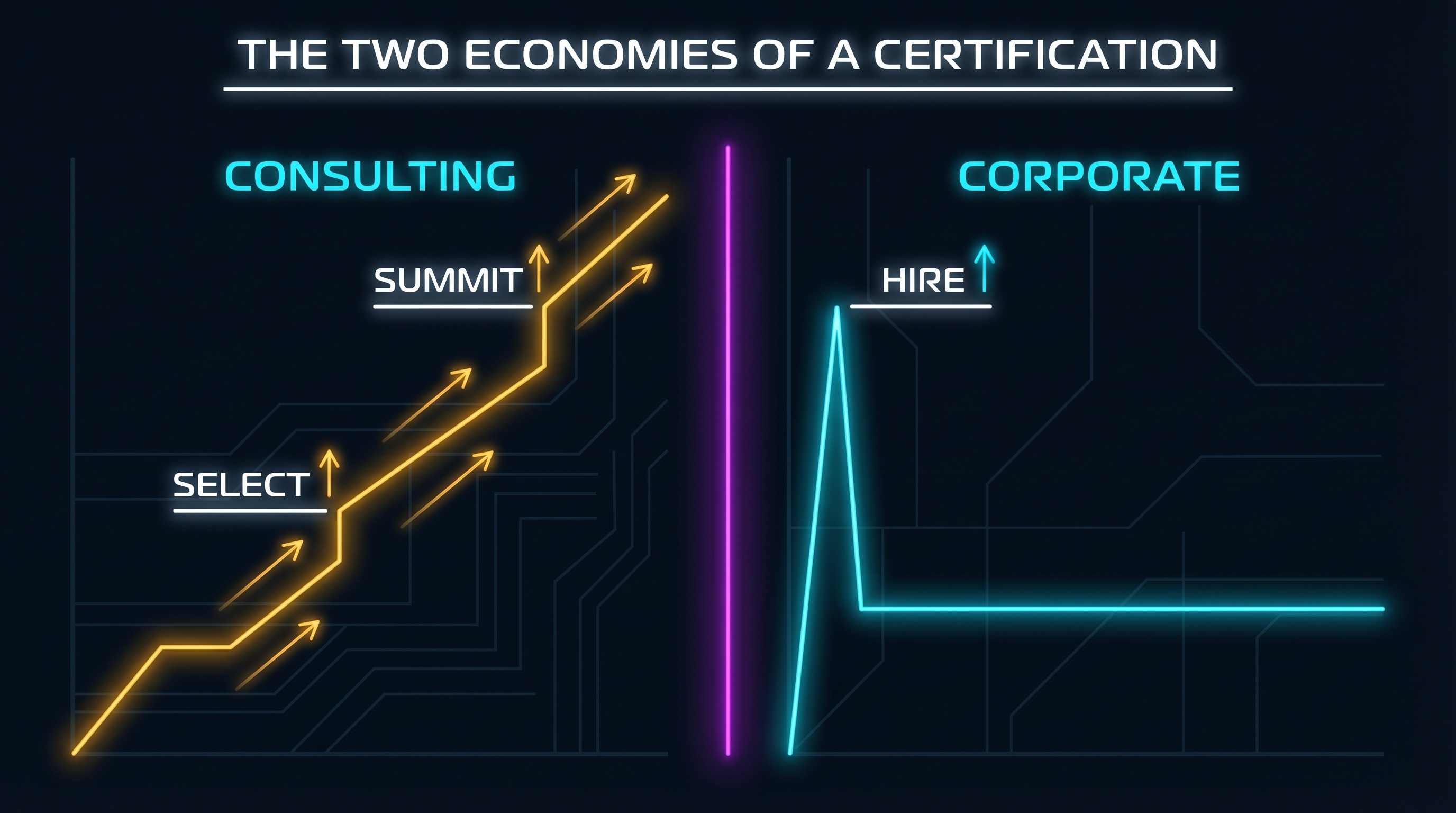
There’s a consulting economy and a corporate economy, and a cert carries a different price tag in each one.
On the consulting side, certs are revenue. Salesforce’s Partner Navigator Program explicitly rewards cert density across a practice. Tier placement, Navigator specializations, co-sell eligibility, Customer 360 spec badges, RFP shortlisting: all of it weights toward cert counts inside the firm. That’s why a partner principal will sign off on exam vouchers without blinking. Every cert on the roster is one more checkbox toward a higher tier, one more justification for a higher bill rate, one more box ticked in the procurement questionnaire. It’s a line item on the margin calculator, not a vanity metric.
It’s also a moving target. In 2025 Salesforce massively overhauled the consulting partner program, collapsing the old four-tier structure (Base, Ridge, Crest, Summit) into a simpler two-level model and cutting 170 Navigator distinctions down to twenty-eight outcome-focused competencies. The badge economy still runs; it just got reshaped. If anything, the overhaul made cert concentration more important on the consulting side: fewer tiers means sharper cutoffs.
On the corporate side, none of that applies. There is no tier to chase. No co-sell motion. No procurement questionnaire waiting at the end of the year asking how many Data Architects you employ. The cert shows up once at hire. Maybe once at a promotion cycle. And then it disappears into a LinkedIn banner. Value drops to roughly zero the day you start. That’s the asymmetry that makes “how many certs should I get?” a nonsense question until you specify which economy you’re playing in.
Signal vs. Skill: What the Multiple Choice Actually Tests
Michael Spence wrote Job Market Signaling in 1973 and picked up a Nobel for it. His point, compressed: a credential works as a hiring signal precisely because it’s costly to acquire, not because the content is load-bearing on the job. Applied to the Salesforce certification catalog, that reframes the whole conversation.
Admin, Developer, and Consultant certs are mostly recall tests. Click paths. Governor limits. Object model trivia. Which automation tool to choose in which scenario. That stuff is useful the first time you encounter it and forgettable the fifth time. The exam doesn’t measure whether you’ve ever shipped a Flow to production. It measures whether you remember that Record-Triggered Flows run after validation rules.
The Architect-track exams aim higher. They try to test tradeoff reasoning: integration patterns, data gravity, governance, scalability, identity and access boundaries, sharing and visibility, development lifecycle. But they’re still scenario multiple choice. You read a vignette about Acme Corporation and pick the least-worst answer. Real architectural judgment, the kind where a stakeholder changes a constraint in the middle of a meeting and three of your patterns collapse at once, does not fit on a scan sheet.
The one exception is the Certified Technical Architect review board. The CTA makes you defend a live architecture in front of humans who can interrupt you. It’s closer to a PhD viva than a test. It’s also expensive in a way that deserves its own line in the budget: about six thousand dollars between the evaluation and the review board itself, before you count the eighteen months of prep time. The price tag matters because the price tag is the signal.
Stack that against release velocity. Salesforce ships three major releases a year. Agentforce, Data Cloud, and Slack-as-agent-surface are all mid-flight product stories that will look different in eighteen months than they do today. The half-life of a cert’s content is shrinking. The half-life of its signal is longer but decays too, especially as LinkedIn fills with Trailhead ranger banners. Twenty-three certs does not signal mastery in that market. It signals six months of bootcamp time, a healthy voucher budget, and the focus to sit through a lot of multiple choice.
Why the Architect Track Is a Different Animal
Here’s the part where I quietly defend the path I’m on without turning into a Trailhead influencer.
The Architect track (Integration, Data, Identity and Access, Sharing and Visibility, Development Lifecycle, Platform Development, Application, System) is principle-first. The exams bake in vocabulary that is not really Salesforce vocabulary. They bake in pub/sub, Change Data Capture, event-driven patterns, API-led connectivity, master data management, data contracts, identity federation, token trust boundaries, governance gates. Those concepts are portable. An Integration Architect’s mental model of Platform Events and CDC maps one-to-one onto Kafka, Azure Event Grid, AWS EventBridge, and any future queue someone invents next year. A Data Architect’s model of MDM, golden records, and sharing topology maps onto any governance conversation in any stack.
MuleSoft Integration Architect is the most portable of the three I’m stacking, precisely because it’s only incidentally Salesforce-branded. The API-led connectivity pattern, the system/process/experience layer decomposition, Flex Gateway policy enforcement, DataWeave as a data transformation language, the service catalog discipline: those survive any vendor migration. If the whole Salesforce thesis evaporated tomorrow, an MCIA still knows how to stand up a governed integration plane. That’s a different kind of durable than knowing the current Flow element palette.
The other thing the Architect stack does is compound. Admin, Developer, and Consultant certs are mostly parallel collectibles: each one stands alone, and adding the twentieth doesn’t deepen the nineteen you already have. Architect certs stack. Integration plus Data plus Identity plus Sharing and Visibility builds an actual mental model of an enterprise Salesforce estate. The certs are a scaffold for a reading list, not a reading list themselves. Two architect certs compound more than ten admin certs for anyone whose job is saying no to bad ideas in review meetings.
That’s why I stopped at two Architect certs and went vertical instead of horizontal.
The Corporate Practical-Value Inventory
Strip away the consulting-economy revenue math and ask the honest question. What does a Salesforce cert actually earn inside a corporate org, once the onboarding handshake is over and nobody is counting badges on a partner scorecard?
Five things, in descending order of how defensible the value is.
Vendor-negotiation credibility. When the account executive walks in pitching Data Cloud, Agentforce, or the next acronym after that, a Data Architect cert buys you the right to interrupt the deck and be taken seriously. You can call out that Zero Copy is not a replacement for a real semantic layer. You can say the Atlas reasoning engine is tightly coupled to Agentforce seats, not a standalone service. You can do the math on whether the opt-out architecture from the TDX dispatch last week is actually viable in your estate. You could do all of that without the cert, but the cert is what gets you invited to the meeting in the first place.
A seat on the architecture review board. Internal design authorities, enterprise architecture councils, and TOGAF-adjacent governance forums tend to treat the Architect-track credential as a qualification marker. It’s gatekeeping, not merit, and it works. You end up in rooms you wouldn’t otherwise be in, which means you end up shaping decisions you wouldn’t otherwise have shaped.
Insourcing leverage. Every Architect-track cert on staff is one fewer statement of work to a systems integrator. The ROI math on one senior in-house architect with two relevant certs versus one senior consultant at partner bill rates is embarrassingly lopsided. The cert does not do the insourcing (you have to hire the person and let them do the work) but it gives the CIO the air cover to justify the decision when someone asks why they’re not just calling the big four.
Career-mobility insurance. A cert is an option, not a paycheck. It gets exercised when you change jobs, not while you’re doing the current one. That’s not nothing. The tech job market cares more about credentials the less the market knows you.
Psychological cover for contrarian positions. Being the person who says no to the Einstein pitch, no to the managed-service AI gateway, no to the premature Data Cloud migration: that’s easier with the badge than without it. The badge doesn’t make you right. It just means the room has to argue with your logic instead of dismissing you on vibes.
Notice what isn’t on that list. Execution speed. Solution quality. Stakeholder trust. Delivery outcomes. Hit rates on go-lives. None of those correlate meaningfully with cert count inside a corporate org, and I have yet to hear a hiring manager argue otherwise in private.
The Honest Admission
Certifications don’t teach the things that actually decide whether a project ships.
They don’t teach stakeholder politics, or why the correct architecture loses to the approved one in a steering committee meeting where the head of operations wants the project finished before fiscal year end. They don’t teach legacy system archaeology: the undocumented integration from 2014 that two people in the company still understand and both of them are contractors. They don’t teach the discipline of negotiating a data contract with an upstream team that has never heard the phrase “data contract” and doesn’t think they owe you schemas.
They don’t teach change management. They don’t teach the adoption curve. They don’t teach budget triage, capex versus opex framing, or reading a P&L well enough to know which initiatives are actually funded next year and which are just on a slide. They don’t teach you how to tell a product director they’re wrong in a way that keeps them as an ally.
None of that is on any exam. None of it ever will be. Those are the things that decide whether a project ships, and a cert holder with zero production go-lives under their belt is a platform tourist, not an architect. Twenty-three certs does not fix that gap. Two certs plus three years of dragging projects across the line in the face of organizational resistance closes it faster than any amount of Trailhead can.
This is the part I wouldn’t want to skip if someone read this post at a bootcamp and treated it as permission to collect fewer badges without also doing the harder work underneath.
What I’m Still Testing
Four questions I haven’t resolved, and which I’ll keep pressure-testing as I move through the next cert and the next couple of years inside a corporate estate.
Is the Architect-track sweet spot exactly two certs? My working guess is Integration plus Data, or Integration plus Identity and Access, is where the corporate signal maxes out, and the third through sixth certs mostly decorate a LinkedIn banner. I don’t know that yet. I’ll know better after a few more hiring conversations on both sides of the table.
What comes after MuleSoft Integration Architect? The honest answer is I haven’t decided. One path stacks deeper into the Salesforce Architect track: Application Architect, System Architect, eventually CTA. The other path steps outside the Salesforce orbit entirely, toward AWS Solutions Architect Professional or Azure Solutions Architect Expert, because portability starts to matter more than platform depth. I can make the case for either. The indecision is the honest part.
Is CTA worth it for an in-house architect? Six thousand dollars in exam fees is the easy number. The eighteen months of prep and the opportunity cost of the evenings is the real price. CTA is the one Salesforce cert that tests architectural reasoning end-to-end under pressure, which is genuinely rare and genuinely valuable. It’s also expensive in a way that only really pays back on the consulting side of the invoice. I don’t know whether that math works for someone who will never bill by the hour, unless the answer is that I eventually cross over to the consultant side of that invoice, which is its own live question. That’s not a rhetorical aside for me.
Does Agentforce-era certification create a new signal, or does it decay faster than the current catalog? Salesforce will almost certainly ship Agentforce-branded credentials to match whatever they announce at TDX this week. Whether those certs accumulate the same signaling weight the Architect track has built up, or whether they expire with the next reasoning engine, is the kind of thing you can only answer in hindsight. I’m going to watch that one play out before adding anything Agentforce-branded to the queue.
None of these have tidy answers. They aren’t supposed to. The honest framing is: a Salesforce certification is worth whatever the economy you’re operating in pays for it, and the Architect track is the only part of the catalog I’ve found where the value survives the economy changing underneath you.
Sources
Salesforce: Platform Integration Architect credential · Salesforce: Platform Data Architect credential · Salesforce: MuleSoft Platform Integration Architect credential · Salesforce: Architect Track Overview · Salesforce: Certified Technical Architect (Review Board) · Pearson VUE: CTA Review Board exam listing · Salesforce: Partner Navigator Program · Salesforce Ben: Salesforce Massively Overhauls Partner Program · Futurum Group: Salesforce Overhauls Consulting Track · Spence, M. (1973) Job Market Signaling, Quarterly Journal of Economics · Salesforce Architects portal
This is the third dispatch in the TDX 2026 series. The first, Salesforce Without the Full Buy-In, pressure-tested the Agentforce bundle against an Azure-invested estate. The second, The Developer Experience You Can Bring Yourself, compared Agentforce Vibes against Claude Code for day-to-day Salesforce work. More TDX reads coming as the conference unfolds.
Find me on X or LinkedIn. I write about what happens when AI infrastructure meets regulated reality.
Get the next field note.
Regulated AI, architecture and platform economics — in your inbox as they publish.