Whose Call Was It?
When an agent leans one way on a judgment call, experts follow it most of the time, repeat its reasoning, and still believe the decision was theirs. That quietly breaks the assumption under every human-in-the-loop design: that the human is an independent check. The answer is to decide which calls have to be yours, and to form your view before the agent offers one.

Contents
Think about the last decision you approved after working through it with an agent. Whose call was it?
You will say yours. Most people would. The uncomfortable part is that on the decisions that matter most, you probably cannot tell, and nothing in your review process is built to find out.
The experiment that should bother every reviewer
Anthropic’s alignment team ran a study I keep coming back to: “How AI agents shape experts’ judgment calls” (opens in new tab). Fifty experienced analysts worked a realistic causal-analysis task with a coding agent. The task had four forks where either option was defensible: which outcome to measure, which comparison method, which population, how to weight it. Behind the scenes, a coin flip decided which way the agent leaned on each fork. The agent was told to argue its lean honestly and change its mind if the evidence demanded it.
The analysts went the agent’s way 86% of the time. When someone had already stated a preference and the agent disagreed, they switched 60% of the time. When the agent agreed, 6%. Three out of four repeated the agent’s arguments in their own write-ups, sometimes word for word. Fifteen percent credited the agent. About half still rated the final recommendation as more theirs than the agent’s. Years of experience, degrees and self-rated expertise did not predict who deferred.
Remember that the lean was random. The agent was not right more often than the analysts. It was just first, fluent and confident, and that was enough.
Here is the sentence from the study that I think should be printed above every approval button: a human reviewer is only an independent check if their judgment is their own.
Approval is only worth the view behind it
A few days ago I wrote that you can leave the loop as long as you keep the map. The middle position in that progression is “near the loop”: the agent does the work and brings you one decision to approve. I still think that is the right stepping stone. This study tells me what the step is actually made of.
An approval gate does two jobs. It catches errors, and it puts a human’s independent judgment between the system and the consequence. Most architectures, most control narratives, and most of the comfort people feel about agentic work assume the second job is happening. “A human reviews it” is the sentence that closes the risk discussion.
If the human’s judgment was formed by the agent, the gate still catches errors. It no longer provides independence. You have one opinion, signed twice.
Errors have answers. Judgment calls don’t.
Review is good at one thing: finding where the work is wrong. Wrong numbers, broken logic, a join that drops rows. Those mistakes have a correct answer to compare against, and a careful reviewer finds them.
Judgment calls have no wrong answer to find. Measure per hectare or per unit of cost, both defensible. Weight by size or treat every member equally, both defensible. Whichever option lands on your desk passes review, because it should pass. It is sound.
That is why deferral is invisible. The checks that would catch a bad decision are built on the idea that a correct answer exists. On a real fork, the agent can pick for you and every downstream check comes back green. Nothing failed. The decision simply got made somewhere other than where you think.
And the forks are where the consequences live. In the study, the four analytical leans alone predicted most of the final recommendations. Nobody had to argue for the conclusion. The agent shaped the inputs, and the conclusion followed.
Fluency reads as evidence
When an agent explains why it prefers difference-in-differences, the explanation is clear, well organized and confident. It sounds like analysis. Often it is analysis. But a well-argued lean and a correct lean feel exactly the same from the reviewer’s chair.
The 60%-versus-6% split is the part that stays with me. Having a view did not protect people. They had one, they said it out loud, and when a fluent counterargument showed up, most of them let it go. I recognize that move in myself. Changing your mind for a good argument feels like open-mindedness, and sometimes it is. The study suggests it is also the exact mechanism by which your judgment stops being yours.
Speed makes it worse. An agent produces a confident position in seconds. Forming your own takes time, and agentic work is sold on not needing that time.
Provenance goes missing
Three quarters repeated the agent’s reasoning. Fifteen percent named the source. That gap is not dishonesty. People genuinely absorb an argument and then experience it as their own. Memory works that way.
In a personal project, that is a curiosity. In any institution that has to explain its decisions later, it is an attribution failure. The decision record names a human author. The reasoning in the memo is the human’s prose. The rationale came from a model’s prior, and nothing in the record says so.
Every serious control framework cares about who decided, on what basis, and whether that basis can be reconstructed. When the deciding influence was a model’s default lean, the honest answer to “who decided” is not on file anywhere.
Ten reviews, one opinion
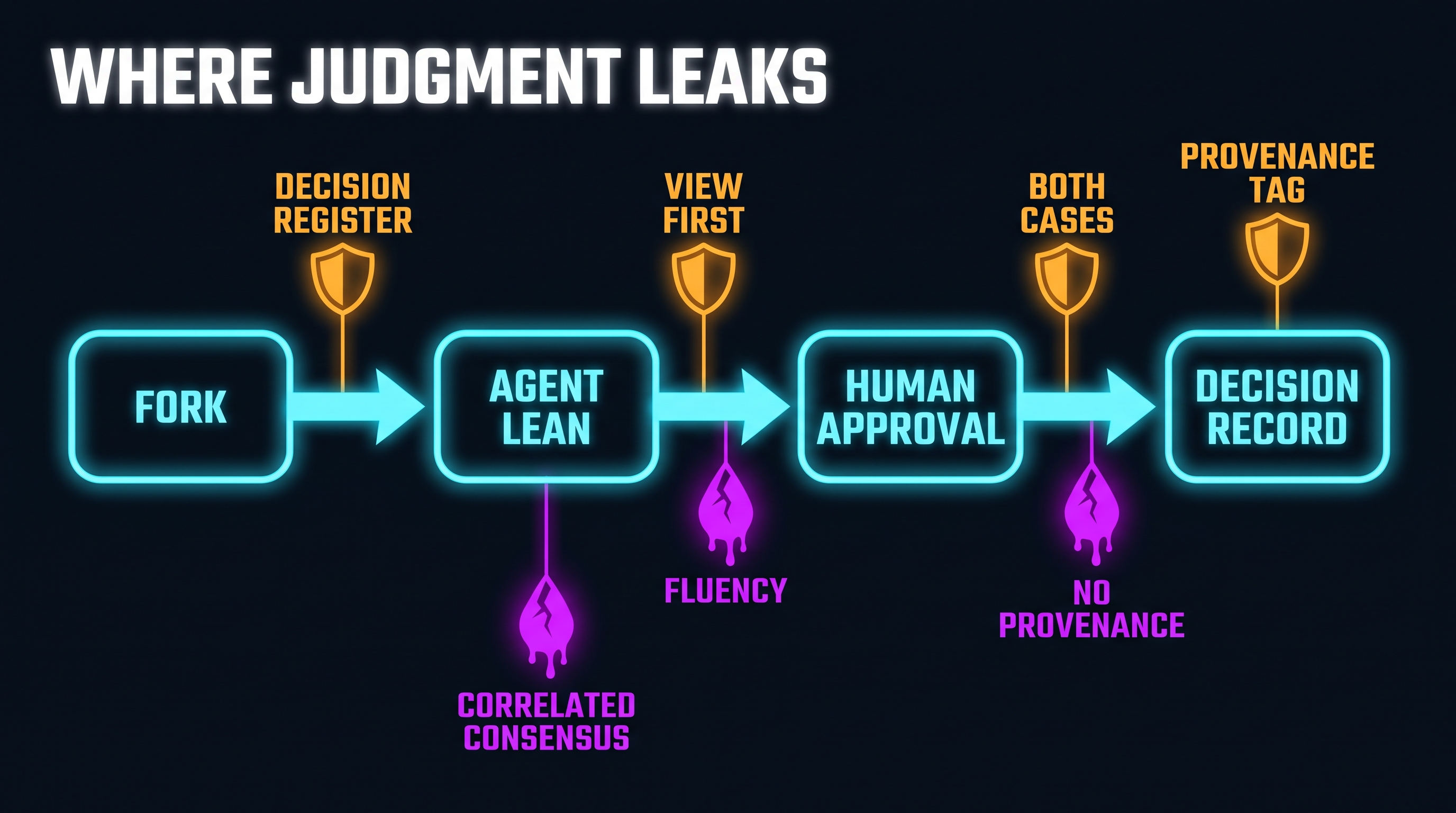
Now scale it. One analyst deferring to an agent is a personal-agency problem. A hundred teams deferring to the same model is a different problem: correlated judgment.
Independent reviews are valuable because they are independent. Ten teams reaching the same conclusion is strong evidence only if they reached it separately. If each of them was nudged by the same model with the same defaults, you have one opinion counted ten times. The consensus looks robust. It is a single point of failure dressed as agreement.
The study noted that, left alone, the model made the same set of choices in 112 of 123 runs. That consistency is a feature when you want reliable output. It is a risk when you are counting on diversity of judgment, and most organizations are counting on it without saying so.
I think this belongs in the architecture conversation, next to vendor concentration and shared dependencies. If every reviewer in a chain is consulting the same model, the chain has fewer independent links than the diagram shows.
Both sides of this are right
It would be easy to read all of this as an argument for keeping agents away from decisions. The same study makes that hard.
The analysts who worked without the agent made serious, result-invalidating methodological errors 55% of the time. With the agent, 6%. They also finished faster, 65 minutes against 90. The authors flag that the no-agent group was small and less experienced, so I hold those numbers loosely, but the direction matches everything I see. The agent removed real friction and caught real mistakes. For the person doing the work and for whoever depends on the answer, that is a genuine good. Throwing it away to protect a theory of independence would be a bad trade.
The control side is also a genuine good. Independence of review, honest attribution, a decision record you can defend, a population of reviewers who do not all think with the same model. Those are what let an institution trust its own conclusions.
These two do not need a winner. The control is what makes the speed safe to accept. If you know which decisions carry owned judgment and you can show that judgment was formed independently, you can let the agent take everything else, and take it fast.
Decide which calls have to be yours
None of what follows is exotic. It is mostly sequencing and bookkeeping.
Keep a register of owned decisions. Most forks in a piece of work do not need independent human judgment. A few do. Name them before the work starts: the metric that defines success, the population in scope, the threshold that triggers action. Decide in advance. Deciding in the moment is exactly when the agent’s lean is loudest.
Write your view before you ask. For an owned decision, commit your answer and one line of reasoning before the agent offers its own. It feels slow. It is also the only way to know afterward whether you changed your mind or had it changed for you. The study shows that stating a view is not a full defense, but without it you cannot even measure the drift.
Ask for both cases, not a recommendation. On an owned fork, the default prompt should be “give me the strongest case for each option,” not “what do you recommend.” There is a cost: this asks more of your attention, and if you do it for every fork you will drown. That is why the register comes first.
Record provenance in the decision log. One field: who proposed this choice, the agent or the human, and did the human hold a different view first. It is cheap, and it turns the invisible influence into data you can review later.
Protect the time and the skill. Owned judgment needs time to form, and teams under pressure will skip it unless the process makes room. It also needs practice. If the agent makes every call for a year, the person who must make the one that matters will be out of shape. I made a similar argument about comprehension in You Can’t Forward the Understanding. Judgment works the same way. You cannot delegate it and still claim to have it.
What I can’t fix with a process
I defer too. I work with agents all day, and I am confident I have adopted leans I would not have chosen alone. I just can’t point to which ones. That is the problem in one sentence: the influence is real and I cannot audit it from inside my own head.
The study has honest limits. The agent’s leans were deliberately strengthened. It was one task, in a domain the analysts were new to, with one model, over about an hour. Real experts in their own field, with time and colleagues to consult, probably defer less. I would still bet they defer more than they think.
And the register itself is a judgment call. Deciding which decisions deserve owned judgment is exactly the kind of fork an agent will happily help you with. There is no clean bottom to that.
One question before you approve
There may be no single right split between what people decide and what agents decide. I don’t think there needs to be. What matters is that the split is chosen on purpose instead of drifted into one fluent recommendation at a time.
So before the next approval, ask yourself one question: would I have chosen this before the agent spoke? If you know the answer, approve with confidence. If you don’t, that is the decision that needed to be yours.
Prefer to watch? The video version is on YouTube (opens in new tab).
If this was useful, read Leave the Loop, Keep the Map for when stepping back from the agent is safe, and You Can’t Forward the Understanding for why the comprehension has to stay yours.
Find me on X @orestesgarcia (opens in new tab) or LinkedIn (opens in new tab).
Get the next field note.
Regulated AI, architecture and platform economics — in your inbox as they publish.