
When the Algorithm Hits Home: What a CS Junior Needs to Know About the AI Job Market
My daughter read the blog post.
I’d written it for her brother — a breakdown of what Anthropic’s legal AI plugin means for his litigation practice. The conclusion was reassuring: judgment, accountability, and courtroom intuition aren’t going anywhere. The billable hour is under pressure, but the attorney behind it is more valuable than ever.
Annette read the whole thing. That night at dinner, she looked up from her phone and asked the question I should have seen coming.
“Okay, but what about me? You told him the tools won’t replace him. I’m the one training to build the tools.”
That’s a harder question. And she knows it.
Annette is a computer science junior. She graduates in 2027 into a job market that looks nothing like the one her older brother Sebastian walked into when he finished his computer engineering degree and landed a government contracting role in California. The path Sebastian took — degree, interviews, offer, career — still existed in recognizable form when he graduated. For Annette’s class, that path is being rewritten in real time.
Her boyfriend Alejandro is in the same boat — also finishing his CS degree, also watching the job market shift underneath him. He reads this blog. So this one’s for both of them.
They deserved more than “you’ll be fine.” They deserved the same thing her brother got: a thorough, honest answer they can actually act on.
The Numbers She’s Living
The job market facing Annette’s graduating class is unlike anything we’ve seen in the modern tech era.
The Federal Reserve Bank of New York reports a 6.1% unemployment rate among recent computer science graduates — higher than art history majors, philosophy majors, and journalism graduates. That’s not a typo. The field parents spent a decade pushing their kids toward now has worse employment numbers than the fields those same parents warned against.
Meanwhile, supply kept swelling. CS bachelor’s degrees more than doubled over the past decade, from roughly 52,000 in 2013–2014 to nearly 113,000 in 2022–2023, according to NCES data. Universities kept expanding programs long after demand signals started weakening.
Handshake’s Class of 2026 data paints the mood. Seventy percent of CS majors describe themselves as at least somewhat pessimistic about their career prospects. Almost 30% said they would have chosen a different major entirely if they’d known about generative AI’s impact on the field. Software engineering roles fell to ninth among the most-posted entry-level positions on the platform — a category they once dominated from the top five.
Annette and Alejandro see this every day. Their classmates feel it. The group chats are different than they were two years ago.
What Makes This Different
This isn’t the dot-com bust. It isn’t 2008. What makes this downturn different is the structural nature of the shift.
The routine, low-risk tickets that once formed the backbone of a junior developer’s education — fixing small bugs, writing boilerplate, handling straightforward CRUD operations — are now exactly the kind of tasks that teams hand to AI agents. Tools like GitHub Copilot, Cursor, and Claude Code have moved beyond autocomplete into territory where they can scaffold entire features, write tests, and debug code with minimal human oversight.
Salesforce CEO Marc Benioff stated on an earnings call that the company would not hire new software engineers in 2025, citing a 30% productivity increase from AI. Meta froze junior-to-mid level engineering hiring. OpenAI’s CFO disclosed A-SWE, an agentic software engineer designed not just to augment developers but to autonomously build applications end-to-end. “It’s literally an agentic software engineer that can build an app for you,” Sarah Friar told a Goldman Sachs conference.
The signal is clear: the traditional entry-level software engineering role is being compressed from both sides — fewer openings and automated alternatives eating into what remains.
The Broken Ladder
Here’s the deeper problem that few are discussing honestly: the career ladder that produced today’s senior engineers is breaking.
Junior roles were never just about output. They were a training ground. You learned to read legacy code, navigate ambiguous requirements, develop architectural intuition, and understand why decisions were made — not just how to implement them. When companies eliminate these roles in favor of AI productivity, they’re optimizing for today while creating a talent pipeline crisis for tomorrow. If we stop training juniors now, who replaces the seniors in ten years?
There’s also a pedagogical paradox. Forty-two percent of 2026 CS graduates use generative AI daily, according to Handshake. When AI can produce working code from a natural language prompt, the temptation to skip understanding why the code works becomes enormous. UC San Diego rewrote its introductory CS course to incorporate LLMs, shifting emphasis from writing code from scratch to reading code, testing, debugging, and problem decomposition — with AI as the code generator. Other universities still ban AI in introductory classes to ensure students build genuine foundational skills. The tension is real and unresolved.
The Paradox That Changes Everything
Here’s what most “CS is dead” articles get wrong — and this matters.
CS graduates have elevated unemployment, yes. But they also have among the lowest underemployment of any major. The 41% underemployment figure circulating in headlines applies to all recent graduates combined, not CS specifically. The NY Fed gives computer science a perfect score on underemployment: if you get hired, the job matches your degree and pays well. Starting salaries remain in the $80,000–$87,000 range.
The real story isn’t that a CS degree has lost its value. It’s that the entry gate has narrowed while the prize on the other side remains substantial. This is a supply-demand mismatch driven by degree oversupply and hiring freezes — not skills devaluation. That distinction matters enormously for how you respond to it.
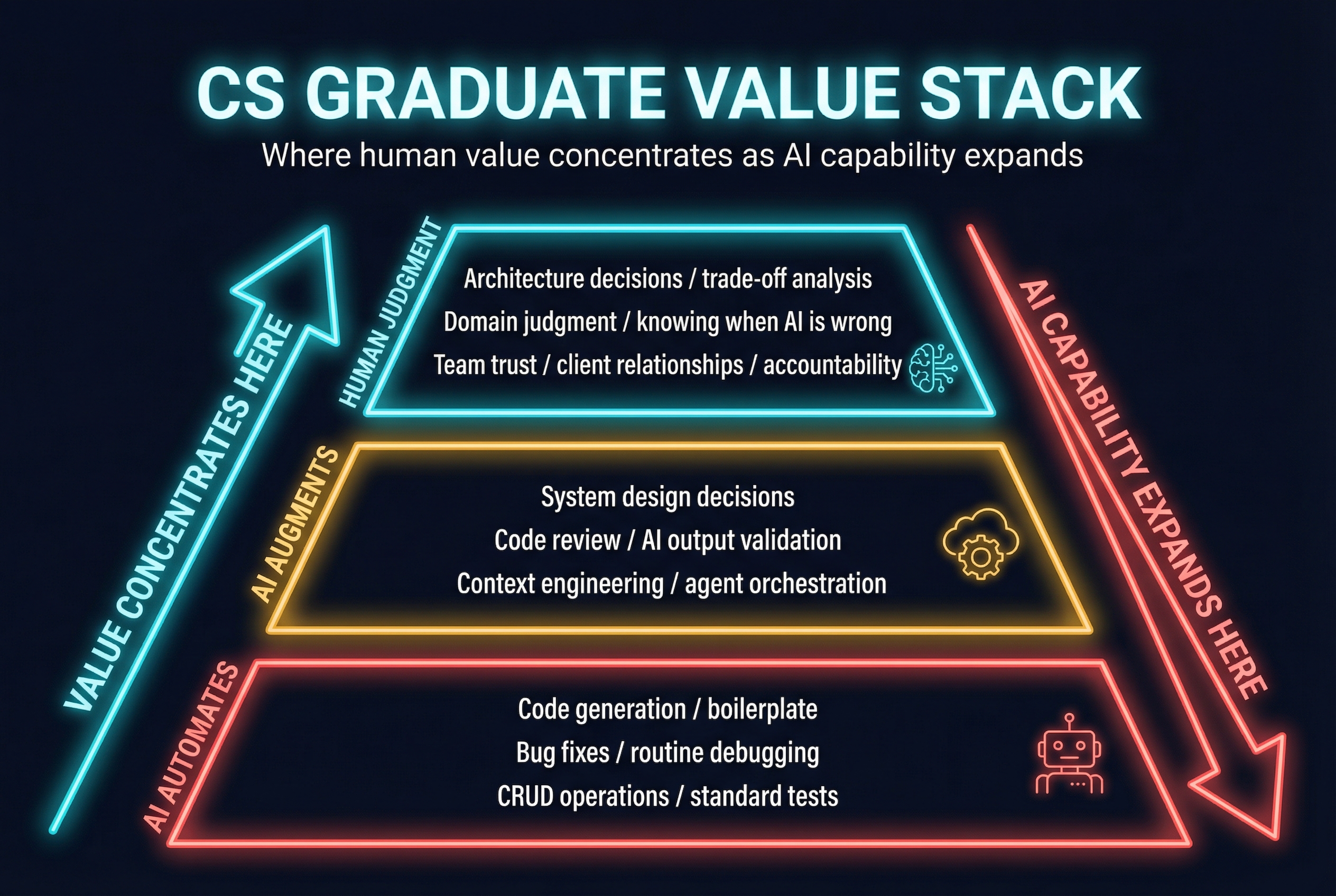
This maps directly to the Trust Ladder framework — not all tasks deserve the same level of AI autonomy. Code generation sits at the lower rungs where AI can operate independently. System design, architectural reasoning, and the judgment to know when AI output is confidently wrong sit at the top where human expertise is non-negotiable. A CS degree teaches exactly that kind of systems thinking. The degree isn’t the problem. The assumption that the degree alone is sufficient — that’s the problem.
What Sebastian Would Tell Her
Annette’s older brother Sebastian is a computer engineer working as a government contractor in California. He got in before the shift. His path — degree, interviews, offer — worked because the market he entered still rewarded straightforward technical competence.
Sebastian didn’t need a portfolio of AI-augmented projects to get hired. Annette and Alejandro will. Sebastian didn’t need to demonstrate that he could work with AI agents as a core competency. They do. The bar shifted while they were still in school, and it shifted in ways their programs weren’t designed to prepare for.
The Playbook — What Actually Works
Here’s the concrete answer to her question — the playbook for Annette, Alejandro, and every CS junior navigating this transition.
-
Learn context engineering, not just coding. Prompt engineering was the buzzword of 2023. By 2026, it’s table stakes. The emerging craft that hiring managers actually care about is context engineering — a term popularized by Shopify CEO Tobi Lutke and endorsed by Andrej Karpathy. It’s the discipline of feeding AI agents the right background information, constraints, and structure so they produce useful output on the first pass. Practice with Claude Code or Cursor on real projects. Pay attention to when the agent fails, and learn to diagnose whether the failure was caused by missing context, ambiguous instructions, or the wrong level of abstraction. That diagnostic skill is what companies pay for.
-
Build an AI-native portfolio. Tech recruiters skip resumes that only list coursework. What they want is proof you can ship working software that demonstrates you know how to work with AI, not just around it. Build an agent that solves a real problem — a research assistant, a workflow tool, a data pipeline. Use a framework like LangGraph, CrewAI, or Anthropic’s Agent SDK. Deploy it, even if it’s just on a free tier. Then document what AI generated, what you changed, and why. “I used Claude Code to scaffold this REST API, then refactored the authentication layer because the generated code stored tokens insecurely” — that sentence demonstrates more judgment than a hundred LeetCode solutions.
-
Contribute to open-source AI tooling. Projects like LangChain, AutoGen, and dozens of smaller agent frameworks have active issue trackers full of beginner-friendly bugs and feature requests. A merged PR in a real open-source AI project carries more weight than a solo todo app, because it proves you can navigate an existing codebase, follow contribution guidelines, and collaborate asynchronously.
-
Go adjacent — the side doors are wide open. The graduates finding jobs fastest aren’t necessarily the ones with the strongest algorithms background. Cybersecurity is projected to grow 29% through 2034, according to the Bureau of Labor Statistics — much faster than average. AI governance and operations — monitoring agent behavior, auditing outputs, managing compliance — is genuinely new territory with a 986% increase in job postings from 2023 to 2024. The pipeline of experienced candidates doesn’t exist yet, which means new grads can compete on more equal footing.
-
Five targeted applications beat fifty. Research the company’s AI stack before applying. If they use LangChain and you’ve built a project with LangChain, say that with specifics. Engage with engineering teams on GitHub — open a thoughtful issue, submit a small PR. Generic applications get filtered by AI screening tools before a human ever sees them. The graduates landing offers report a consistent pattern: fewer, higher-quality applications supported by actual relationship-building.
What I Don’t Know
I owe Annette and Alejandro — and anyone reading this — an honest accounting of what I can’t predict.
The timeline is uncertain. The World Economic Forum projects a net increase of 78 million jobs by 2030 — 170 million new roles created, 92 million displaced. The BLS projects 317,700 annual IT openings through 2034. The long-term fundamentals remain strong. But the transition path between “now” and “strong long-term fundamentals” is where her generation lives, and that path is genuinely unclear.
Universities are scrambling. Some are rewriting curricula around AI-assisted development. Others still ban AI in introductory classes. The skills the market wants — context engineering, agent orchestration, multi-agent coordination — barely existed 18 months ago. No curriculum moves that fast.
I’m a technologist, not their professor. I can analyze the technology, the economics, and the strategic implications. Annette and Alejandro live this daily. They know things about being CS students in this moment that I never will. The best advice I can give is filtered through a technology lens. The adaptation has to come from students who understand the constraints I can’t see from the outside.
What Happens Next Semester
She could have gotten a two-line answer over dinner. Something like “you’ll be fine, CS is always in demand.” But “what about me?” deserved better than that. It deserved the same thing her brother got — a thorough, precise answer she can actually act on when she opens her laptop Monday morning.
The CS degree isn’t dead. The Bureau of Labor Statistics still projects computer and IT occupations growing much faster than average, with over 300,000 annual openings. The skills that a CS program teaches — systems thinking, debugging logic, architectural reasoning — are more valuable in the agent era, not less. But the definition of what makes a CS graduate valuable has changed, and they’ve got a year and a half to make that shift.
The tools are changing. The thinking isn’t. At least not the parts that matter — the ability to decompose a problem, design a system, and exercise judgment when the AI gets it confidently wrong.
The entry gate narrowed. But the CS graduate who learns to work with the agents instead of competing against them? More valuable than ever. If they’re paying attention.
And they are.
If your son or daughter is navigating this shift — whether as a lawyer, a CS student, or an engineer watching AI adoption reshape their industry — I’d like to hear your perspective. Find me on X or LinkedIn.