TDX Day Two: The Floor Read
Day Two on the TDX floor answered the keynote questions and raised a bigger one. MuleSoft MCP Bridge is GA, React is sandbox-only, Vibes 2.0 ships a CLI, and the real Salesforce decision was never technical. The final dispatch.
Contents
I passed the MuleSoft Platform Integration Architect exam on Tuesday night. Last day of bootcamp, last exam slot of the evening. The bootcamp itself was Agentforce Development, a first-hand feel of the Salesforce developer experience from the inside, but the MuleSoft cert was different. Integration architecture is what I’ve been doing for years. The exam just made it official.
The next morning I walked into the Day One keynote with a fresh integration cert and a list of architecture questions. Now it’s Day Two, the floor day, and those questions need answers.
Grading the Day 1 Questions
I left the Day One Read with four explicit things I wanted to verify on the TDX floor. Here’s what I found.
React-to-production path. Straight answer: sandbox-only beta. You cannot deploy a React app to a production Salesforce org today. The asterisk is exactly the size of a release note, which is what I feared. The demos on the floor were compelling (real React components connected to org metadata via GraphQL, inheriting security primitives) but “beta now, GA by Dreamforce” means five months of unknowns. The LWC moat I discussed in the second dispatch is cracking, but it hasn’t broken yet.
Agent Script portability. Answered: version-controlled and DevOps-ready. The Salesforce skills repo is public: full language specification, grammar, parser, and compiler. Agent Script is a single flat file that lives in a git repo, reviewable in a PR, deployable from a CI/CD pipeline. That checks the box I set in Post 4. But it surfaced a question nobody on the floor could answer cleanly: which orchestration layer prevails, Salesforce’s native agent orchestration or MuleSoft Agent Fabric? For customers who invested in both platforms, the boundary between the two is blurred. Salesforce wants to offer options for those without MuleSoft, but dual-investors get overlapping capabilities with no clear winner. That’s a governance question disguised as a product question.
Open agent harness. Too early to tell. Hosted MCP servers are GA in every Developer Edition org. The forcedotcom/mcp-hosted repo is public. Sixty-plus MCP tools. Architecture looks open. But “genuinely runtime-agnostic” is a claim that needs hands-on time with real workloads, not a floor demo. I want to run Claude Code and the OpenAI Agents SDK inside the trust layer under load before I call this one.
Experience Layer custom components. Too early to tell. AXL separates agent functionality from appearance: renders across Slack, mobile, ChatGPT, Claude, and Teams. The demos looked right. But Beta July ‘26 means no production verdict yet. “Define once, deploy everywhere” remains a slide until I can build something real on it.
Two straight answers, two “I need to build something before I have an opinion,” and one new question nobody’s answering yet. That’s an honest scorecard for a two-day conference.
The Tooling That Matters
The floor sessions revealed a developer tooling stack that’s deeper than the keynote had time to show. Here’s what stood out.
MuleSoft MCP Bridge is GA now, and it’s the announcement with the most immediate enterprise value. It wraps existing REST, SOAP, and GraphQL APIs with MCP protocol support, no rewrite required. If you have thousands of legacy APIs sitting behind MuleSoft, they just became agent-ready without a single line of new integration code. MuleSoft’s announcement frames it as extending security controls through Flex Gateway at the enterprise control plane. For an Azure-invested enterprise running MuleSoft as the integration layer (the architecture I described in the first dispatch) this is the most load-bearing announcement of the week.
Agentforce Vibes 2.0 ships with multi-model support (Claude Sonnet 4.5 as the default LLM, GPT-5 support) and a browser-based IDE that’s now free in every Developer Edition org. The Vibes CLI is the piece that caught my attention: terminal-native developers can now work with Agentforce tooling without leaving their workflow. In the Vibes-versus-Claude-Code comparison, I wrote that Vibes’ biggest limitation was its scope. The CLI and multi-model support narrow that gap. Whether they close it depends on how much of the MCP surface actually works from the command line.
ApexGuru is something I hadn’t heard of before the floor sessions. It’s a code analysis tool, but dynamic: it analyzes JVM traces with an LLM to find runtime performance issues, not just static patterns. It’s integrated into Vibes 2.0 and available under Setup. The distinction matters: static analysis tells you what your code looks like. ApexGuru tells you what your code does under load. That’s a different category of tool.
Scale Center is the companion: a load testing tool under Setup that integrates with ApexGuru for monitoring key metrics and detecting anti-patterns at scale. Enterprise-grade performance testing as a platform primitive, not a third-party bolt-on.
Named Query exposes SOQL as a REST API without writing Apex or building Flows. Think stored procedures for the Salesforce platform. Admins define the query, the platform exposes the endpoint. It’s in beta moving to GA, and for data-heavy agent architectures, it eliminates an entire layer of custom code.
DevOps Center is now installed by default. CI/CD as a first-class primitive in every org, not an optional package you have to request. That’s a small line item in the release notes and a significant signal about where Salesforce thinks the developer experience should start.
Agent Sprawl Is API Sprawl in a Trench Coat
The TDX floor sessions leaned heavily into “agent sprawl” as the next enterprise problem. If that framing sounds familiar, it should. Five years ago it was API sprawl. Before that it was microservices sprawl. The pattern is the same: a powerful primitive gets adopted faster than governance can keep up, and the vendor who sells the governance layer wins the next cycle.
MuleSoft Agent Fabric is Salesforce’s answer: discover, orchestrate, govern, and observe any AI agent regardless of where it’s built or operating. InfoWorld covered the details: agent scanners for auto-discovery, a visual authoring canvas, and enterprise-grade trust mechanisms. Andrew Comstock, SVP at MuleSoft, framed it directly: “As agent adoption matures, the challenge shifts from building individual agents to bringing them together.”
That’s the API management pitch from 2019 with “agent” swapped in for “API.” I don’t say that dismissively. The rebranding works because the underlying problem is real. Enterprises will build agents faster than they can govern them, just like they built APIs faster than they could catalog them. The question from the first dispatch, which Salesforce layers are load-bearing, has a new axis now. Agent governance is becoming as load-bearing as data integration.
The other piece worth watching: AgentExchange. Salesforce consolidated AppExchange, Slack Marketplace, and the Agentforce ecosystem into a single marketplace. Diginomica called it “the corporate clearing house for apps.” Ten thousand Salesforce apps, 2,600 Slack apps, 1,000-plus agents, tools, and MCP servers. And you can publish your own MCP listings. That’s not just a marketplace. It’s an ecosystem play backed by a $50 million builders initiative. Whether the ecosystem actually materializes at that scale is an open question. But the infrastructure for it shipped this week.
Data Cloud as the Semantic Layer
Data Cloud with the GraphQL API is positioning itself as the semantic layer for agentic architectures. Agents don’t query databases. They query meaning. Data Cloud’s zero-copy architecture and federated grounding mean the data stays where it lives, and the agent gets a unified query surface that understands relationships across systems.
Marketing Cloud is going “in core” as Marketing Cloud Next, rebuilt natively on the Salesforce core platform, eliminating the ETL connectors and batch data mirroring that defined the old integration pattern. That’s not a product update. That’s Salesforce acknowledging that the old architecture (sync data from Marketing Cloud into Core via connectors) doesn’t survive the agentic era. Agents need real-time data, not batch-synced snapshots.
Security Mesh is the piece that connects this back to the opt-out architecture from Post 1. It’s a cross-platform security fabric connecting Salesforce security primitives with external security stacks. I wrote in Post 1 that replicating the Einstein Trust Layer on the Azure side was “a build, not a purchase.” If Security Mesh genuinely integrates with external SIEM, identity providers, and threat intel feeds, the dual-governance-console problem I flagged has a potential answer. That’s a meaningful development for anyone running Salesforce alongside Azure or AWS security tooling.
The Cert That Preceded the Keynote
In the third dispatch, I wrote about cert economics with the MuleSoft Platform Integration Architect “in the queue.” That queue cleared Tuesday night. Three certs now: Platform Integration Architect, Platform Data Architect, and MuleSoft Platform Integration Architect. Not a cert-stacking exercise. A deliberate bet on the integration layer.
The timing turned out to matter. I formalized years of integration architecture experience the night before Salesforce announced MCP Bridge and Agent Fabric GA. Everything I validated on that exam (API-led connectivity, Anypoint Platform design patterns, security policies on Flex Gateway) is exactly what MCP Bridge wraps into the agentic stack. The integration layer I’ve been building on for years just became the bridge between legacy enterprise APIs and the agentic future. That’s not irony. That’s the thesis from Post 1 confirmed: MuleSoft is the load-bearing Salesforce layer for an Azure-invested enterprise, whether you buy the rest of the bundle or not.
The Agentforce Development bootcamp class was the other half. Building agents from the inside, seeing the developer experience firsthand, feeling the rough edges and the smooth ones, gave me the context to evaluate the floor sessions with practitioner eyes instead of analyst distance. The combination of building the thing and then watching the vendor pitch the thing is a perspective most TDX attendees don’t walk in with.
The Decision That Was Never Technical
Here’s the thesis I’ve been circling for five dispatches.
Salesforce keeps innovating. The platform depth is real. Headless 360, MCP-first decomposition, React support, open agent harness, Agent Fabric, MCP Bridge, AgentExchange: these are architecturally coherent moves. The Register called it the most significant architectural pivot in the platform’s 25-year history. Diginomica framed it as a shift from determinism to probabilism. Vernon Keenan at SalesforceDevops.net identified the real tension: Salesforce is “optimizing for the segment fueling the growth of Anthropic, Cursor, and the vibe coding revolution” while the traditional admin and declarative builder workforce faces potential obsolescence without visible remediation.
Their marketshare is not going anywhere. Computer Weekly reported AI agents on Slack have grown 300% since January 2026. The ecosystem is compounding. The $50 million AgentExchange fund is an ecosystem bet, and ecosystem bets are how platforms win decades.
But whether you buy deeper into Salesforce or bet on the competition is not a technical decision. It never was. It’s a senior executive decision driven by existing vendor relationships, contract economics, risk tolerance, and organizational politics. The architect’s job, my job, is to make either path viable.
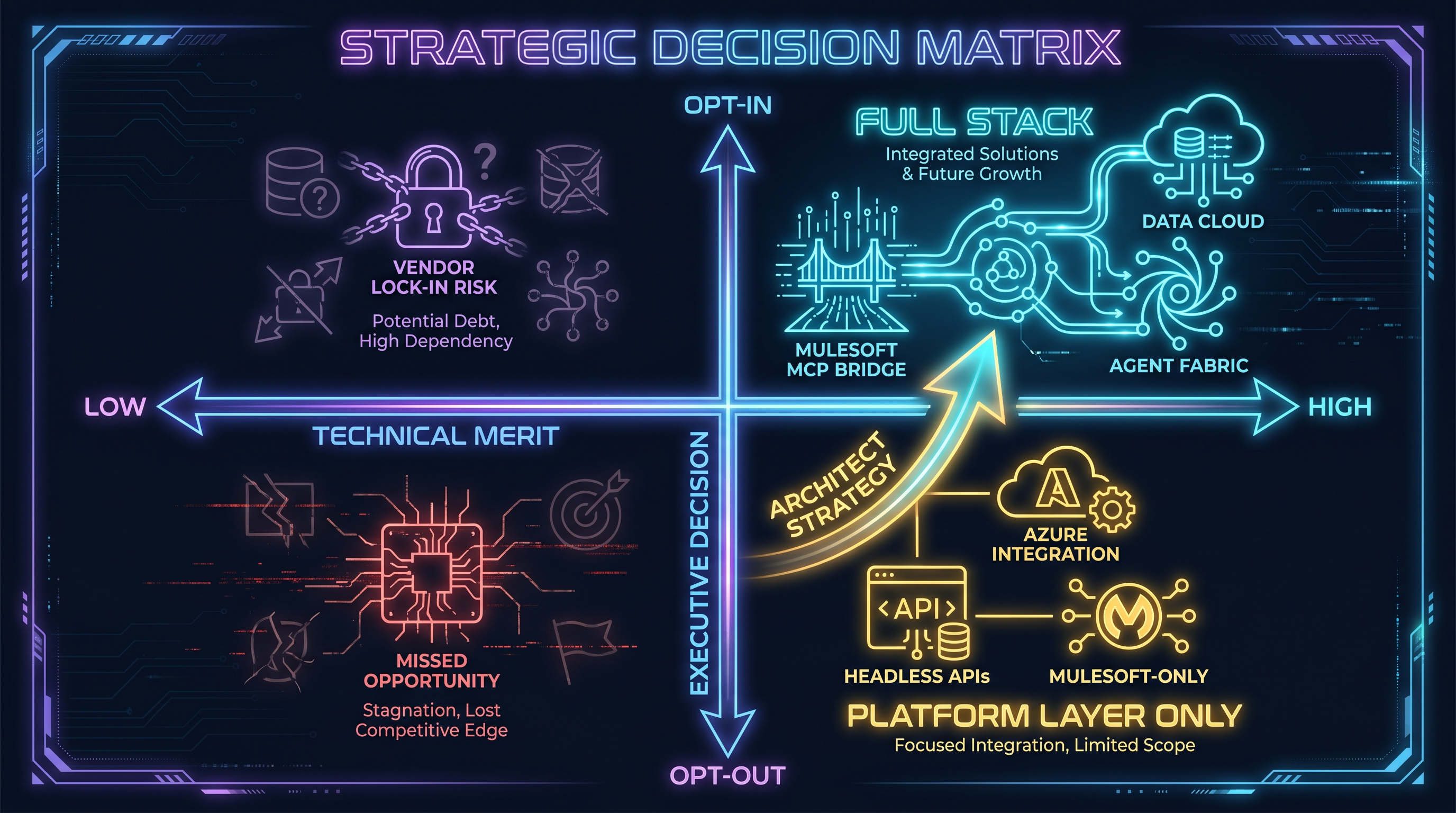
The opt-out architecture from Post 1 still works. The opt-in architecture got meaningfully better this week. Both are defensible. Neither is obviously wrong.
The talent gap is the constraint that neither architecture solves. Patrick Stokes acknowledged it on the Day One stage: 55% of enterprise companies say AI talent is their number one blocker. The tools got better this week. The talent equation didn’t change. Vernon Keenan’s “widening builder gap” observation is the sharpest criticism of TDX I read from any outlet: the factory is operational, but the workforce question remains open.
Five dispatches, two days, one thesis: Salesforce built a platform worth taking seriously. Whether you should take it seriously is a question for your executive team, not your architecture review board. The architect’s job is to make sure the answer works either way.
Sources
Salesforce TDX 2026 Roundup · MuleSoft MCP Bridge (GA) · The Register: Salesforce Debuts Headless 360 · SalesforceDevops.net: Reporter’s Notebook · Diginomica: Determinism to Probabilism · Diginomica: AgentExchange · Computer Weekly: SaaS Agentic Evolution · InfoWorld: MuleSoft Agent Fabric · Salesforce Ben: Agent Fabric · Salesforce Skills Repo · Hosted MCP Servers
This is the fifth and final dispatch in the TDX 2026 series. The first, Salesforce Without the Full Buy-In, mapped the opt-out architecture before the keynote. The second, The Developer Experience You Can Bring Yourself, compared Agentforce Vibes against Claude Code. The third, The Practical Value of a Salesforce Certification, pressure-tested cert economics. The fourth, Salesforce Headless 360: The Day One Read, broke down the keynote architecture. This one closes the loop.
Find me on X or LinkedIn. I write about what happens when AI infrastructure meets regulated reality.
Get the next field note.
Regulated AI, architecture and platform economics — in your inbox as they publish.