One Word Moves the Control
The governed lifecycle has one weak joint, and it is the review gate. Code review works partly because the machine runs the test and tells you, objectively, that something broke. For prose where meaning is the payload, one changed word can move a control, and no test catches it. This is where everything-as-code stops being a mechanical win and starts demanding human judgment, and why automating a broken review just scales the mistake.
Contents
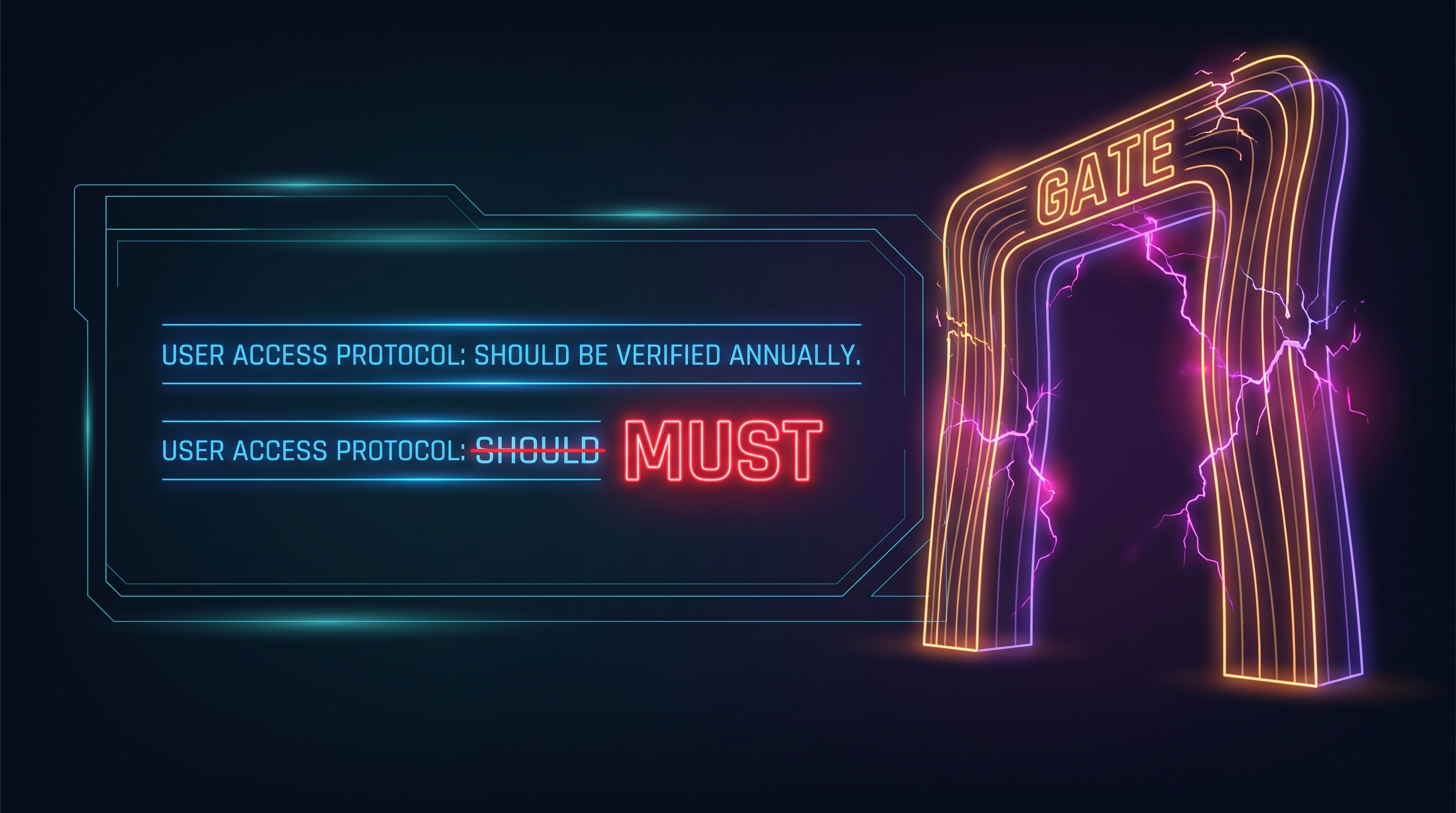
A change lands on a standard. The diff is one word: “should” becomes “must.” Two characters of git history. And with those two characters a control that was advisory is now mandatory, an audit that would have passed now fails, and a team that was compliant on Friday is out of compliance on Monday. The pull request looks trivial. The blast radius is not. This is the joint where everything-as-code strains, and an honest series has to spend a post here.
The whole argument so far has been that software’s governed lifecycle generalizes to every versionable artifact. It does, with one asterisk that grows as the artifact gets softer. The review gate, the human approval before merge, was built for a world where a machine could tell the human what broke. For prose, the machine mostly can’t, and the gate has to carry weight it was not designed for.
Code review had an unfair advantage
We rarely name why code review works as well as it does, so we miss what does not transfer. Code review has a partner the reviewer trusts: the test suite. The machine adjudicates correctness, objectively and before the human looks. Did it compile, did the tests pass, did the types check. That frees the human to adjudicate the things machines can’t, taste, design, clarity.
Take away the test and you take away the partner. For a risk standard or a contract, there is no suite that runs and reports that the meaning broke. As I argued in the policy-as-code post, a real chunk of governance can be tested mechanically, consistency, mapping, citations, structure. But “should” versus “must” passes every one of those checks. The document is still internally consistent. The citations still resolve. The structure is intact. And the meaning has completely changed.
The gate was built for a human at human speed
There is a second problem stacked on the first, and it is about volume. I wrote in The Gate Was Built for a Human that review gates assume human-rate change: a person proposes, a person reviews, at a pace two people can sustain. Machine-generated change breaks that assumption the same way it broke everything else.
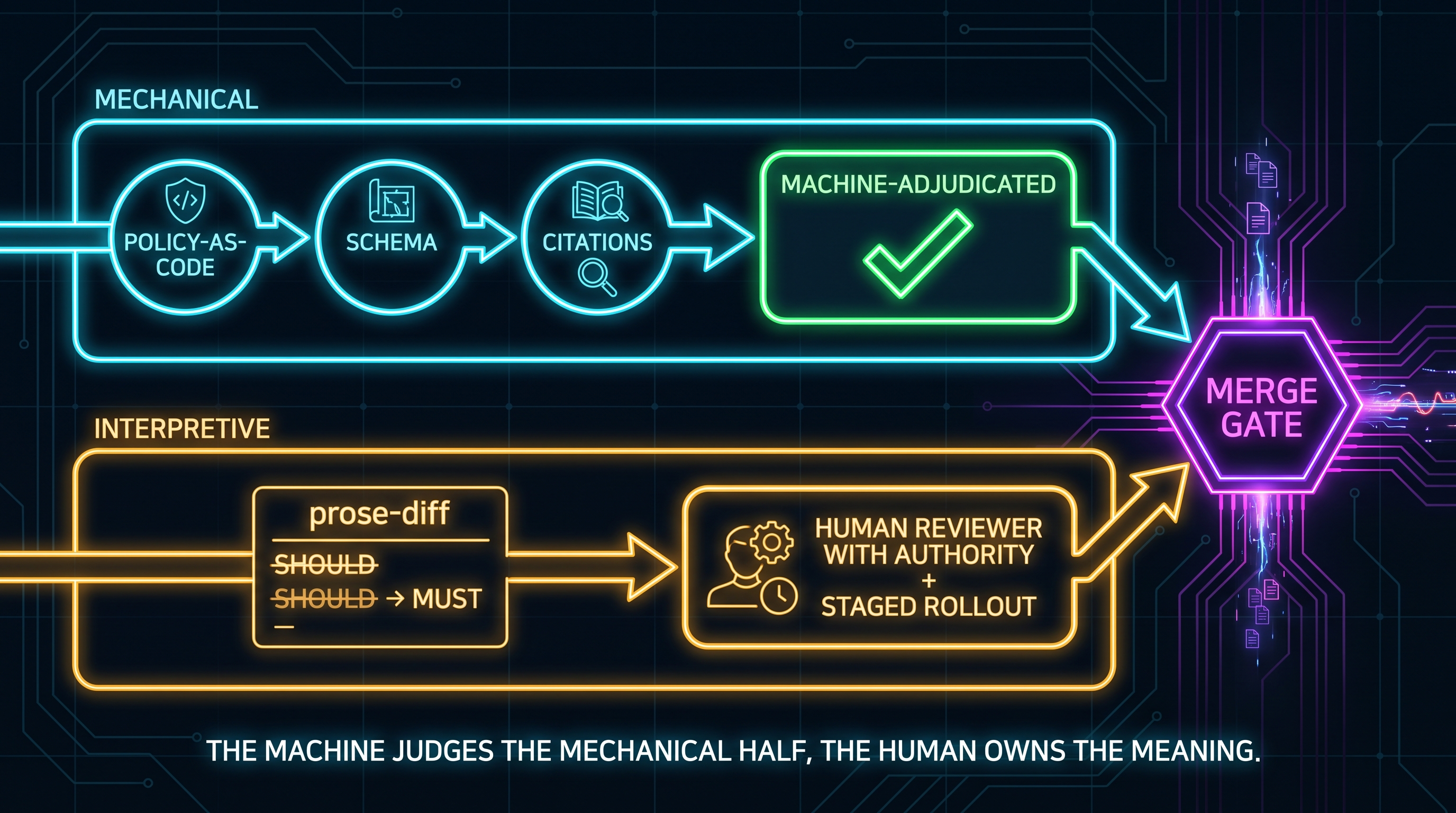
When an agent can draft fifty policy edits in an hour, and the mechanical checks pass all fifty, the human review that has to judge meaning becomes the bottleneck, and a bottleneck under pressure becomes theater. Reviewers start approving on the strength of the green checks, because the green checks are all they have time to trust, and the green checks are exactly the ones that miss the word that moved the control. The faster the machine proposes, the more the interpretive gate gets skipped precisely when it matters most.
What actually transfers, and what doesn’t
So be precise about the split, because the answer is not to abandon the pipeline. The mechanical half genuinely transfers: run policy-as-code, schema, and citation checks, and let them fail changes automatically, exactly as the last posts described. That is real and worth having.
The interpretive half needs two things software culture already half-invented. It needs a human reviewer with actual authority over meaning, whose job is explicitly the semantic diff and who is given the time the volume is trying to take away. And it needs the equivalent of a feature flag: a way to stage a prose change, roll it out to a bounded audience, and watch before it governs everyone, so a wrong “must” is caught in a limited blast radius instead of enterprise-wide. Neither is automation. Both are the discipline of not pretending the machine settled a question it cannot reach.
Automating a broken review
The trap underneath all of this is the one I named in Automating Chaos Produces Automated Chaos. If your standards were incoherent when they lived on the shared drive, putting them in git does not make them coherent. It makes them incoherent with excellent version history, reviewed faster, by a gate that waves them through because the mechanical checks are green. Speed applied to a broken review process does not fix the process. It ships the brokenness at scale, with an audit trail proving you did.
There is a real tension here with an earlier post. I argued in The Machine Has Better Discipline Than Your Team that an agent is a better audit citizen because it fills the ticket and records the decision every time. That is true, and it is not in conflict with this. The machine has better procedural discipline. It does not have better judgment about meaning. The audit trail will be immaculate. Whether the thing it faithfully recorded was right is still a human question.
What I don’t have a clean answer for
The honest admission, and it is the least resolved in the series. I do not know how to review meaning at machine volume. The mechanical gates are solved enough to trust. The interpretive gate, a human with authority plus staged rollout, is a direction, not a finished mechanism, and it fights the exact economics that make automation attractive in the first place. Every other post in this series ended with the pattern basically working and the judgment left to humans. This is the post where the judgment and the volume collide, and the collision is unsolved.
Which is why it belongs in the series and not swept under it. Everything-as-code is a genuine advance for every governed artifact, and it has one joint that does not fully hold: the review of what a change means, at the speed a machine can now produce change. Name the joint, staff it with authority, stage the rollout, and refuse to let a green checkmark stand in for a human who understood the word that moved the control. That is the most honest thing I can say about where the pattern still breaks.
If this resonated, read The Gate Was Built for a Human, on human-speed review under machine-speed change, and Compile the Policy, on the mechanical half that does transfer. Both sit in the Everything as Code series, under the pillar.
Find me on X @orestesgarcia or LinkedIn /in/setsero.
Get the next field note.
Regulated AI, architecture and platform economics — in your inbox as they publish.