
From Paperclip to Production: The Open-Source SDLC/SRE Bet Every Enterprise Is Weighing
I have been running two browser tabs for three weeks. One has the Azure SRE Agent documentation: generally available, Entra-integrated, audit-ready. The other has the GitHub repositories for Paperclip AI and Hermes Agent. Paperclip: 64,000 GitHub stars, a TypeScript orchestration control plane that describes itself as “if OpenClaw is an employee, Paperclip is the company.” Hermes: 146,000 stars accumulated in three months, a self-improving autonomous agent framework with a purpose-built SRE incident commander and an AI-native SDLC integration.
Neither is a toy. Neither has cleared the kind of compliance review a regulated bank demands. That gap, between genuinely capable and production-compliant, is the actual decision regulated buyers are weighing. The question is not which stack is better. The question is whether the open-source projects will close the compliance gap before the enterprise vendors close the capability gap.
That timing bet is what this post is about. This is engineering-side infrastructure automation: the SDLC pipelines, SRE incident loops, and developer tooling that technology teams run. Not the customer-facing agents, business process workflows, or LOB solutioning that the business side is building separately.
What Paperclip Actually Is
Not the thought experiment. The GitHub repo. Paperclip AI is a governance and orchestration control plane for teams of AI agents. Its framing is deliberately organizational: if individual agents are employees, Paperclip is the company they work for.
Paperclip is general-purpose: it can orchestrate customer service agents, back-office automation, or any other workflow. This post scopes to engineering intentionally. The compliance evaluation for SDLC and SRE automation in a regulated bank is where this decision bites hardest, and that is where the analysis below applies most directly.
What that means in practice: Paperclip provides an org chart for your agent fleet: hierarchical roles, parent-child agent relationships, delegated authority. It handles identity and access control with authentication, API key management, and audit trails for every agent action. It enforces per-agent monthly budgets with hard stops, preventing the runaway token spend that kills enterprise AI pilots. It supports scheduled automation through heartbeat execution: cron-style agent wakeups with defined scope. And it has approval workflows: a human-in-the-loop gate before agents take high-risk actions.
The latest release is v2026.512.0. It has 2,458 commits on master and 3,600 open issues, both signals of active production use, not abandonware. The plugin system is extensible. Deployment is local-first via embedded PostgreSQL, which matters in environments where data sovereignty is non-negotiable.
What Paperclip is not: it is not the agent doing the work. It is the management layer above the agents. If Azure’s agent control plane and Microsoft Entra had a lightweight open-source counterpart, this is close to what it would look like. The capability is real. Neither Paperclip nor the agents it orchestrates have been through the security assessment and organizational approval process a regulated institution requires before production deployment.
What Hermes Agent Actually Does
Hermes Agent from Nous Research is the execution layer that Paperclip is designed to orchestrate. But it is worth understanding on its own terms because the architecture is genuinely different from what most enterprise AI tooling looks like.
Hermes is self-improving by design. When an agent solves a problem, it converts that solution into a reusable skill stored in its procedural memory. The next time a similar problem appears, it draws on that skill rather than reasoning from scratch. Over time, an agent running Hermes accumulates institutional knowledge: exactly the compounding loop that makes experienced SREs dramatically more effective than junior ones.
The framework is model-agnostic: Claude, GPT-4, any OpenRouter provider without code changes. It ships with 40+ built-in tools and deploys across VPS, Docker, serverless, and GPU clusters. The multi-channel reach (CLI, Telegram, Slack, Discord) is either a feature or a compliance concern depending on where you sit in the org.
The SDLC and SRE applications are not hypothetical. bigiron uses Hermes with a code graph backend for AI-native software development, handling the full cycle from issue to PR. hermes-incident-commander is an autonomous SRE agent for production incident detection and self-healing: detection, triage, diagnosis, remediation, runbook update. The same loop that Azure SRE Agent and PagerDuty have productized, implemented in open-source Python with a pluggable model backend.
The Stack They Form Together
Paperclip and Hermes are architecturally complementary in a way that maps directly onto what enterprise SDLC and SRE automation requires.
Hermes runs the work. It handles incident triage, code generation, PR creation, runbook updates. It builds institutional memory across sessions. It coordinates with other agents. Paperclip governs the work. It defines what each agent is allowed to do, enforces budget limits, logs every action to an audit trail, and gates high-risk operations on human approval.
The enterprise alternative stack maps almost one-to-one. hermes-incident-commander does what Azure SRE Agent does: correlate telemetry, form hypotheses, remediate with approval. bigiron does what GitHub Copilot with Claude does: take an issue, open a PR, run within a policy-governed pipeline. Paperclip does what Microsoft’s agent control plane does: registry, identity, audit, governance.
The capability comparison is closer than enterprise pricing suggests. Azure SRE Agent reports 75% MTTR reduction and 94% root cause accuracy. These numbers are from controlled production deployments with Entra integration and existing monitoring pipelines, not raw benchmarks. Hermes running hermes-incident-commander against the same infrastructure would produce comparable incident response performance. The gap is not the model. The gap is everything around the model: the identity integration, the compliance audit trail, the vendor support SLA, and the cloud provider certifications Microsoft carries as part of Azure’s existing compliance posture.
What Enterprise Platforms Have Actually Shipped
The enterprise platforms are not standing still while open-source catches up. That is the other side of the timing bet.
Azure SRE Agent is generally available. It runs inside your existing Entra boundary: the same identity, RBAC, and conditional access policies that govern everything else in your Azure footprint apply to the agent. Audit logs feed into your existing SIEM. Change control integration is a configuration, not a build. For a regulated bank, “audit-ready on day one” is not a convenience feature. It is the prerequisite for running anything in production.
PagerDuty’s SRE agent adds contextual memory across incident history: detection, triage, diagnosis informed by past resolutions, human-approved remediation, runbook update. The compounding knowledge loop Hermes achieves through skill creation, PagerDuty achieves through incident memory indexed against service topology. Both are doing the same thing architecturally. PagerDuty has the compliance posture and the 250+ production deployments.
Datadog Bits AI SRE went generally available in December 2025, tested across 2,000+ customer environments. It runs automatic incident investigations without setup, delivers root cause analysis in minutes, and claims 90% faster service restoration, pulling from the full Datadog observability stack the agents already have wired up. The pricing model is consumption-based: $25 per conclusive investigation on annual plans, $30 on monthly, with inconclusive investigations free, more predictable economics than seat-based models for high-volume alert triage environments.
GitHub Copilot with Claude and Codex runs within GitHub’s existing agent control plane: policy management, audit logging, and centralized enablement that enterprises already have configured. The agent takes issues, opens PRs, and operates within the governance boundary you defined when you set up GitHub Enterprise.
Claude Code ships inside Anthropic’s Claude Enterprise plan: a CLI tool bundled at $20/user/month (50-seat minimum, usage separate) with SSO, SCIM, RBAC, and audit logs integrated into Splunk, Datadog, and Elastic. For engineering SDLC work it operates as a developer-facing agent: code generation, debugging, PR handling from the terminal. More augmentation layer than autonomous CI/CD agent, but the compliance packaging is cleaner than running a raw Hermes instance.
The Timing Dilemma
This is the actual decision. Not build versus buy in the abstract, but: at what point does the open-source compliance posture clear the bar for a regulated institution, and does that happen before or after enterprise vendors reach capability parity with Paperclip and Hermes?
The case for betting on Paperclip and Hermes now: Hermes accumulated 146,000 stars in three months. That is not a niche project trajectory. The community velocity behind self-improving agents is real, and community velocity predicts both feature development speed and the emergence of compliance integrations. Paperclip already has audit trails, approval workflows, and per-agent budgets: the governance architecture is sound even if it has not been through an enterprise security assessment. First-mover advantage in an organization is real: the team that builds expertise on Hermes now has a year of institutional knowledge before the enterprise alternatives mature.
The case for waiting: Paperclip has not been through a bank’s OSS security assessment: no penetration test, no CVE management process established, no codebase review on record. The agents Hermes orchestrates have not been through model risk management review under SR 11-7. hermes-incident-commander running against production infrastructure without Entra identity integration and a compliant audit trail is not a difference of configuration. It is a difference of architecture. In a regulated environment, the compliance gap is not a feature request on a roadmap. It is a gate that determines whether the tool touches production at all. Sol Rashidi’s data puts enterprise AI failure at 70% organizational, not technical, and in banking, “organizational” includes legal, compliance, and risk management, none of whom are moved by GitHub star counts.
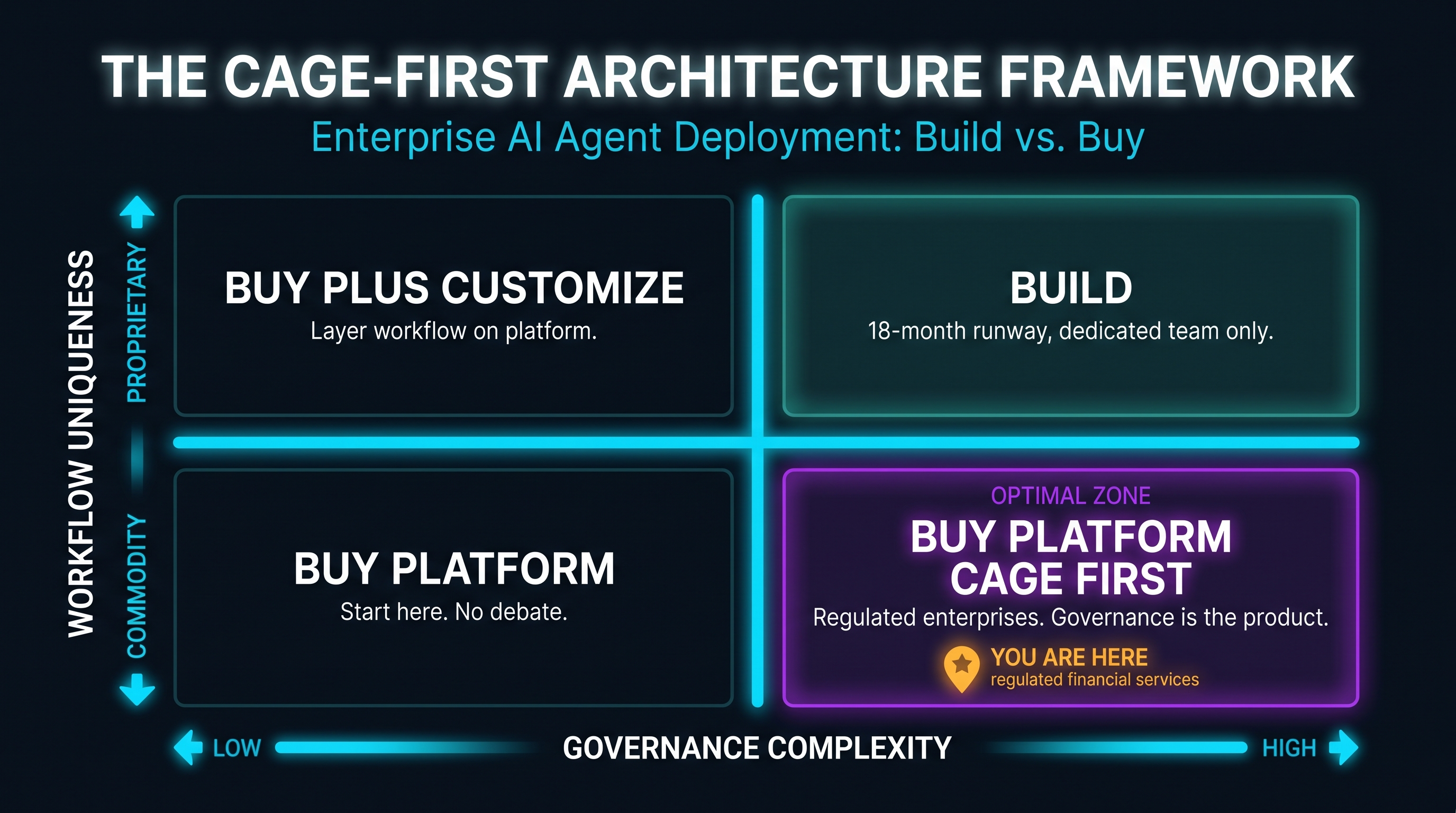
The diagram maps where this lands in practice. The decision axes are governance requirements complexity and workflow uniqueness. Most SDLC and SRE automation in banking is commodity workflow with high governance requirements: incident triage, deployment automation, runbook generation. That quadrant points to enterprise platforms in the near term, not because the open-source capability is lacking, but because the compliance architecture is. Where Paperclip and Hermes make sense today: internal developer tooling, sandbox and staging automation, non-production SDLC workflows where the compliance bar is lower. Get the team fluent, accumulate the institutional knowledge, run real workloads, then migrate to production as the compliance posture matures.
The control plane war between Microsoft and Salesforce matters less if Paperclip becomes the default open-source engineering control plane, and the pace of Azure SRE Agent development suggests Microsoft knows it. The Dust analysis of 1,000+ deployments shows custom builds exceed managed platform costs within eighteen months, but that assumes you are building the governance layer from scratch. Paperclip changes the equation. The timing of the cost inflection depends on when your organization clears Paperclip through its OSS security assessment, not on when the technical capability does.
Where This Actually Lands
Honest position: for production SDLC and SRE automation at a regulated bank, the open-source stack is not the one to deploy today. Azure SRE Agent and GitHub Copilot with Claude already sit inside an established compliance boundary. The audit trail exists before day one. The exam team can answer questions about it. That matters more than capability headroom in the current window.
But that is not a permanent answer. The right posture is to run Hermes in a sandbox against non-production systems and track what it actually takes to bring Paperclip into a compliance boundary, because that checklist looks different from a SaaS vendor evaluation. Because Paperclip is self-hosted, SOC 2 is the wrong question: there is no service organization to certify. What applies instead is your own organization’s OSS governance framework: license review, CVE patching cadence, codebase security assessment, SIEM integration for audit logs. SR 11-7 applies not to Paperclip itself but to the agents it orchestrates: autonomous decision-making agents need validation and documentation regardless of whether the orchestration layer is SaaS or self-hosted. Thread-based engineering maturity applies here too: build Paperclip fluency in sandbox while the compliance process runs.
The Three Doors model from Anthropic’s managed agent platform still applies to the entry point. The pragmatic entry for production is Door 2 (Azure-native engineering tooling, Azure SRE Agent and GitHub Copilot). What you build alongside that is the institutional knowledge to evaluate Door 3 (API-first custom orchestration with Paperclip as the control plane) when the compliance gate clears.
The workflows to migrate to Paperclip + Hermes first, when that happens: internal developer tooling, staging environment automation, and non-production incident response. The workflows to hold on enterprise platforms longest: anything touching production systems, customer data, or requiring change control documentation for examiners.
The answer is not “never.” Hermes at 146,000 stars in three months with an active incident commander module is not a technology to dismiss on a multi-year horizon. The bet not worth making today is the one worth watching most carefully.
What I Don’t Have Figured Out
The compliance timeline is opaque. Paperclip’s governance architecture is sound (audit trails, approval workflows, budget enforcement) but “architecturally sound” and “security-assessed, OSS-approved, with documented FFIEC applicability for the agents it orchestrates” are different claims. What I do not know: how long a bank’s internal approval process takes for a self-hosted open-source orchestration platform with no prior precedent in the institution, and whether Paperclip’s security posture holds up under a serious pen test. I have not found reliable public signals on either.
The institutional knowledge compounding question is genuinely open. If Hermes’s self-improving skill loop works as advertised in production, and the hermes-incident-commander architecture suggests it does, then early adopters accumulate a different kind of advantage than enterprises who wait and buy the mature product. The bought product gives you the playbook. The early bet gives you engineers who wrote the playbook. Those are not equivalent, and I do not have a clean model for how to value the difference.
The Real Question Is Timing
Both stacks automate SDLC and SRE. Hermes can triage your incidents. Paperclip can govern your agent fleet. Azure SRE Agent and GitHub Copilot can do the same with better compliance documentation today.
The dilemma is not capability. It never was. The dilemma is: how much of a head start does the open-source community need to clear the compliance bar before enterprise vendors compress the capability gap enough to make the switching cost irrelevant?
For most regulated enterprises right now, that question resolves to: wait, but not passively. Use the window to build institutional knowledge on these platforms in sandboxed environments. Track the compliance roadmaps. Know which workflows migrate first when the gate opens. The answer shifts from “enterprise now, open-source later” to “open-source everywhere” faster than enterprise pricing models want to admit.
The timing bet is the actual investment decision. And in regulated industries, timing is almost always the hardest part.
If you are working through the compliance evaluation for Paperclip or Hermes in a regulated environment, I am curious what your risk management team’s criteria are. Find me on X @orestesgarcia or LinkedIn. This is a conversation I am actively in.