
Core-Agnostic Still Needs a Core
Two vendors just bet on opposite architectures for banking agents. Both bets land on the same box.
Fiserv built an operating system so agents could live inside its stack. FintechOS built a product layer so agents could live above any core, on purpose, coupled to none. Chase either one down to the floor and you find the same dependency waiting there: a core modern enough to answer an agent in real time. Most banks do not have one.
The Layer the Keynote Skipped
I spent last week reading Fiserv Forum from the floor, and the three dispatches I wrote from it kept circling downward. Announced or Shippable? read the stack layer by layer. agentOS Has to Eat Fiserv’s Own APIs argued an agent inherits the reliability of everything beneath it. The Data Was Always the Problem landed on the data layer, and on the quiet fight to become the context your agents reason over.
That closed the loop on the Forum, and on the data layer specifically. It left a different layer open, the one directly above the ledger where a bank actually configures, prices, launches, and operates a product. Call it the product-operations layer. In the agent era it is also the orchestration layer, because the thing running those product workflows is increasingly an agent, not a screen.
Two credible companies are now fighting over who owns that layer, and they come at it from opposite ends of the stack. Watching them collide tells you more than either pitch does alone.
agentOS Bets Inside the Stack
Fiserv’s bet is that agents belong inside the stack that already runs the bank.
agentOS, the “operating system for agentic AI in banking,” launched in May with OpenAI on Amazon Bedrock, and Fiserv is clear about the shape: it runs natively across Fiserv’s own platforms, core, payments, issuer processing, servicing. The launch agents are the operational spine of a bank, Commercial Loan Onboarding, Daily Operational Analysis and Reporting, Agentic Deposit Intelligence, Agentic AML Triage. A governed marketplace sits around them, with Fiserv-built agents and third-party ones under policy control.
The strategy is coherent, and I have said so. Agents orchestrate work by calling Fiserv’s APIs, which reach into Fiserv’s cores, all first-party, all inside the tent. The advantage is real: when the agent, the API, and the ledger share an owner, nobody argues about whose fault the timeout is.
But notice what the bet does to lock-in. It does not remove it. It moves it up. The core was always sticky. Now the agent layer that orchestrates the core is sticky too, and it only speaks fluently to one estate. You are not just running a Fiserv core anymore. You are running Fiserv’s agents on top of it, and the two reinforce each other by design.
FintechOS Bets Above the Core
FintechOS makes the opposite bet, and states it as a feature.
It calls itself “The AI Platform for Financial Product Operations”, and the whole pitch of FintechOS 8 is reduced core dependency. A product-operations engine, agentic workflow orchestration that pairs deterministic steps with SOP-driven agents, a data core that decouples data access from the transactional system, and a financial-services copilot called Dex. Governed AI, above the core, on whatever core you happen to run.
Where agentOS wants agents native to the stack, FintechOS wants them portable across stacks. It sits above the ledger and lets a bank define pricing, eligibility, and product logic once, then publish it across channels without touching the system of record underneath. The claim is that you innovate at the product layer without a rip-and-replace of the core.
And it is not vaporware positioning. FintechOS runs live with more than fifty institutions, and its headline core partnership is with a Fiserv competitor: it is integrated with Finastra’s Phoenix core for account origination. So when FintechOS says core-agnostic, take it seriously. That is the entire architecture, and it is the direct philosophical opposite of agentOS.
Where Core-Agnostic Meets the Core
Here is where the clean opposition runs into a wall, and the wall is the same one agentOS hits.
Core-agnostic is an architectural claim, not a delivery guarantee. A layer that can sit above any core still has to actually integrate with the specific core in front of it, and those integrations get built one real core at a time. So look at what happens when FintechOS meets the Fiserv estate specifically.
On the Fiserv stack, the only real, live integration is Finxact, the modern real-time core Fiserv lists FintechOS against as one ISV partner among many. Not exclusive, not special, but real and running. The rest of Fiserv’s core estate, the older systems of record that most of the installed base actually runs, is reachable only in theory. The architecture supports it through Communicator Open, the OpenAPI layer Fiserv puts in front of its cores. Support in the architecture is not the same as a client in production. As far as I can find, no real implementation of FintechOS against a legacy Fiserv core exists in the field.
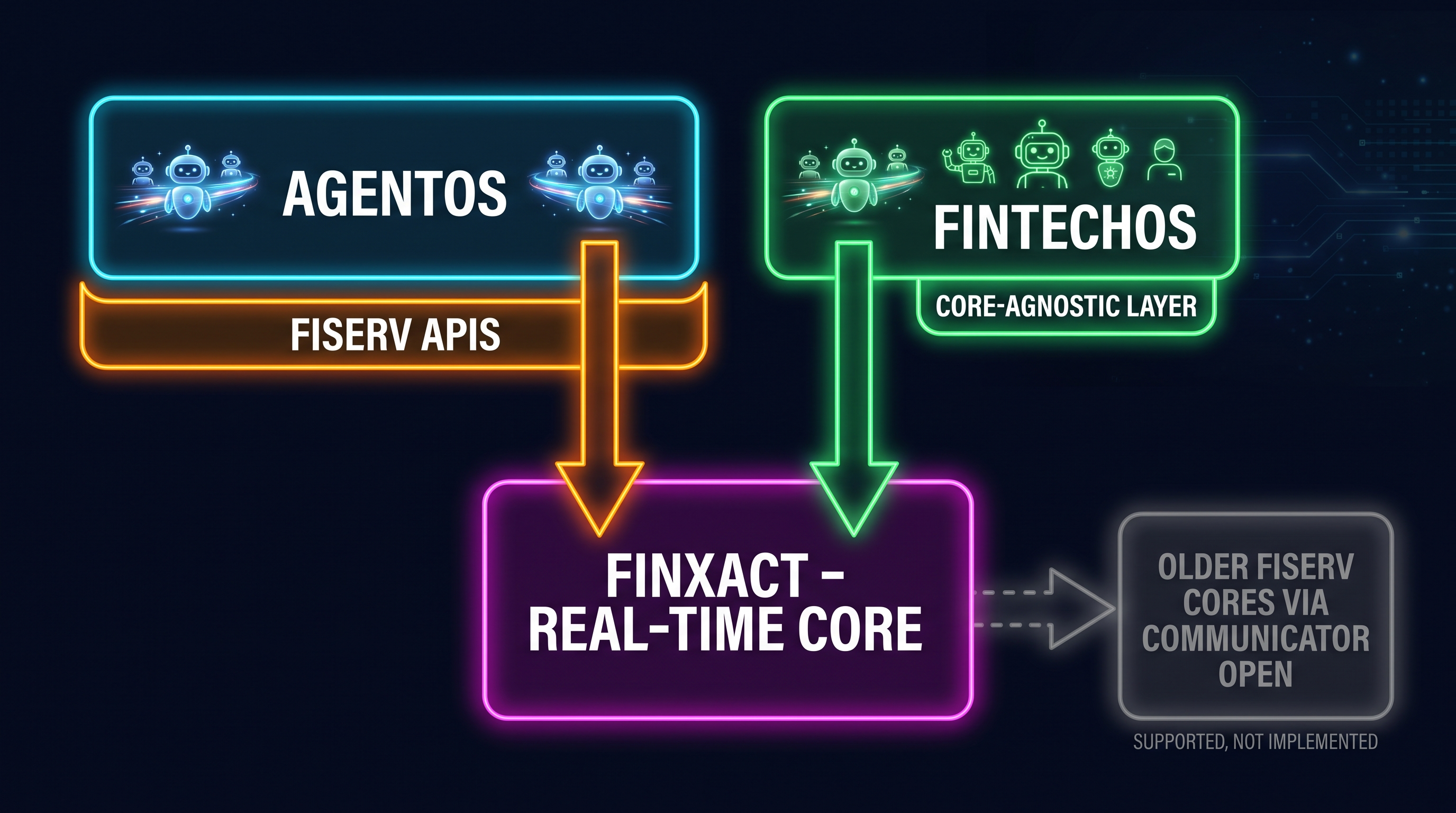
That is the tell. The core-independent challenger, the one whose entire value proposition is that it does not care what core you run, in practice cares a great deal. On the Fiserv side it needs Finxact to be real. Everything else is a statement of work waiting for a first customer brave enough to fund it.
Both Roads Reach the Same Core
Which lands both companies, from opposite directions, on the identical dependency.
agentOS says agents run across all of Fiserv’s platforms. FintechOS says agents run on top of any core. Point either sentence at a real Fiserv bank and it resolves to the same practical clause: it runs well on Finxact. Fiserv’s own cross-core depth is, by its own roadmap, still forming for the legacy systems. A third party’s core-agnostic layer is only as agnostic as its shipped integrations. The floor under both is a core that can answer an agent in real time, with clean error semantics and idempotent writes, while the batch is running.
An agent does not tolerate a slow core the way a teller does. A human at 11pm sees a spinning screen and waits. An unattended agent mid-workflow sees a timeout it was never taught to handle. That is the reliability argument I made about agentOS eating its own APIs, and it does not soften for a third party. If anything it sharpens, because FintechOS has less control over the core than Fiserv does. Both of them need the same thing underneath, and only one core in the Fiserv catalog reliably provides it.
So the real precondition for agentic banking is not the agent framework. It is a modern real-time core. Buy the most elegant product-operations layer on the market, and if it lands on a nightly-batch ledger from the 1980s, the agents on top will fail plausibly and confidently, which in a regulated bank is the worst way to fail.
The Decision the Keynote Won’t Frame
Strip the branding off and the choice in front of an architect is not “agentOS or FintechOS.” It is two questions asked in order.
First, do I have a modern real-time core? If the honest answer is no, the agent-layer debate is premature. Whatever you buy above the ledger will be gated by the ledger. The first project is the core, and everyone who has run one knows it is a program, not a purchase.
Second, if I do have that core, who owns the layer above it? This is where the two bets genuinely diverge, and where the money is. Take Fiserv’s in-stack agents and you get tight integration and one throat to choke, at the cost of a deeper dependency on a single estate. Take a core-agnostic layer like FintechOS and you get portability in principle and a hedge against the core vendor, at the cost of owning an integration seam yourself and betting that “agnostic” stays true for your core.
Either way, the lock-in did not disappear. It relocated. The Forum series watched it move down to the data and context layer, the governed meaning an agent has to be handed before it can be trusted. This is the same move one rung up, at the orchestration layer, where the product logic and the agents that run it now live. The layer that looks open, the core with its OpenAPI surface, gets commoditized. The layer above it, the one that decides what your bank can actually launch next quarter, is where the switching costs quietly compound. I traced that pattern in Steal the Contract, Not the Catalog, and it holds here without a dent.
The Part I’m Reasoning To
I should mark the edge of what I know. This is a read from the public record and from the shape of the Fiserv estate, not from anyone’s integration backlog. If FintechOS, or anyone, has a live agentic layer running against a legacy Fiserv core through Communicator Open today, I would genuinely like to see it, because it would move the “supported in theory” line into “shipped,” and that is exactly the gap this whole argument turns on.
And I am not waving off core-agnostic as marketing. It is a real and defensible architecture, and against Finastra it is running in production. My claim is narrower and, I think, harder to dodge: agnostic in general still means specific in practice, and the specific core that carries agents well on the Fiserv side is Finxact. The philosophy is portable. The plumbing is not, yet.
The two companies could not have chosen more opposite architectures, and they arrived at the same floor. Whoever wins the agent era in banking will own the layer above the core, but that layer only stands where there is a real-time core to stand on. Right now, on the biggest core estate in the country, there is essentially one. That is the constraint the keynote never says out loud, and the one an architect should price in first.
The companion read is The Data Was Always the Problem, the last dispatch from the Fiserv Forum floor, on the layer one rung below this one. It sits at the end of the Fiserv Forum 2026 series, and this piece is the coda that walks back up the stack.
If you have shipped a core-agnostic agent layer against a legacy core, or you read the FintechOS-versus-agentOS bet differently, I want to compare notes before the verdict hardens. Find me on X @orestesgarcia or LinkedIn /in/setsero.