agentOS Has to Eat Fiserv's Own APIs
Fiserv's agentOS promises agents that do real banking work. That promise inherits the reliability of every API and core beneath it, and the hard test isn't the demo at 2pm, it's the unattended agent at 11pm while the core is closing the books. A banking architect on dogfooding, the end-of-day problem nobody demos, and whether the plumbing ships on time.

Contents
Fiserv wants agents to do real banking work. Every one of those agents will run on Fiserv’s own APIs.
That is the quiet commitment inside agentOS, and it is the most interesting thing about the whole announcement.
I flew to Las Vegas for Fiserv Forum this week, and I brought one question, the same one I wrote down before I boarded in Announced or Shippable?: which layers of this stack can I actually put my hands on today. That piece read the architecture from the outside, layer by layer. This one is about a promise the architecture quietly makes to itself.
Forum is crowning agentOS, the “operating system for agentic AI in banking” that Fiserv announced in May with OpenAI on Amazon Bedrock. The public strategy is coherent and, honestly, correct. APIs are the foundation. Agents are the orchestrators that call those APIs to get work done. Partners fill the gaps around the edges. Fiserv keeps the core products, the tellers and the ledgers, first-party. The ambition reaches past the bank’s own walls, too: Fiserv is wiring agentic payment tools with the card networks. Say all of that on a slide and every architect in the room nods, because it is the right shape.
Here is what the slide does not say out loud. If agents orchestrate work by calling APIs, then agentOS is now Fiserv’s largest and most demanding API consumer. The company has spent years telling partners to build on its APIs. Now its own flagship has to build on them too. Fiserv has to eat its own cooking.
The Stack Only Works Bottom-Up
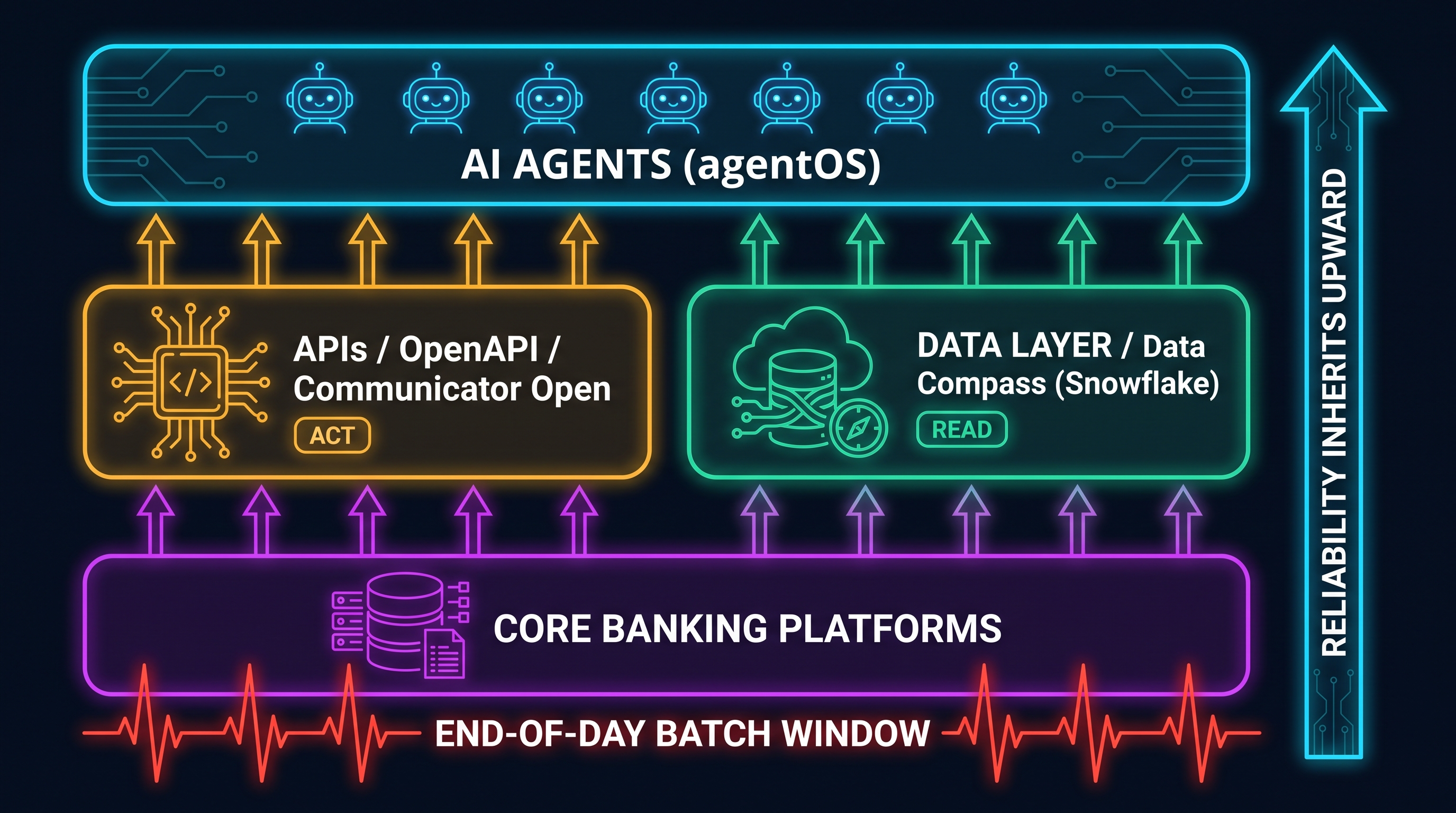
Picture the stack the way an agent actually traverses it. At the top, an agent in agentOS decides to do something: onboard a commercial loan, run a daily operational report, triage an AML alert. Fiserv named agents like these at launch, co-created with six banks and OpenAI. To do any of it, the agent calls an API. That API, through Fiserv’s Communicator Open layer and its OpenAPI surface, reaches down into a core banking platform where the money and the records actually live.
There is a second path down, and it carries just as much weight. An agent does not only act, it reasons, and to reason it has to read. That reading runs through a data layer, and Fiserv already sells one: Data Compass, a cloud data platform built on Snowflake with Alation carrying the catalog and lineage. Its job is to turn more than 250,000 raw core-banking fields into a governed single source of truth, the customer-360 an agent needs to trust before it moves. Fiserv calls it a data layer, not a semantic layer, but functionally that is the semantic job: making raw records mean something. Fiserv has not publicly wired Data Compass to agentOS, yet the architecture almost writes itself, because a governed data platform is exactly what an agent platform needs to read from.
So there are two ways down from the agent. It acts through the API layer and it reads through the data layer, and both of them rest on the same core banking platforms where the money and the records actually live. Count it as four layers or as a fork, the rule does not change. Each layer inherits the reliability of the layer beneath it. An agent cannot be more available than the API it calls, or work from data fresher than the layer it reads. And neither the API nor the data layer can be more available, or more current, than the core behind them. Reliability does not flow down from the impressive layer at the top. It flows up from the boring one at the bottom.
The End-of-Day Problem Nobody Demos
Here is the failure mode that never makes it into a keynote, and it is an industry pattern, not a vendor’s secret. Core banking platforms are not uniformly available around the clock. Every night they run batch: interest accrual, posting, statement cycles, reconciliation, the end-of-day close. During that window the core is under heavy load and parts of it cycle up and down. The API layer sitting in front of it has to absorb that. Built well, it degrades gracefully: it queues, it returns a clean “try again later,” it stays honest about what it could not do. Built poorly, it times out, throws opaque errors, or worse, half-completes and leaves the caller guessing whether the money moved.
A human teller feels this as a slow screen at 11pm and shrugs. An autonomous agent does not shrug. An agent running an unattended workflow at 11pm, mid-batch, is exactly the case a 2pm demo is designed to hide. The demo runs when the core is quiet and every call returns in forty milliseconds. Production runs when the core is closing the books and the same call might hang for thirty seconds, or fail in a way the agent was never taught to handle.
This is the difference between an API that returns data and an API you can build an autonomous system on. The second one needs contract-level guarantees: predictable error semantics, idempotency so a retried payment does not post twice, backpressure so a slow core does not turn into a stampede of retries that makes things worse. Those guarantees are unglamorous, and they are the whole game.
Dogfooding Cuts Both Ways
This is why agentOS running on Fiserv’s own APIs is the healthiest thing about the announcement, and also the riskiest.
Healthy, because a vendor that consumes its own APIs the way a partner does finally feels its own seams. The oldest incentive gap in platform companies is that the team shipping the API and the team consuming it are different people carrying different pain. Dogfooding closes that gap. If an agentOS agent times out against a core at end of day, that is now Fiserv’s outage, on Fiserv’s roadmap, not a partner’s support ticket aging quietly in a queue. The pain lands on the party that can fix it.
Risky, because the commitment is public and testable. If Fiserv’s own agents cannot reliably run against Fiserv’s own APIs during the hard windows, then those APIs were never reliable enough for partners either. The partners just could not prove it. Agents make the reliability of the API layer legible in a way a status page never did. Dogfooding is a promise you cannot walk back once the room has watched you make it.
The Developer On-Ramp Is Real
Give credit where the shipping is real, because not all of this is a pilot. The developer layer is genuinely public. Developer Studio gives you an account, a sandbox, and API docs without a signed partnership. There is an AI assistant inside it that answers technical questions about the APIs and how to use them, which is a sensible on-ramp for developers who would otherwise file a ticket and wait. The AppMarket gives third parties a place to publish. And the whole thing is organized around an OpenAPI surface, which matters more than it sounds.
An OpenAPI contract is not documentation. It is the machine-readable description an agent reads to learn what actions exist and how to call them. I made this argument in The API Catalog Is the Tool Catalog: in the agent era your API catalog quietly becomes the set of things your agents are allowed to do. A clean OpenAPI surface is the difference between an agent that can discover an action and one that has to be hand-wired to it. This is the part of the strategy that is already load-bearing, and it is the part I would build on first. I pushed the deeper version of it in Steal the Contract, Not the Catalog: the durable asset is the contract, not the list of endpoints.
What Separates Announced From Shippable
So here is the checklist I am carrying through the Experience Center, and none of it is about the agents. It is all about the layer underneath them.
- Error semantics. Do the APIs document what happens on failure, or only on success? A success-only spec is a demo spec.
- Idempotency. Can I safely retry a write? For anything that moves money this is not optional, and an agent will retry.
- End-of-day behavior. What does the API do while the core is mid-batch? “It stays up and returns a clean error” is a real answer. Silence is also an answer.
- Beta to general availability. Six institutions co-developing and two running agents in beta is a strong pilot roster. It is not the same as GA. Which agents, against which cores, are in production today?
- Marketplace depth. Is the marketplace a catalog of agents that ship, or a wall of logos and intentions?
On Time Is Its Own Test
agentOS went public in May with wider availability pointed at roughly now. That timing is itself a claim worth watching, because agentic roadmaps slip in a specific way. The agent demos are the easy twenty percent. The reliability work underneath, the retry logic, the graceful degradation, the batch-window hardening, is the eighty percent that does not demo and does not slip gracefully. When one of these programs is late, it is almost never the model or the agent interface that is late. It is the plumbing.
Delivering agentOS on time, in the sense that actually matters, does not mean the agents look good on stage this week. It means the API layer they stand on holds up on a Tuesday night in November while the core is closing the books. That is the deliverable. Everything above it is inheriting.
The Part I Can’t See From Here
I should be honest about the limits of this read. I am reasoning from the public record and from one failure pattern the whole industry knows, not from anyone’s internal telemetry. It is entirely possible that agentOS has already hardened the batch-window path, that the error semantics are clean, that this is a solved problem I am waving at from the cheap seats. I would be glad to find that out.
And saying the right things is not nothing. Plenty of vendors never get the strategy straight, and Fiserv has: APIs as the foundation, agents as the orchestrators, a real developer on-ramp, the core products kept in-house. The direction is right and the ordering is right. My skepticism is not about the vision. It is about the plumbing, which is the least glamorous and most decisive layer in the entire stack, and the one a general session is built to skip.
An agent is only as reliable as the API it calls, and that API is only as reliable as the core behind it at 11pm. agentOS is a bet that Fiserv can make all three layers hold at once, for its own agents first and everyone else’s right after. It is a good bet to make, and the only way to lose it is to ship the top of the stack and not the bottom. I will know a lot more by the time the lights come up.
The companion read is Announced or Shippable?, the layer-by-layer read I did before I landed. This is that same test from inside the building, pointed at the one layer everything else stands on. For the announced-versus-shipped gap in a different corner of the agent world, see The Second Brain Doesn’t Ship.
If you’re at Forum, or running this same reliability read on your own vendor stack, I want to compare notes before the verdict gets written. Find me on X @orestesgarcia or LinkedIn /in/setsero.
Get the next field note.
Regulated AI, architecture and platform economics — in your inbox as they publish.