The AI Employee Roster Was Built for a Plumber. Every Line Has a Bank-Sized Twin.
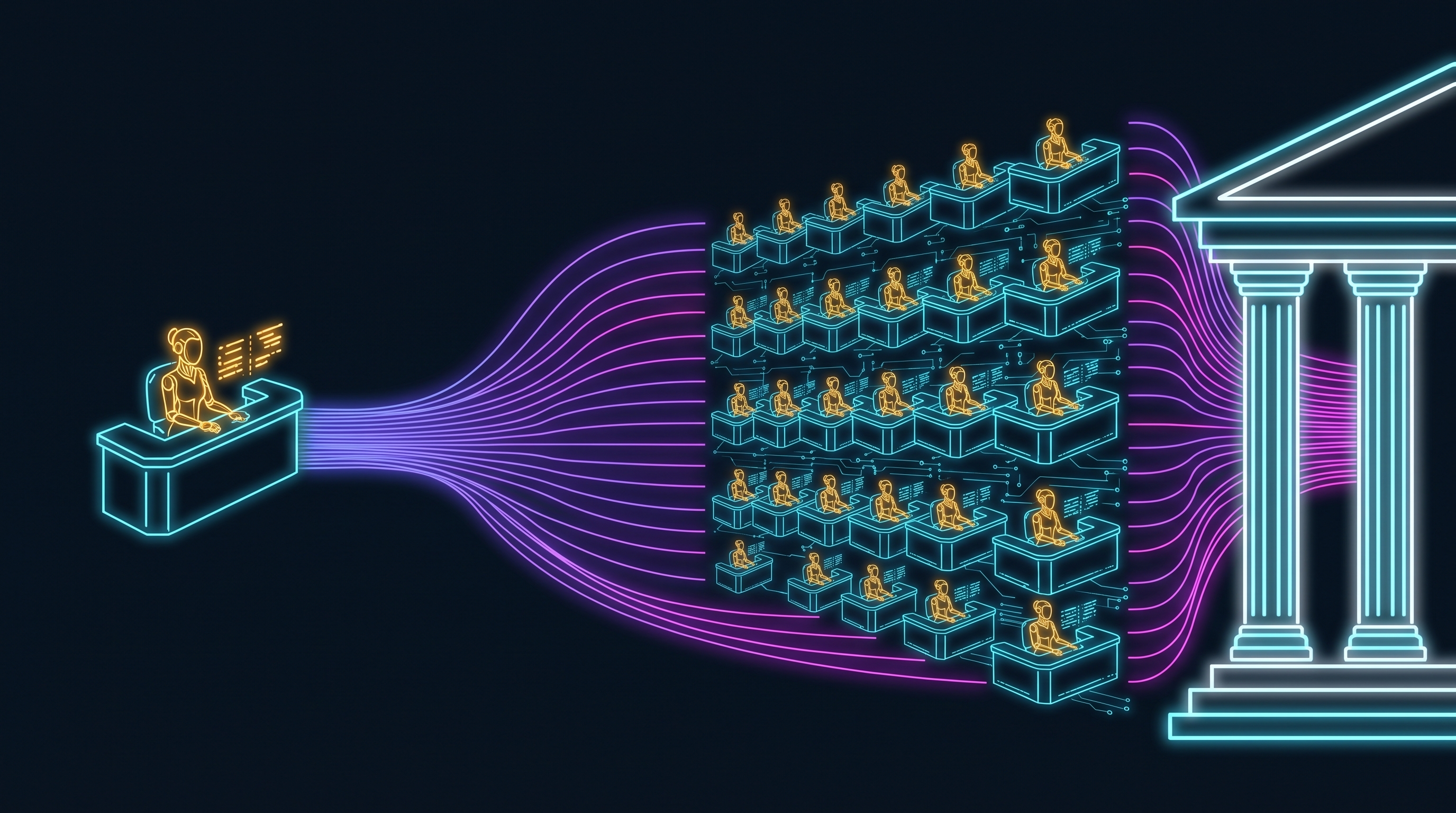
The SMB pitch sells an AI receptionist to a plumber losing $500 a missed call. Read the same roster as a bank and every role maps to a line item a bank already measures. Here is the ROI, role by role, and the compliance tax that decides which ones actually clear the bar.
Contents
The pitch making the rounds in small-business circles is clean. Don’t sell a chatbot, sell an employee. Name her Sophia, train her in thirty seconds on a service menu, and she answers every call at lunch, after hours, on holidays. The math sells itself: a plumber who misses fifty calls a month at five hundred dollars a call is leaving a quarter million on the table a year, and eighty percent of the people who hit voicemail never call back.
It’s a good pitch for a plumber. My first reaction was that it has nothing to do with a bank. That reaction was wrong.
A plumber who misses a call loses a job. A bank that misses a call loses a customer across a thirty-year relationship: a checking account, a card, a car loan, a mortgage, a small-business line, the kids’ first accounts. The roster of AI “employees” being sold to Main Street reads, line for line, as a list of things a bank already spends money on and already measures. The dollar figures are just bigger.
So the useful question is not whether these roles are too small for an enterprise. It’s which ones survive contact with a regulated bank, and which ones the regulation quietly kills.
Read the roster as a balance sheet, not a novelty
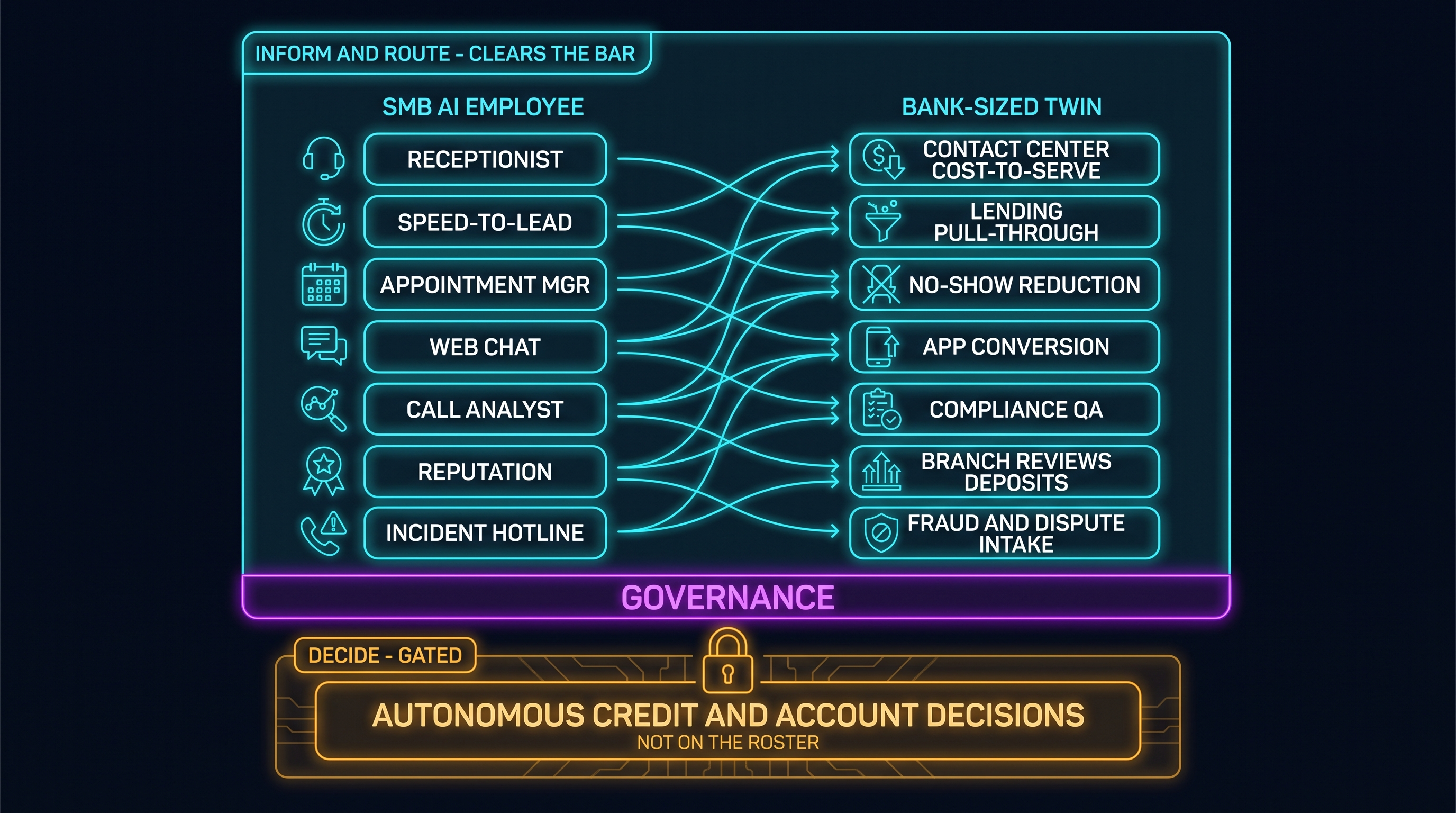
The roster is familiar: a receptionist, a speed-to-lead agent, an appointment manager, a web chat, a sales-call analyst, a reputation manager, an incident hotline. In the SMB story each one is a person you don’t have to hire. In a bank each one is a cost center you already run, at consumer scale on one side of the house and commercial scale on the other.
That reframing matters because most banks evaluate this technology as an experiment and then wonder why nothing compounds. Adoption is not impact. I made that case in The Bank Got Dumber While Its People Got Smarter: individuals get faster while the institution learns nothing, because the tool never touches a number the institution reports. The roster is useful precisely because every role on it points at a number the bank already reports. Cost to serve. Pull-through on a funded loan. Complaint volume. Abandoned applications.
Map the roles to those numbers and the ROI question stops being a vibe and becomes arithmetic.
The wedge is the same at every size: the front desk
The receptionist is the anchor role in the SMB pitch for a reason. It’s the cheapest to prove and the math is undeniable. In a bank the receptionist has a name the industry already uses: the contact center, plus the chat window on the app and the site.
The public numbers are not modest. Bank of America’s Erica has surpassed three billion interactions since 2018, serving close to fifty million clients at an average of forty-eight seconds per interaction, with the bank reporting that ninety-eight percent of clients find what they came for. Klarna’s assistant handled 2.3 million conversations in its first month, work the company put at roughly seven hundred full-time agents, resolving issues in under two minutes against eleven for a human and driving an estimated forty million dollars in profit improvement.
The cost gap under those numbers is the whole argument. An assisted contact in financial services can cost ten to twenty times what the same interaction costs through digital self-service, because identity verification, call length, and workflow complexity all run higher in banking. Multiply that gap by deflectable volume and the receptionist is not a feature. It’s the single largest line item in support, addressed.
The role splits cleanly across the two sides of the bank:
- Consumer. Balance and transaction questions, card activation, lost-card and travel notices, payment scheduling, and the endless “did my deposit post.” These are high volume, low variance, and identity-gated. The perfect deflection target.
- Commercial. A treasury-management support desk that answers wire and ACH status, positive-pay exceptions, token resets, and onboarding questions for a business client whose time is expensive and whose relationship manager should not be the help desk.
Same brain, two front doors. The commercial door is worth more per interaction because the relationship behind it is worth more.
Speed and scheduling are lending problems in disguise
The speed-to-lead agent is the second SMB role that translates without strain, and in a bank it lands directly on revenue. The research is old and brutal. Harvard Business Review’s study of online sales leads found that firms contacting a prospect within an hour were nearly seven times likelier to have a meaningful conversation than those who waited just one hour longer, and more than sixty times likelier than those who waited a day.
Now put that against a mortgage inquiry submitted at eleven at night, an auto-loan lead from a dealership on a Saturday, or an SBA application that lands while the branch is closed. An agent that responds in seconds, qualifies intent, and books the next step is not doing customer service. It is protecting pull-through on funded loans, which is the number the lending business is actually graded on. The plumber loses a job to whoever calls back first. A bank loses a mortgage the same way, and a mortgage is not a job.
The appointment manager rides alongside it. Confirmations, reminders, and rescheduling for banker and branch meetings are unglamorous, but a booked meeting that turns into a no-show is spent acquisition cost with nothing to show. An agent that follows up the moment a request comes in, and fills the gap when someone cancels, converts intent that today evaporates between the click and the calendar.
The back office is where the roster gets interesting
Past the front desk, the mapping keeps working, and one of the translations is better in a bank than it ever is for an SMB.
- Call intelligence. For a small business it summarizes sales calls and updates the CRM. For a bank it does that and pulls double duty as compliance. Banks already record and review calls for quality and conduct. An agent that transcribes every call, keeps the CRM honest, and surfaces the interactions a human reviewer should sample is cheaper surveillance on a cost the bank is already paying and cannot stop paying.
- Reputation. The SMB version moves a Google rating. For a bank, per-branch reviews and local search are a deposit-gathering channel, not vanity. An agent that drafts responses to every review in a consistent, compliant tone, and reports the three- and six-month trend by location, turns a scattered chore into a managed signal.
- Incident hotline. The custom build in the SMB pitch answers, records, and auto-fills incident reports. A bank has an obvious home for it: fraud and dispute intake, where structured, timestamped, complete first-contact records are exactly what the downstream investigation and the regulator want.
The one role I would not oversell is the CFO agent. The demo where it finds a hidden loss on a live call is a great demo. Inside a bank, financial analysis of that kind runs into finance, risk, and audit functions with their own controls and their own numbers, and an agent narrating the P&L on a call is a briefing tool, not a decision maker. Useful. Not the flagship.
The part the pitch leaves out: the compliance tax
Here is where the SMB roster and the bank part ways, and it is the whole reason a bank cannot just buy the bundle and switch it on.
Every claim that makes the SMB pitch sing is a claim a bank cannot make. “Trained in thirty seconds on a PDF.” “No human touch.” “It just handles it.” Those are selling points on Main Street and violations waiting to happen inside a regulated wall.
Start with the front desk, the safest role of all. The CFPB has already put banks on notice about chatbots, warning about the “doom loop” where a customer is trapped in unhelpful automation with no offramp to a human. Roughly thirty-seven percent of Americans interacted with a bank chatbot in 2022, and the bureau’s message was blunt: a deflection tool that blocks access to a person can itself be the harm. So the bank version of the receptionist needs a guaranteed human escalation path, logging that survives an examiner, and guardrails that keep it from wandering into advice it isn’t allowed to give. That is real engineering the plumber never has to fund.
Move one step toward a decision and the constraint hardens. The moment an agent touches a credit or account outcome, it enters a different legal universe. Under the Equal Credit Opportunity Act, a lender must give specific, accurate reasons for an adverse action, and the CFPB has said plainly that a creditor using AI cannot hide behind a checkbox form that fails to describe what the model actually scored. And any model that drives decisions falls under SR 11-7, which expects a bank to develop, validate, and govern that model across its entire lifecycle. “Trained in thirty seconds” is not a sentence you can say to a model-risk validator.
This is the tax. It is why regulated AI returns three times, not the ten the vendors promise, and why that is fine. I made the full argument in The Compliance Tax. The tax does not make the roster worthless. It sorts it.
Which roles clear the bar, and which don’t
The clean test is a single distinction: does the agent inform and route, or does it decide?
Roles that inform and route clear the bar with ordinary engineering discipline. The contact-center front desk, the speed-to-lead responder, the appointment manager, the call-intelligence and compliance-QA agent, the review responder, the incident-intake hotline. None of them make a binding decision about a customer. They handle, they qualify, they draft, they escalate to a human at the line where judgment starts. That line is the product.
Roles that decide do not clear the bar, not autonomously, not yet. Anything that approves or denies credit, closes an account, waives a fee as a matter of policy, or issues an adverse action is a decisioning system wearing an assistant’s clothes, and it inherits the full weight of model risk and fair-lending law the instant it acts on its own. I drew that maturity ceiling for the software factory in The AI Factory Has Five Rungs. Most Banks Are on the Second. and it holds here too. The bank tops out below full autonomy on purpose. The cap is a control, not a failure of nerve.
The bundling instinct from the SMB pitch survives the translation, but the reason changes. On Main Street you bundle the roles into one operating system because inseparability drives retention. In a bank you bundle them because shared identity, shared audit, and shared guardrails are how you govern them at all. The moat inside a bank is not lock-in. It’s governance.
None of this is an argument against the roster. Gartner expects more than forty percent of agentic AI projects to be canceled by the end of 2027, undone by cost and unclear value, and even Klarna, the poster child for AI customer service, walked its all-in stance back and rehired humans for the work the agent handled worst. The projects that die are the ones sold as magic. The ones that pay are the ones scoped to a number and gated by a human.
So take the roster, but read it right. It is a shopping list a bank can price against its own cost to serve, its own pull-through, its own complaint volume, one role at a time, cheapest and safest first. The receptionist is still the wedge. The math still sells itself. The agent was never the constraint. The governance around it always was, and building that well is the actual work.
The companion read is The AI Factory Has Five Rungs. Most Banks Are on the Second., which draws the same autonomy ceiling for the engineering side of the house. And for why the returns come in at three times rather than ten, see The Compliance Tax.
I write about AI-assisted development, enterprise architecture, and building in regulated environments. If you’re pricing one of these roles against your own numbers, I’d like to compare notes. Find me on X @orestesgarcia or LinkedIn /in/setsero.
Get the next field note.
Regulated AI, architecture and platform economics — in your inbox as they publish.