UiPath Isn't the New MuleSoft. It's the New Power Platform.
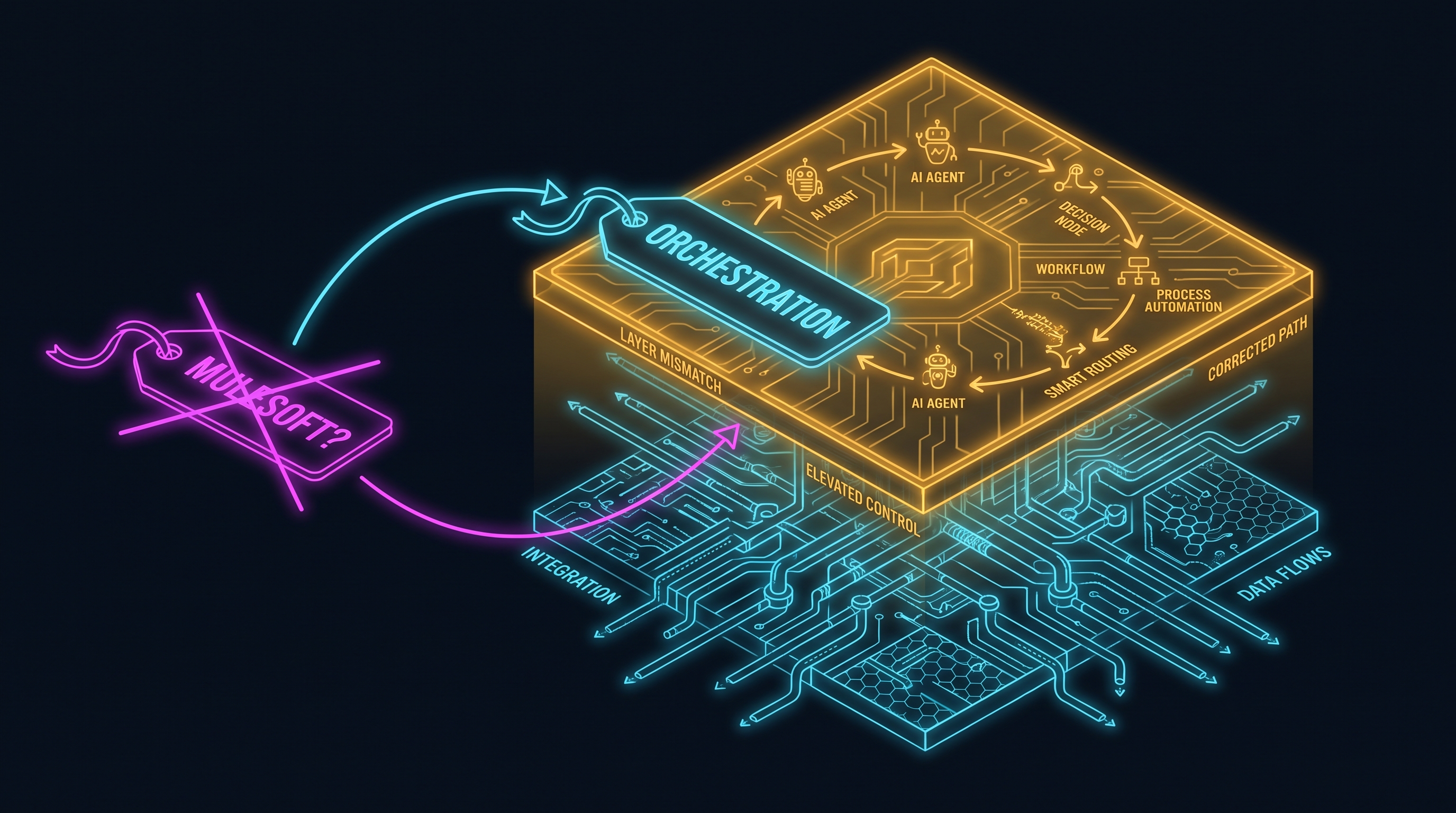
UiPath's Maestro pivot has people asking if it's a MuleSoft competitor. Wrong question. Classic MuleSoft is integration plumbing at a different altitude; the real overlap is Power Automate and Copilot Studio. An architect on where UiPath, Microsoft, MuleSoft, and Salesforce actually compete, why Agent Fabric muddies the one seam that's genuinely contested, and how to lay out all four without two control planes fighting.
Contents
It plays out in enterprise architecture reviews everywhere: someone looks at UiPath’s roadmap, sees the word “orchestration,” and says the thing that starts a bad procurement cycle: “So UiPath is basically our MuleSoft now, right?”
Wrong question. And the wrong question, in a shop that already writes checks to four platform vendors, is how you end up paying twice for one capability and nothing for another.
The mislabel is expensive
Imagine a shop that already owns the full modern-enterprise starter pack: UiPath for automation, Microsoft for productivity and cloud, MuleSoft for integration, Salesforce for the customer record. None of these are hypothetical purchases. They are sunk cost, renewed annually, defended by whoever signed the contract.
When a new capability shows up, the instinct is to slot it against something you already own. UiPath ships agentic orchestration, and because MuleSoft also says “orchestration” in its marketing, the two get filed as competitors. That single misfile drives two failure modes. Either you conclude you are double-paying and kill the wrong renewal, cutting the tool that was actually doing a job nothing else covers. Or you let two products both claim to be the control plane for your AI agents, and you stand up two governance layers that disagree about who is allowed to do what. In a regulated environment, the second one is the one that shows up in an audit finding.
The fix is boring and it works: figure out what altitude each tool actually flies at before you decide what competes with what.
What Maestro actually is
UiPath Maestro reached general availability in April 2025 and got a heavy expansion at the company’s FUSION event that September and October. UiPath calls it agentic orchestration, and for once the marketing noun is accurate. Maestro models a long-running business process in BPMN and then coordinates the three kinds of workers that process needs: AI agents, software robots, and humans. It handles the waiting, the branching, the handoffs, the exceptions, and the part every demo skips, which is what happens when step four fails at 2 a.m.
The nuance that matters, and the one most hot takes miss, is that Maestro did not replace UiPath’s older Orchestrator. They coexist at different altitudes. Orchestrator is the execution-layer manager: it runs robots, manages queues, fires triggers, holds assets. Maestro sits above it and models the end-to-end process, calling down into Orchestrator, into the Integration Service, and into agents as it goes. If you file Maestro as “Orchestrator 2.0” you will mis-scope every conversation that follows.
So the honest one-line description is this:
- Orchestrator runs the workers.
- Maestro runs the process the workers are part of.
- The agents and robots do the actual work inside the steps.
That is a process and agent orchestration layer. Hold that thought, because it decides everything downstream.
The claim that holds up
Before the competitive argument, the part of the UiPath story that is unambiguously true and worth stating plainly: the platform is model-agnostic, and it speaks the emerging agent standards.
UiPath’s AI Trust Layer includes an LLM gateway that fronts both UiPath-managed models and third-party models. You can bring your own. It ships connectors for GPT through Azure OpenAI, Gemini through Vertex AI, Claude through Amazon Bedrock, and an OpenAI-compatible connector for any provider that follows that API shape, plus a bring-your-own-model path. If your shop standardized on Azure AI Foundry, UiPath meets you there. On September 30, 2025, UiPath announced Azure AI Foundry integration that uses the Model Context Protocol for two-way exchange with Microsoft 365 Copilot and Copilot Studio, and agent-to-agent interaction between UiPath agents and Foundry agents, coordinated through Maestro.
Two standards are doing the heavy lifting there, and they are worth keeping straight because vendors blur them constantly:
- MCP, the Model Context Protocol, is Anthropic’s open standard from late 2024 for connecting one agent to many tools and data sources. Think of it as a universal port for an agent to reach APIs and systems. It has since been donated to a Linux Foundation body, so it is no longer a single-vendor play.
- A2A, Agent2Agent, is Google’s protocol from April 2025, now also governed by the Linux Foundation with a roster that includes AWS, Microsoft, Salesforce, and ServiceNow. Where MCP is agent-to-tools, A2A is agent-to-agent: how independently built agents discover each other and hand off tasks.
The reason this matters for procurement is that “LLM-agnostic and standards-native” is not a differentiator anymore. It is table stakes, and every serious platform in this comparison now claims it. Which means the model layer is not where these products actually compete. Keep looking up.
The real overlap is Power Platform
If you want to know who UiPath is fighting, do not look at your integration bus. Look at Microsoft Power Platform, because the overlap there is nearly total.
Power Automate does cloud flows and, through Power Automate Desktop, robotic process automation. That is the same job as UiPath’s robots. Copilot Studio builds and governs agents. That is the same job as UiPath’s Agent Builder plus Maestro’s orchestration. Power Apps and Dataverse round out the low-code app and state layer. Both vendors are converging on the identical territory: RPA, plus low-code process automation, plus agents, under one governed roof. When two products chase the same three capabilities for the same buyer, that is a competition, and it is the one that actually decides your architecture.
The honest split, the part a vendor will not tell you, is that neither wins outright. Power Automate tends to win on cost and citizen-developer reach when you already own Microsoft 365, because the licensing is folded into an estate you are paying for regardless. UiPath tends to win on the hard automation: complex attended desktop work, computer vision, legacy and Citrix environments, and governed orchestration at genuine enterprise scale. If your shop already runs both, the question is not which to cut. It is which one you make the primary orchestrator for a given family of processes, so that you are not maintaining two half-populated control planes that each know about half your automations.
This is the same pattern I wrote about in The Harness Went Multiplayer: a capability that used to be a differentiator moves up a floor and becomes commodity infrastructure, and the interesting decision is no longer the tool, it is which layer owns the accountability.
Why “MuleSoft competitor” is a category error
Now the claim that started this. Classic MuleSoft is not a UiPath competitor, and the reason is altitude.
MuleSoft Anypoint is an integration platform and full-lifecycle API manager built around API-led connectivity. It connects systems, exposes reusable APIs, and manages their lifecycle. It is the wiring between your systems, not the work that runs across them. MuleSoft, now a Salesforce product, moves data and standardizes access. UiPath drives a process and puts agents and robots to work inside it. One is plumbing, one is labor. A process orchestrator calls integration APIs constantly; that makes MuleSoft something UiPath consumes, not something it replaces. Filing them as competitors conflates the pipe with the thing flowing through it.
Here is where I have to be honest instead of tidy, because the person who said “UiPath is our new MuleSoft” was not entirely hallucinating. They were probably reacting to Agent Fabric.
In September 2025 Salesforce launched MuleSoft Agent Fabric, an enterprise agent control plane that discovers, governs, orchestrates, and observes AI agents across ecosystems, including Agentforce, Bedrock, Vertex, and any MCP server. Read that sentence again with Maestro in mind and the overlap is obvious. Agent Fabric reaches straight into the agent-orchestration and governance space UiPath is claiming. And separately, MuleSoft now exposes existing integrations as MCP servers through its MCP Bridge, so agents can call your governed APIs directly.
So the precise version of my claim is this. Anypoint versus UiPath is not a competition; they are different layers. Agent Fabric versus Maestro is a real one, and it is the single seam in this whole stack that is genuinely contested. But even there they are not the same bet. Agent Fabric governs agents from the integration layer looking up, native to your API estate and your Salesforce record. Maestro orchestrates from the process and robot layer looking across, native to long-running work that spans systems and includes humans and legacy UI automation. You can prefer one philosophy over the other. What you cannot do is pretend they are interchangeable, or that either one makes classic MuleSoft integration redundant.
The practical layering
If your shop already owns UiPath, Microsoft, MuleSoft, and Salesforce, here is the map I would put on the wall. No new purchases. Just each tool assigned to the altitude it actually flies at.
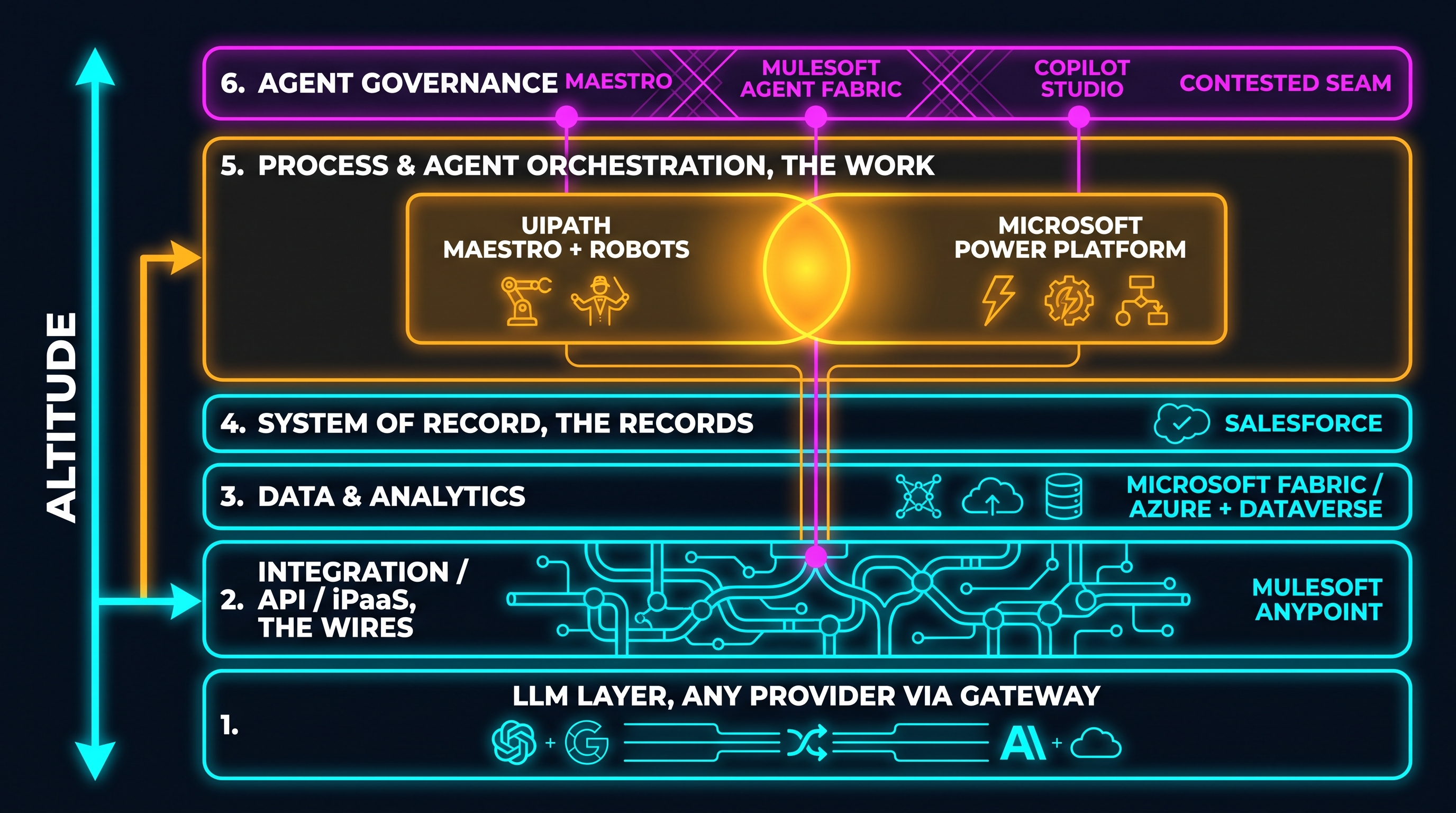
- Salesforce is the system of record. Customer data, the transactional truth, and the Agentforce agents that live natively against that data. When a question is about a customer or a deal, this is the source.
- MuleSoft Anypoint is the integration layer. API-led connectivity, the wires between systems, and the place you unlock on-premise and legacy data. It also exposes those systems as MCP servers so agents anywhere can reach them under governance. This is plumbing, not process. Do not ask it to run your workflow.
- Microsoft Fabric and Azure, plus Dataverse, are the data and analytics layer. Lakehouse, business intelligence, and low-code app state. Name Microsoft Fabric out loud and keep it far away from MuleSoft Agent Fabric in every diagram, because the two “Fabrics” are unrelated products and the collision has already confused at least one architecture review near you.
- UiPath Maestro with robots, or Microsoft Power Platform, is the process and agent orchestration layer. This is where the real overlap lives. Pick one as the primary orchestrator per family of processes. Do not let both own the same workflow, and do not run two agent control planes that disagree.
- The contested seam is agent governance. Maestro’s AI Trust Layer, MuleSoft Agent Fabric, and Copilot Studio all now reach for the “who governs the agents” role. This is the one decision to make deliberately and in writing, not by accident of whichever team shipped first.
- The LLM layer is anyone’s. Route to Azure AI Foundry, Bedrock, or Vertex through a gateway. It is a commodity input, not an architectural commitment.
If you want the whole thing as one line to repeat in meetings: MuleSoft is the wires, Salesforce is the records, Microsoft Fabric and Azure are the data, and UiPath or Power Platform is the work. The fight is over the work and over who governs the agents doing it. Nothing in that sentence is a fight between UiPath and MuleSoft.
The part I won’t pretend away
These lines are moving, and anyone who draws them as permanent is selling something. Gartner already coined a category, Business Orchestration and Automation Technologies, that deliberately bundles RPA, workflow, integration, low-code, and document processing under one label, and named a Leader in the inaugural 2025 version. The whole industry is converging toward the middle. In eighteen months my “different altitude” argument may need a revision, because every vendor here is climbing toward the same agent-orchestration floor from a different staircase.
The one seam to watch is agent governance, because that is where the convergence is happening fastest and where three products you already own now overlap. Everything else in the stack is still cleanly layered. That one is not, and it will not stay quiet.
The label matters less than the layer
The useful move is not to decide whether UiPath is the new MuleSoft or the new Power Platform. It is to stop reasoning by vendor name and start reasoning by altitude. Once you know which layer owns the process, which owns the integration, and which owns the agents, the procurement questions answer themselves, and the audit questions get answers you can defend.
UiPath is not the new MuleSoft. It is a process and agent orchestration layer whose real rival is Power Platform, whose real dependency is exactly the integration plumbing it gets confused with, and whose one genuine turf war, over who governs the agents, is worth watching precisely because you already own three of the combatants. Decide that seam on purpose. Everything else is just knowing what flies at what altitude.
The companion read is Steal the Contract, Not the Catalog, where I argued the thing worth adopting is rarely the tool itself, it is the layer and the contract underneath it. The same instinct applies here: buy the altitude, not the logo.
I write about AI-assisted development, enterprise architecture, and building in regulated environments. If you are untangling an automation and integration stack under real compliance pressure, I would like to compare notes. Find me on X @orestesgarcia or LinkedIn /in/setsero.
Get the next field note.
Regulated AI, architecture and platform economics — in your inbox as they publish.