Koa Isn't the Best Model. It's the Best-Placed One.
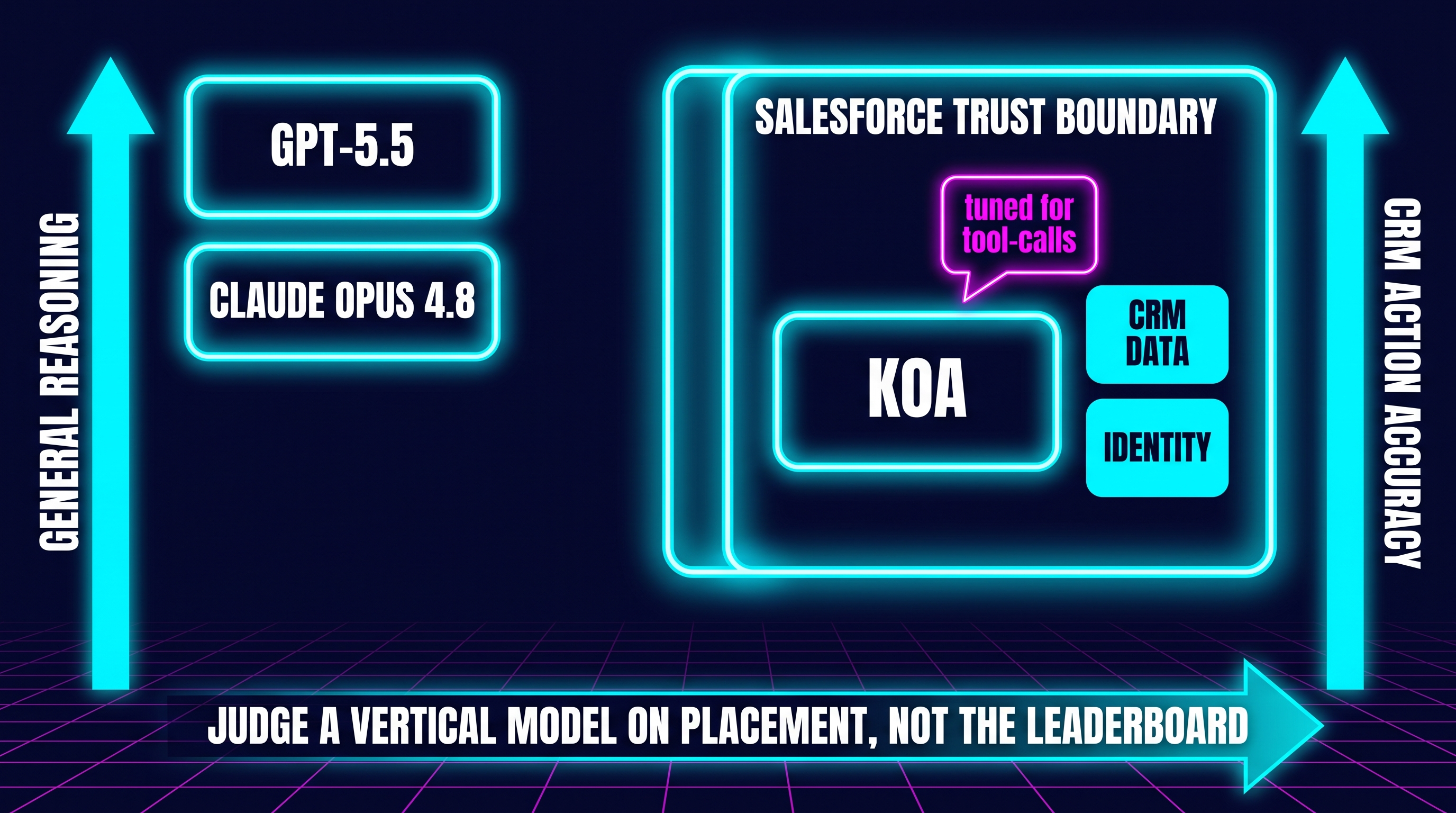
Salesforce's first CRM reasoning model trails frontier models on the independent benchmark and near-tops Salesforce's own. That contradiction is the story. Koa is not a capability play, it is a placement play: reasoning post-trained for CRM actions, running inside the vendor's trust boundary, next to the data and identity it needs. Judge a vertical model on placement and action accuracy, not on a leaderboard it was never built to win.
Contents
Salesforce trained a model that trails the frontier on the public benchmark, and for CRM work that may be exactly the point.
Koa, announced at Dreamforce on September 15, is Salesforce’s first CRM reasoning model, built on NVIDIA’s Nemotron 3 Super and post-trained for Agentforce. The launch copy says it matches or outperforms leading models while making three times fewer errors. The reflex, for anyone who has been watching frontier models, is to line Koa up against GPT-5.5 and see who wins. That is the wrong axis, and reaching for it is how you misread what Salesforce shipped.
The benchmark you reach for is the wrong one
Two numbers tell the whole story if you read them together. On Salesforce’s own CRM Bench, Koa scores 0.86, near the top of the field and just under GPT-5.5 at 0.90. On the independent Tau2Bench, Koa scores 69.41, beating GPT-4.1 by roughly fifteen points but trailing Claude Opus 4.8 at 74.00 and GPT-5.5 at 83.99.
A vendor benchmark that scores the vendor’s own model at the vendor’s own task is not a trick. It is a category signal. Koa is a vertical model, and the honest way to judge a vertical model is on the vertical, not on a general leaderboard it was never designed to top. The contradiction between the two scores is the product: competitive on raw reasoning, differentiated on the specific work.
What a CRM reasoning model actually is
Strip the announcement down and Koa is a model post-trained to reason step by step through multi-step CRM workflows and call the right tool at each step. Update the opportunity, route the case, schedule the follow-up, retrieve the account context, in the right order, with the right arguments. That is a different skill from answering a question well.
The differentiators Salesforce cites are shaped like that skill. It reports Koa choosing the right action eleven percent more often, retrieving customer context more than twice as reliably, and holding up fifteen percent better across long conversations. Take those as vendor figures, because they are, but notice what they measure. None of them is eloquence. All of them are the mechanics of taking a correct action inside a system of record. For an agent whose job is to do CRM work rather than talk about it, action accuracy is the number that pays rent.
The real feature is placement
Here is the part that matters to an architect, and it has nothing to do with the leaderboard. Koa was trained on a synthetic dataset modeled on decades of CRM deployments across more than fourteen industries, with no customer data. Salesforce holds the weights, runs post-training and inference inside its own trust boundary, and keeps customer data from leaving that boundary during use.
That is the reasoning-layer instance of a pattern I keep tracing on this blog. The open layer is where you get choice, the durable layer is what the vendor keeps, and Salesforce keeps the layers that carry switching cost. I made that case about the runtime in You Bring React. Salesforce Keeps the Runtime. Now the same logic reaches the model. The reasoning moves inside the boundary where the data and identity already live, and it grounds on the reference system I described in Data 360 Is a Reference System, Not a Database. Koa is not competing to be the smartest model in the room. It is competing to be the model already standing where the work happens.
Both sides of the boundary
The experience case is real, and it is strong. For a service agent or a banker taking multi-step actions in the CRM, a model that picks the right action more often, pulls the right context more reliably, and runs where the record already sits removes friction that a smarter general model sitting outside the boundary would reintroduce. Fewer wrong actions on a real workflow is worth more than a higher score on an abstract test. When the work is bounded by the CRM, a model bounded to the CRM is a feature.
The control case is just as real. Running Koa means you run what Salesforce ships, so model choice for that workload is gone. The headline advantage rests on the vendor’s own benchmark, which you cannot independently reproduce. And your reasoning is now coupled to Salesforce’s trust boundary, which raises the questions the boundary always raises: attribution of a decision, model-risk inventory under guidance like Fed SR 11-7 that expects you to catalog and monitor the third-party models you rely on, and the exit cost of reasoning you did not train and cannot move.
These reconcile the way they usually do. For CRM-bounded action-taking where your data gravity is already Salesforce, an in-boundary purpose-built model is the right call, and buying open model choice you will not exercise there is its own waste. For open-ended reasoning that is not CRM work, you keep choice somewhere you control. The control plane is what lets you say yes to the in-boundary model without losing the audit trail: log which model and which version served each request, and the placement advantage stops being a black box.
The honest limit
A better-placed model does not settle whether the agent around it earns its keep. The Agentforce ROI question is still open, and a model that takes the right CRM action more often is an input to that answer, not the answer. Koa is competitive, not dominant, on capability, and differentiated on placement. Anyone selling it as a frontier-beating model is reading the wrong benchmark on purpose.
But the direction is worth naming. The interesting move here is not a vertical model edging a general one on a friendly test. It is that reasoning is becoming a layer you place, the way data and identity became layers you place. Expect more vertical, in-boundary models tuned to the system they live in. When they arrive, judge them on placement and action accuracy, keep a record of which one ran, and hold model choice open where the reasoning is open. Koa is not the best model. For CRM work, it is standing in the best place, and that is the more useful thing to be.
If this resonated, read You Bring React. Salesforce Keeps the Runtime., on the layers a platform keeps, and Data 360 Is a Reference System, Not a Database, on the grounding layer a reasoning model needs.
Find me on X @orestesgarcia or LinkedIn /in/setsero.
Get the next field note.
Regulated AI, architecture and platform economics — in your inbox as they publish.