The Aircraft Carrier's Business Brain
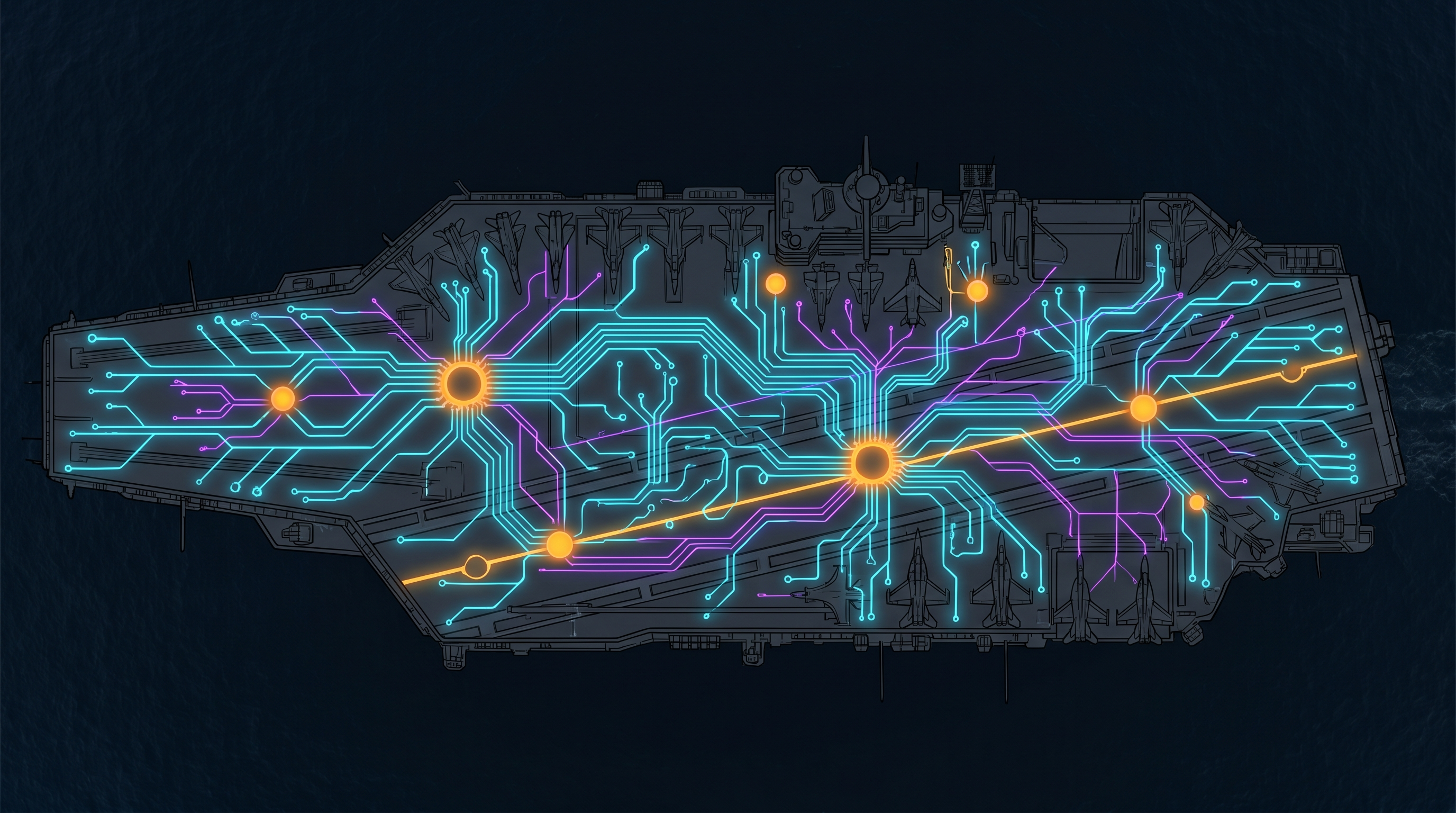
Daniel Miessler says most companies aren't ready for AI. Block.xyz says hierarchy is a 2,000-year-old information routing workaround AI makes obsolete. Both are right, and neither was written for a large regulated bank. Here's the enterprise translation.
Contents
Can your organization answer basic questions about itself, consistently, across every level, in under five minutes?
Most enterprise teams can’t. Not because the answers don’t exist somewhere. Because five different people will give you five different answers, and nobody has the standing to say which one is right. I’ve sat in enough architecture reviews and transformation steering committees to know that this isn’t dysfunction. It’s the logical output of a structure that was never designed to hold a single source of truth.
Two frameworks put the same problem in sharp relief from different angles. One diagnoses it. The other explains why it was inevitable, and what to build instead.
The Diagnostic Most Enterprises Are Failing
Daniel Miessler’s readiness test for AI is deceptively simple. His argument: most companies are “chaotic black boxes that barely work.” They can’t consistently articulate what problems they solve for customers, what their goals are and how they’re measured, what obstacles stand between them and those goals, or who is responsible for what.
The paradox he identifies: companies already succeeding with AI looked exactly like this before AI. Organized, self-aware organizations got better. Chaotic ones got something worse than they had: the ability to fail faster, at greater scale, with more confidence. AI doesn’t fix organizational dysfunction. It amplifies whatever state you’re already in.
In enterprise banking, the amplification problem is acute. More hierarchy means more layers where information distorts. More departments means more competing versions of the same truth. The compliance infrastructure creates an illusion of operational clarity (ITSM processes, runbooks, change control frameworks) that conceals the actual ground-level reality. Five engineers documenting the same process will produce five different answers, and that gap is diagnostic data, not a communication failure.
The Architecture Block Built
The structural reason this happens, and why it was always going to happen, is the subject of Block’s “From Hierarchy to Intelligence” essay. It’s the most coherent organizational argument I’ve read in years.
The thesis: two thousand years of management innovation has been a series of workarounds for a single constraint: the span-of-control problem. One person cannot effectively monitor and direct more than a handful of others, so you build layers. The Roman Legion created nested hierarchies as an information routing protocol. The Prussian General Staff codified this after Napoleon. U.S. railroads commercialized it in the 1840s. Frederick Taylor optimized tasks within the pyramid. Modern alternatives (Spotify squads, Holacracy, flat orgs) each attempted to escape the pattern and hit scaling limits.
Every one of these innovations failed for the same reason: “no alternative information routing mechanism has been powerful enough to replace” hierarchical human coordination. Until now.
Block’s answer isn’t another org chart variation. It’s a four-layer intelligence architecture:
Capabilities are the atomic primitives: discrete functions that do one thing reliably and can be composed into larger workflows. Not tools you buy. Functions you build, documented and testable.
The World Model is the intelligence system maintaining a continuously updated picture of the organization and its customers, replacing what managers have always done by routing information between people. A Company World Model (how the business actually operates) and a Customer World Model (what each customer needs, built from behavioral signals, not CRM fields someone filled in).
The Intelligence Layer composes capabilities into solutions in response to real-time needs. Block’s example: a merchant experiencing seasonal cash-flow tightening receives a composed solution (short-term loan with adjusted repayment schedule) before they ask for it. No product manager predefined this workflow. The system recognized the moment.
Interfaces are delivery surfaces: hardware, software, reports, dashboards. Important, but not where the value lives.
The inverted org structure follows: intelligence lives in the system, people operate at the edge. Three roles replace the traditional pyramid. ICs (Individual Contributors, everyone makes things directly, not just engineers) are autonomous because the world model provides the context managers used to supply. DRIs (Directly Responsible Individuals, one person owns one outcome end-to-end, with authority to mobilize resources across teams) replace the committee ownership model entirely. Player-Coaches build and develop people, but no longer route information. The system does that.
When the intelligence layer can’t compose a needed solution, that failure becomes the backlog. Customer reality drives priorities. Not product manager hypotheses.
The Speedboat Implementation
The YC framework took Block’s architecture and turned it into an operational playbook for organizations that can implement it from scratch. Four stages: Learn (leadership develops personal AI fluency, not a task force, personal experience), Wire (build the Business Brain, the structured knowledge foundation every subsequent layer runs on), Automate (deploy closed loops per department, test harnesses first), Scale (reinvest freed bandwidth into what was previously impossible).
The premise is explicit: this is designed for the Speedboat Advantage. No legacy to migrate. No political resistance to manage. No IT governance to navigate. Complete operational redesign in months.
The unspoken assumption is equally important: you control the whole system. You are the DRI. Nobody needs to approve your Business Brain architecture.
Enterprise banking is the other thing.
Where the Aircraft Carrier Breaks
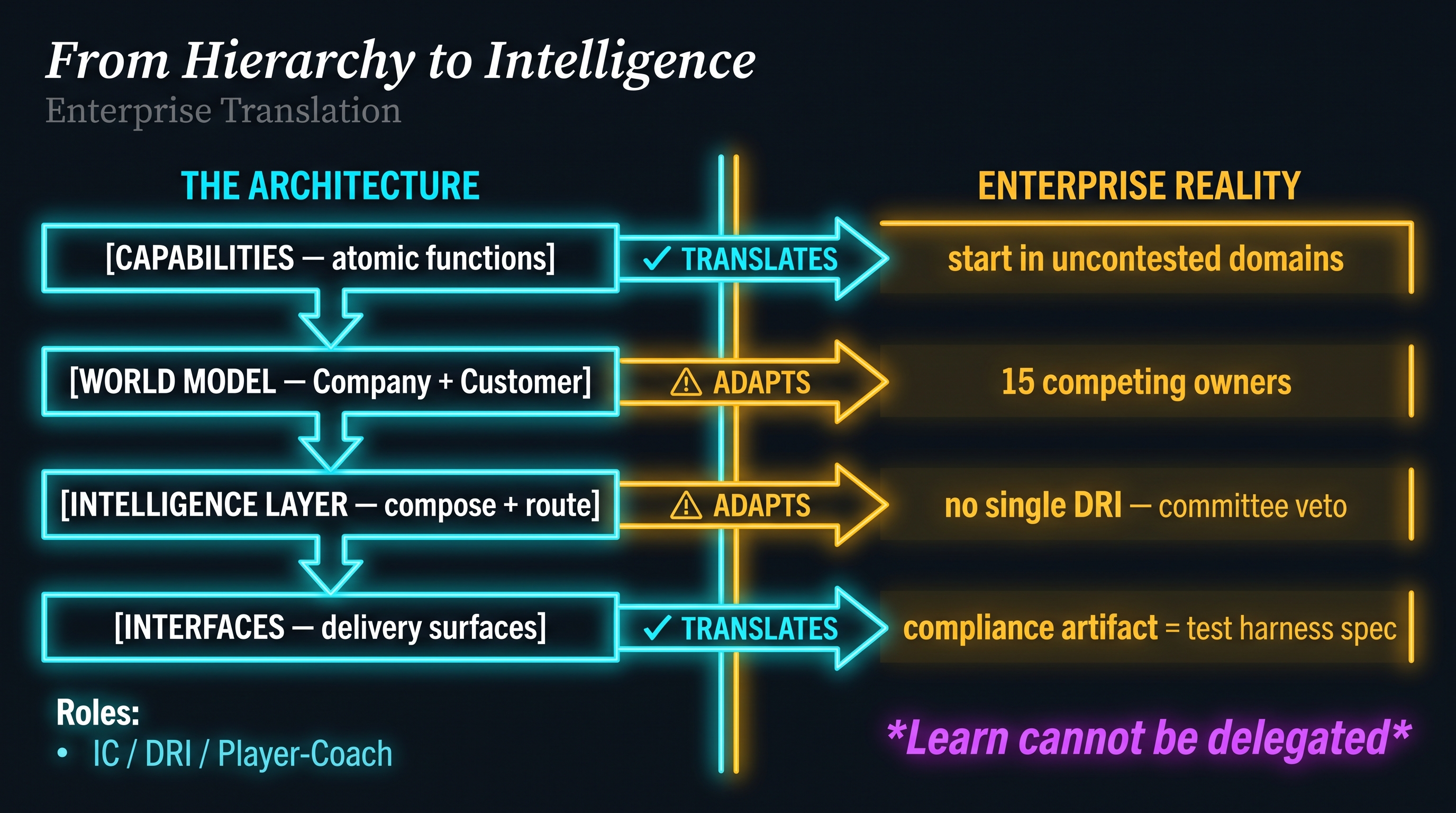
The World Model has fifteen owners. Block’s Company World Model works because the intelligence system maintains a single, continuously updated picture of the organization. Enterprise banking has the same aspiration and none of the conditions. From where engineering sits, trying to build systems that need authoritative answers, the pattern is consistent: ask which team owns the credit risk framework and you’ll get three different answers. Ask who the canonical source is for loan pricing logic and count the stakeholders who show up. Wire assumes you can structure knowledge from a single source of truth. What engineering finds instead is a landscape of contested sources nobody has been assigned to resolve. Everyone has been assigned to operate around the contradiction.
Learn cannot be delegated, and enterprise routinely delegates it. Both Block and the YC framework insist leadership must have personal AI experience. Not a briefing. Not a steering committee. The cognitive shift from “interesting tool” to “this changes the question entirely” happens through hands-on use, not through reading a McKinsey report. Enterprise creates task forces. Task forces produce decks. Decks don’t produce the cognitive shift. The executive who has personally built something with an AI agent is a categorically different sponsor than the one who was briefed by their chief of staff. Find which one you have before you write the program charter.
The DRI model collides with committee governance. Block’s DRI concept: one person owns one outcome end-to-end, with authority to mobilize resources across teams. That sentence doesn’t survive contact with a bank’s governance structure. CIO, CISO, CRO, Compliance: every stakeholder has veto power, none has end-to-end accountability. Nobody can say yes fast enough. Everyone can say no immediately. An AI initiative without a de facto DRI becomes a permanent proof of concept. Sol Rashidi’s data is specific: 74% of AI initiatives stall at the MVP stage, and the primary cause is not model capability or compute cost. It’s organizational.
The intelligence layer needs compliance artifacts, and that’s not the problem it seems. Most enterprise AI teams treat model risk management review as a barrier to automation. It’s actually the spec. The SR 11-7 guidance for model validation mandates exactly what Block’s intelligence layer calls for: upfront definition of acceptable outcomes, validation before deployment, ongoing monitoring, explainability. That’s a test harness in regulatory language. The organizations that understand this write the compliance artifact first and let it drive the architecture. The ones that treat it as a post-hoc approval gate spend six months fighting it instead.
Corporate politics is the 70% problem. Block frames the challenge as architectural: hierarchy impedes information flow. Sol Rashidi’s 200+ deployments across Fortune 500 companies put a number on it: “70% of the issues I’ve encountered when doing the deployments are all human-based.” Not model accuracy. Not data quality. People, process, politics. Daniel’s readiness test, Block’s historical analysis, and Sol’s failure data all converge on the same constraint from different angles.
The Engineering Team as Proof of Concept
There is one surface inside every aircraft carrier where the speedboat conditions actually hold: the engineering team running AI-Assisted SDLC and SRE.
The team owns its own development processes. No committee required. No cross-departmental negotiation over canonical truth. When you ask an engineering team to Wire the Business Brain for PR review, deployment validation, and incident response, you’re not fighting anyone. The World Model is tractable: five engineers giving five different answers to “how do we run a PR review” is still more tractable than fifteen VP stakeholders contesting the credit risk framework.
The Capabilities are also concrete and demonstrably valuable without a long approval chain: PR review automation, test harness generation, deployment validation, incident runbook execution, alert correlation, post-mortem drafting. And the intelligence layer is already present: it’s the coding agent the team is already using. You’re not introducing new technology. You’re filling the knowledge gaps that make the tool keep asking questions no one should have to answer twice.
The Wire stage at team scale starts with one exercise: ask the team to document a process they run every day. What comes back is the actual state of the team’s Business Brain: five engineers, five completely different responses, each valid from their role: builder, extender, designer, troubleshooter, aggregator. That gap is not dysfunction. It’s the Wire roadmap made visible. Every gap between what the team knows and what they can describe is a place where the intelligence layer will fail.
Block’s failure-driven roadmap works at this scale before it works anywhere else. When the coding agent can’t compose what a developer needs, that failure is the capability backlog. An engineer who thinks “I wish the agent could verify my PR doesn’t break staging before I push” has just written a Wire gap into a Capability. The DRI is obvious. The feedback loop is tight. The iteration time is days, not quarters.
The vendor dimension makes this more urgent, not less. Most enterprise engineering teams aren’t purely internal: staff augmentation, managed services, and consulting firms extend the delivery capacity, and managing that extended team is part of the SDLC responsibility. These team members are fully integrated into delivery but outside your organizational memory. When a senior developer from a consulting engagement rolls off, the knowledge of how they approached a system goes with them. A well-wired Business Brain changes that calculus: the documented PR review standards, deployment validation steps, and incident response runbooks become the onboarding mechanism for rotating vendor staff just as much as for new hires. A coding agent oriented by clear process documentation can get an extended team member productive in days. Without it, you’re spending senior engineers on orientation calls that cover the same ground every six months, while the knowledge gap between internal staff and vendor staff compounds with every rotation.
One engineering team running a working AI-Assisted SDLC loop (documented, repeatable, passing code review the same way it eventually passes a model risk audit) earns the political capital for the next team to try it. This is how the aircraft carrier starts to turn. Not by redesigning the whole ship. By proving the pattern in the one compartment where the conditions already hold.
The engineering team as proof of concept is not a consolation prize. It’s the only honest entry point.
The Enterprise Translation
The architecture Block built is right. The constraint it removes, hierarchy as an information routing bottleneck, is real at any scale. The question isn’t whether to pursue it. It’s how to execute it inside an organization designed before that constraint was removable.
Start Wire where ownership is uncontested. Not the most valuable processes, but the ones where a single team clearly owns the knowledge and the truth isn’t politically contested. Build the Business Brain there first. Prove the pattern in a low-stakes domain before taking on the processes where three departments will fight over canonical truth.
Let the compliance artifact become your engineering team’s test harness. Engineering doesn’t own SR 11-7 or OCC model risk guidance, but we own the systems that have to satisfy them. The requirements compliance hands us (upfront validation criteria, explainability, ongoing monitoring) are exactly what a well-designed intelligence layer needs as its acceptance spec anyway. Write the validation criteria before you build, not after. The intelligence layer design follows from it, not the other way around. This is counterintuitive to most AI engineering teams and obvious to anyone who has sat through a model risk examination with a half-built system.
Find the executive with personal AI experience before you plan anything. That person is your DRI proxy. Without one, every initiative dies in the alignment process, not because anyone actively kills it, but because nobody has the authority to move it forward and everyone has the authority to slow it down.
Accept 18 months for Wire. The speedboat timeline (8 to 10 weeks for a functioning Business Brain) doesn’t exist in a regulated institution with contested knowledge ownership and CAB review cycles measured in weeks. Wire is an 18-month initiative at minimum when done properly. The organizations pretending otherwise are the ones cycling through POCs that never reach production.
Treat each closed loop as a trust deposit. Every automated workflow that survives a regulatory exam earns organizational credibility for the next one. The compounding isn’t just operational. It’s political. The first AI-assisted decision that clears model risk review and runs cleanly through audit is worth more than ten pilots that proved the technology works in theory.
What I Don’t Have Figured Out
Block built this architecture as the organization. They didn’t insert it into a 150-year-old hierarchy; they designed the hierarchy out from the start. Most enterprise architects don’t have that option, and the frameworks don’t fully account for the insertion problem.
Sol Rashidi names the career dimension directly: “I had to exchange popularity for progress.” Telling leadership that the AI initiative they announced to the board requires 18 months of Wire work before anything ships is a career-risk statement. The accurate architectural answer and the quarterly earnings narrative are not compatible. I’ve watched architects absorb that tension personally while the executives who announced the initiative suffered no consequences for the gap between promise and delivery.
The closest I’ve found to a workable frame: “We can’t build the intelligence layer before we build the Business Brain” lands differently than “we’re not ready.” Same message. The first is prerequisite language. The second is failure language. The framing doesn’t change the underlying constraint, but it changes who carries the cost of naming it.
The Documentation Dividend gets at the operational layer of this: what building a Business Brain actually looks like at ground level in banking, and why the knowledge excavation problem is harder than it looks.
The Constraint Is Real. The Architecture Is Correct.
Daniel’s readiness test will correctly identify most enterprises as not ready. Block’s essay explains exactly why, and exactly what to build instead. The YC implementation playbook works, but only for speedboats.
The aircraft carrier version is slower, messier, and more politically fraught than any framework accounts for. But the destination is the same: an organization where intelligence lives in the system, information routes through AI rather than through hierarchy, and structure exists for the edge cases rather than for everything.
The constraint that made hierarchy inevitable for two thousand years is now removable. The question is whether your organization will remove it before a competitor does, and whether you have the 18 months to start with Wire before you try to automate anything.
The Documentation Dividend explores what building a Business Brain looks like at the operational level inside a bank: a different angle on the same constraint.
Find me on X @orestesgarcia or LinkedIn /in/setsero.
Get the next field note.
Regulated AI, architecture and platform economics — in your inbox as they publish.